


What follows is a translation of the official statement issued on 2 October 2026 in the name of the Undang Yang Empat ¹ and the Tunku Besar Tampin. The allegations in it are the signatories' alone. The Dewan Keadilan dan Undang (DKU) responded to this statement on 4 October 2026 and asked that no effect be given to it.
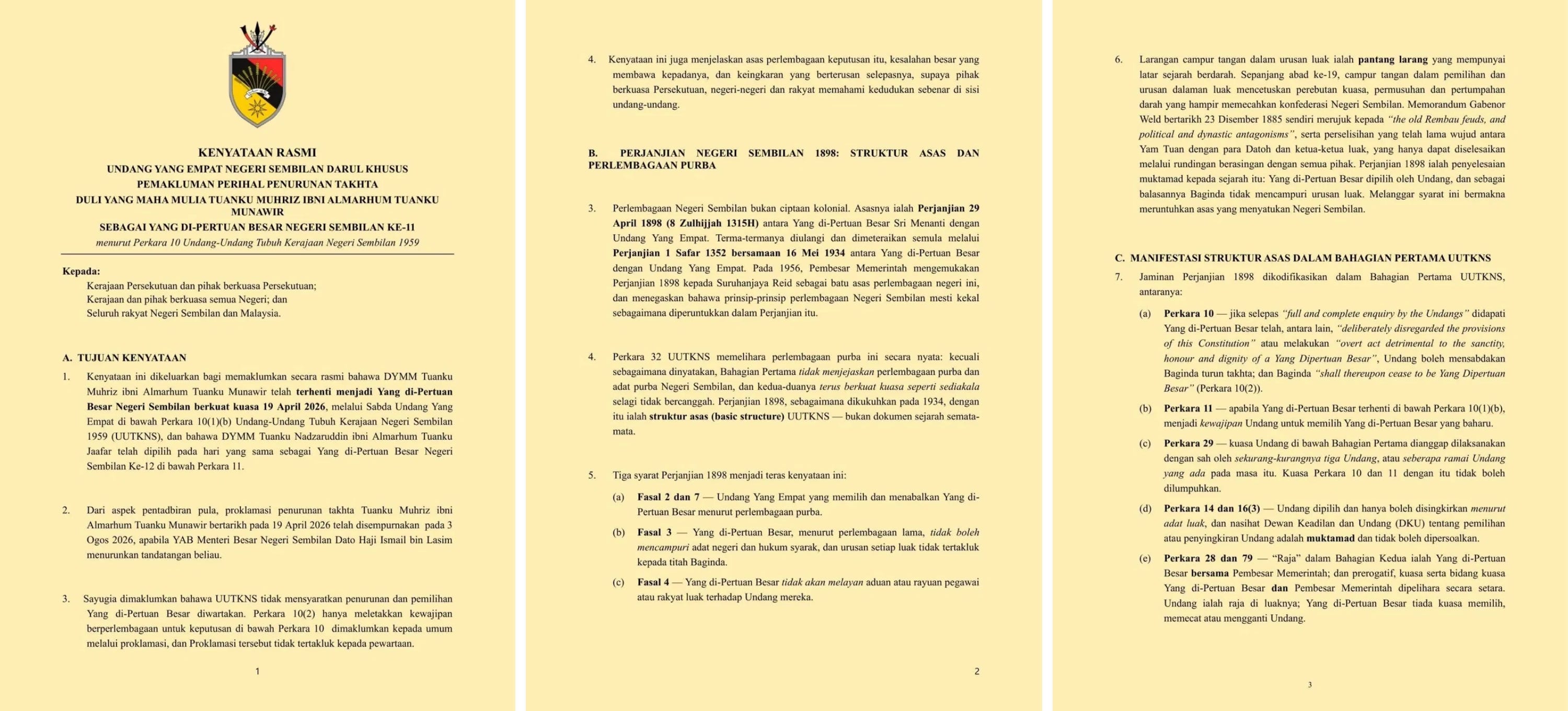
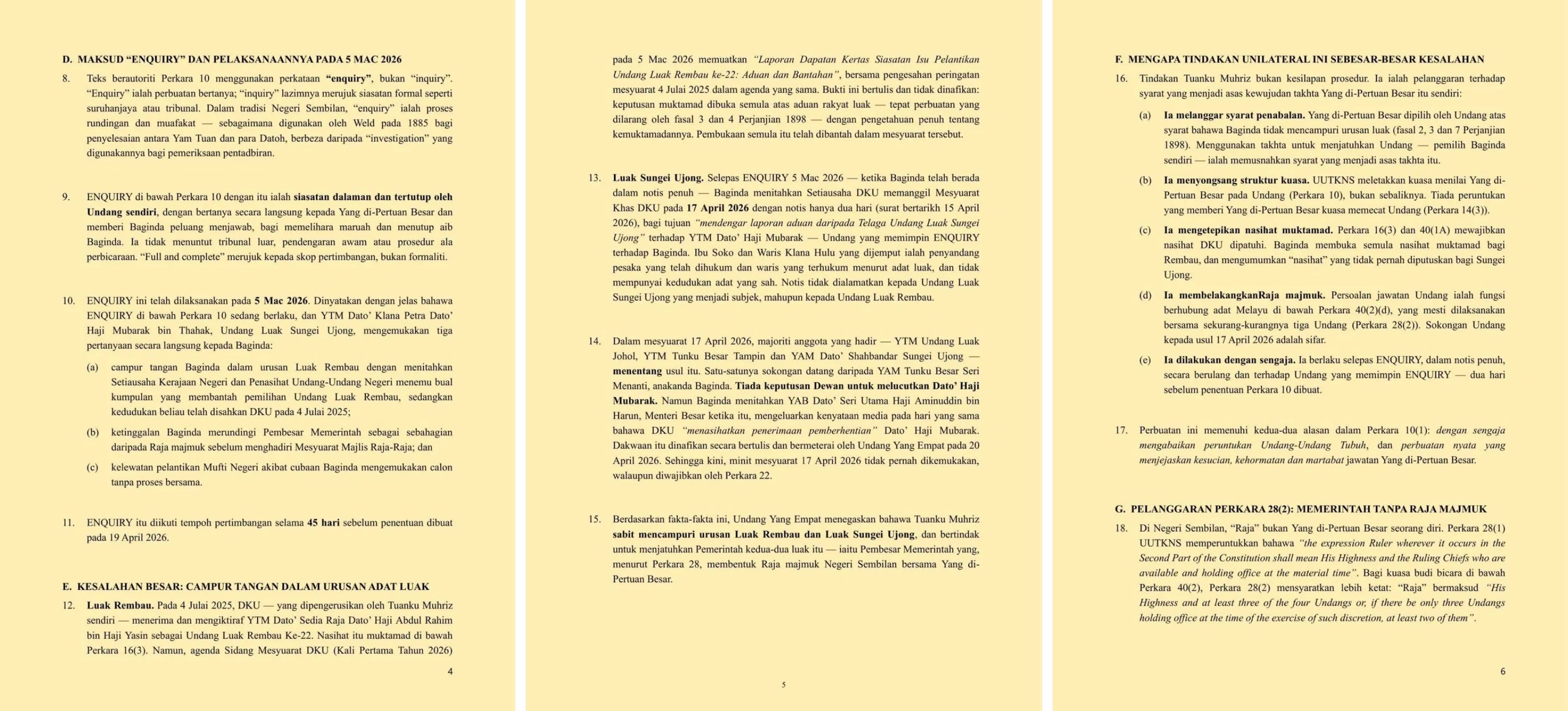
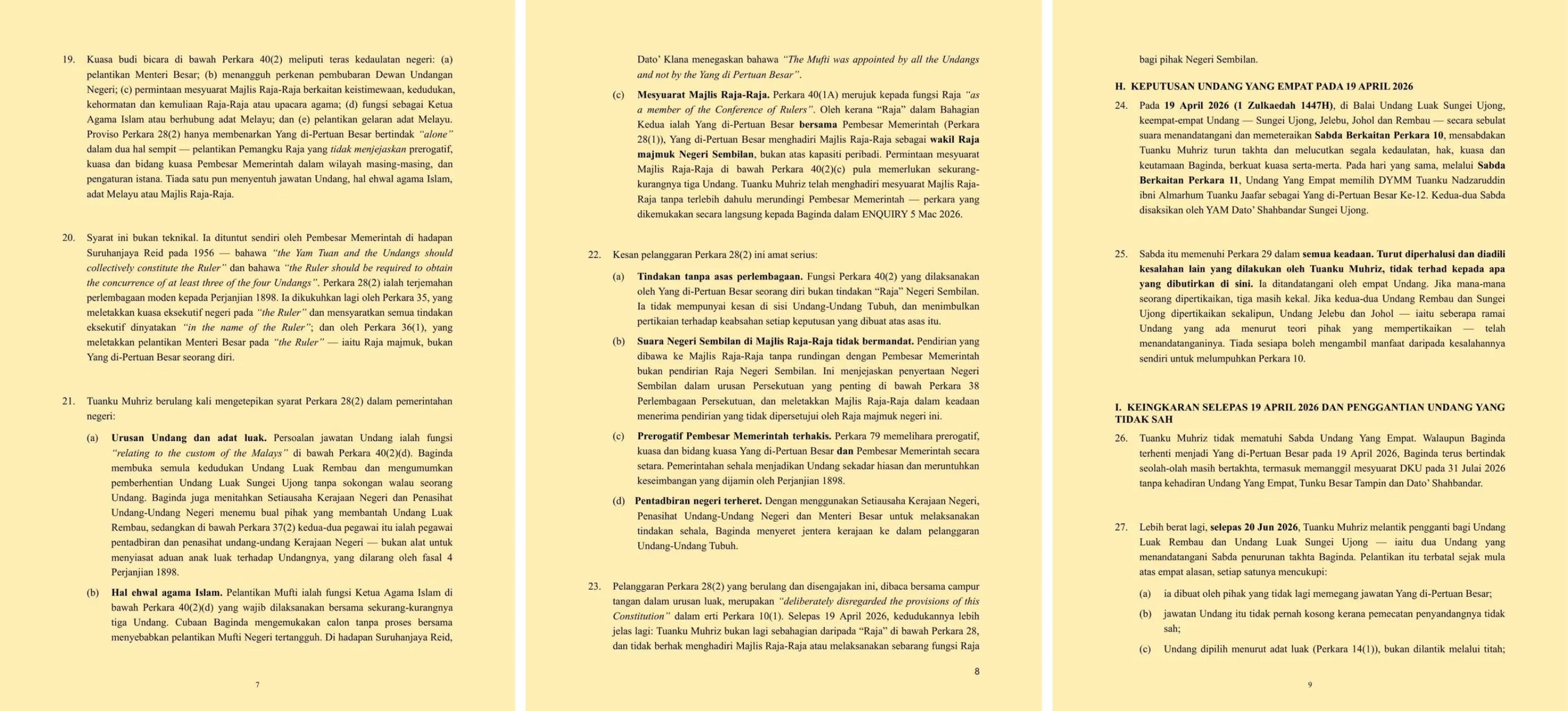
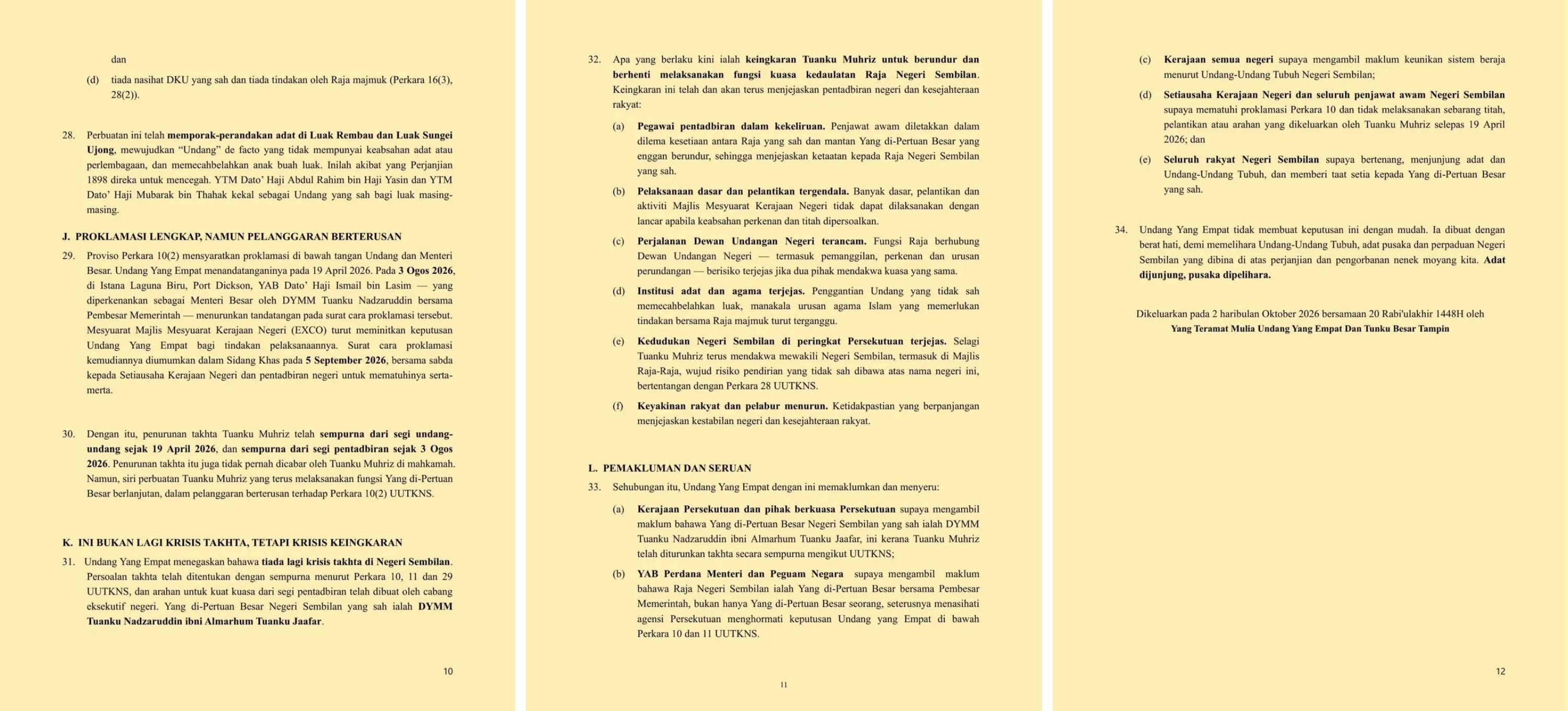
The original Malay statement runs to 12 pages. To keep this page readable, the English translation appears first and the original Malay pages are reproduced in full at the bottom. Where there is any difference in wording or interpretation, the Malay original is authoritative.
OFFICIAL STATEMENT
THE UNDANG YANG EMPAT OF NEGERI SEMBILAN DARUL KHUSUS
NOTIFICATION CONCERNING THE DEPOSITION OF DULI YANG MAHA MULIA TUANKU MUHRIZ IBNI ALMARHUM TUANKU MUNAWIR AS THE 11TH YANG DI-PERTUAN BESAR OF NEGERI SEMBILAN
pursuant to Article 10 of the Constitution of the State of Negeri Sembilan 1959
To:
The Federal Government and Federal authorities;
The Governments and authorities of all States; and
All the people of Negeri Sembilan and Malaysia.
A. PURPOSE OF THE STATEMENT
This statement is issued to formally announce that DYMM Tuanku Muhriz ibni Almarhum Tuanku Munawir ceased to be Yang di-Pertuan Besar of Negeri Sembilan with effect from 19 April 2026, by Sabda (decree) of the Undang Yang Empat under Article 10(1)(b) of the Constitution of the State of Negeri Sembilan 1959 (UUTKNS), and that DYMM Tuanku Nadzaruddin ibni Almarhum Tuanku Jaafar was elected on the same day as the 12th Yang di-Pertuan Besar of Negeri Sembilan under Article 11.
Administratively, the proclamation of the deposition of Tuanku Muhriz ibni Almarhum Tuanku Munawir, dated 19 April 2026, was completed on 3 August 2026, when the Menteri Besar of Negeri Sembilan, YAB Dato Haji Ismail bin Lasim, affixed his signature.
It should be noted that the UUTKNS does not require the deposition and election of a Yang di-Pertuan Besar to be gazetted. Article 10(2) imposes only a constitutional obligation that decisions under Article 10 be made known to the public by proclamation, and that Proclamation is not subject to gazettement.
This statement also sets out the constitutional basis of the decision, the grave wrongdoing that led to it, and the continuing defiance that followed, so that the Federal authorities, the States and the people understand the true position in law.
B. THE NEGERI SEMBILAN AGREEMENT OF 1898: BASIC STRUCTURE AND ANCIENT CONSTITUTION
The constitution of Negeri Sembilan is not a colonial creation. Its foundation is the Agreement of 29 April 1898 (8 Zulhijjah 1315H) between the Yang di-Pertuan Besar of Sri Menanti and the Undang Yang Empat. Its terms were restated and resealed in the Agreement of 1 Safar 1352, corresponding to 16 May 1934, between the Yang di-Pertuan Besar and the Undang Yang Empat. In 1956, the Ruling Chiefs submitted the 1898 Agreement to the Reid Commission as the cornerstone of the State’s constitution, and insisted that the constitutional principles of Negeri Sembilan must remain as provided in that Agreement.
Article 32 of the UUTKNS expressly preserves this ancient constitution: except as stated, the First Part does not affect the ancient constitution and ancient custom of Negeri Sembilan, and both continue in force as before so far as they are not inconsistent. The 1898 Agreement, as affirmed in 1934, is therefore the basic structure of the UUTKNS, and not merely a historical document.
Three terms of the 1898 Agreement are central to this statement:
(a) Clauses 2 and 7: it is the Undang Yang Empat who elect and install the Yang di-Pertuan Besar according to the ancient constitution.
(b) Clause 3: the Yang di-Pertuan Besar, under the old constitution, may not interfere in State custom and hukum syarak (Islamic law), and the affairs of each Luak are not subject to His Majesty’s command.
(c) Clause 4: the Yang di-Pertuan Besar will not entertain complaints or appeals by officials or people of a Luak against their Undang.
The prohibition on interference in the affairs of the Luak is a pantang larang (taboo) with a bloody history. Throughout the 19th century, interference in the election and internal affairs of the Luak provoked power struggles, feuds and bloodshed that nearly broke the Negeri Sembilan confederacy apart. Governor Weld’s memorandum of 23 December 1885 itself refers to “the old Rembau feuds, and political and dynastic antagonisms”, and to long-standing disputes between the Yam Tuan (the Yang di-Pertuan Besar) and the Datohs and Luak chiefs, which could only be resolved through separate negotiation with every party. The 1898 Agreement was the final settlement of that history: the Yang di-Pertuan Besar is elected by the Undangs, and in return His Majesty does not interfere in the affairs of the Luak. Breaching this condition means demolishing the foundation that unites Negeri Sembilan.
C. MANIFESTATIONS OF THE BASIC STRUCTURE IN THE FIRST PART OF THE UUTKNS
The guarantees of the 1898 Agreement are codified in the First Part of the UUTKNS, including:
(a) Article 10: if, after “full and complete enquiry by the Undangs”, the Yang di-Pertuan Besar is found to have, among other things, “deliberately disregarded the provisions of this Constitution” or committed an “overt act detrimental to the sanctity, honour and dignity of a Yang Dipertuan Besar”, the Undangs may decree His Majesty’s deposition; and His Majesty “shall thereupon cease to be Yang Dipertuan Besar” (Article 10(2)).
(b) Article 11: when the Yang di-Pertuan Besar ceases to hold office under Article 10(1)(b), it becomes the duty of the Undangs to elect a new Yang di-Pertuan Besar.
(c) Article 29: the powers of the Undangs under the First Part are deemed validly exercised by at least three Undangs, or by however many Undangs there are at the time. The powers under Articles 10 and 11 therefore cannot be paralysed.
(d) Articles 14 and 16(3): Undangs are elected, and may only be removed, according to the custom of the Luak, and the advice of the Dewan Keadilan dan Undang (DKU) on the election or removal of an Undang is final and cannot be questioned.
(e) Articles 28 and 79: “Ruler” in the Second Part means the Yang di-Pertuan Besar together with the Ruling Chiefs; and the prerogatives, powers and jurisdiction of the Yang di-Pertuan Besar and the Ruling Chiefs are preserved equally. The Undang is raja (ruler) in his Luak; the Yang di-Pertuan Besar has no power to elect, dismiss or replace an Undang.
D. THE MEANING OF “ENQUIRY” AND ITS CONDUCT ON 5 MARCH 2026
The authoritative text of Article 10 uses the word “enquiry”, not “inquiry”. “Enquiry” is the act of asking; “inquiry” usually refers to a formal investigation such as a commission or tribunal. In the tradition of Negeri Sembilan, “enquiry” is a process of consultation and muafakat (consensus), as Weld used the word in 1885 for the settlement between the Yam Tuan and the Datohs, as distinct from “investigation”, which he used for administrative examination.
An ENQUIRY under Article 10 is therefore an internal and closed siasatan (inquiry) by the Undangs themselves, conducted by putting questions directly to the Yang di-Pertuan Besar and giving His Majesty the opportunity to answer, so as to preserve His Majesty’s dignity and spare him aib (public disgrace). It requires no external tribunal, public hearing or trial-like procedure. “Full and complete” refers to the scope of consideration, not to formality.
This ENQUIRY was conducted on 5 March 2026. It was stated clearly that an ENQUIRY under Article 10 was taking place, and YTM Dato’ Klana Petra Dato’ Haji Mubarak bin Thahak, Undang of Luak Sungei Ujong, put three questions directly to His Majesty:
(a) His Majesty’s interference in the affairs of Luak Rembau, by commanding the State Secretary and the State Legal Adviser to interview the group objecting to the election of the Undang of Luak Rembau, when his position had been confirmed by the DKU on 4 July 2025;
(b) His Majesty’s failure to consult the Ruling Chiefs, as part of the Raja majmuk (composite Ruler), before attending meetings of the Conference of Rulers; and
(c) the delay in the appointment of the State Mufti caused by His Majesty’s attempt to put forward a candidate without a joint process.
The ENQUIRY was followed by a period of deliberation of 45 days before the determination was made on 19 April 2026.
E. GRAVE WRONGDOING: INTERFERENCE IN THE CUSTOMARY AFFAIRS OF THE LUAK
Luak Rembau. On 4 July 2025, the DKU, chaired by Tuanku Muhriz himself, accepted and recognised YTM Dato’ Sedia Raja Dato’ Haji Abdul Rahim bin Haji Yasin as the 22nd Undang of Luak Rembau. That advice is final under Article 16(3). Yet the agenda of the DKU meeting (First Sitting of 2026) on 5 March 2026 included the “Laporan Dapatan Kertas Siasatan Isu Pelantikan Undang Luak Rembau ke-22: Aduan dan Bantahan” (Report of Findings of the Investigation Paper on the Appointment of the 22nd Undang of Luak Rembau: Complaints and Objections), together with confirmation of the minutes of the meeting of 4 July 2025 in the same agenda. This evidence is in writing and has not been denied: a final decision was reopened on complaints from the people of the Luak, precisely the act prohibited by clauses 3 and 4 of the 1898 Agreement, with full knowledge of its finality. The reopening was objected to at that meeting.
Luak Sungei Ujong. After the ENQUIRY of 5 March 2026, when His Majesty was on full notice, His Majesty commanded the Secretary of the DKU to convene a Special DKU Meeting on 17 April 2026 on only two days’ notice (letter dated 15 April 2026), for the purpose of “mendengar laporan aduan daripada Telaga Undang Luak Sungei Ujong” (hearing a complaint report from the Telaga Undang (the lineage from which the Undang is drawn) of Luak Sungei Ujong) against YTM Dato’ Haji Mubarak, the Undang who led the ENQUIRY into His Majesty. The Ibu Soko and Waris Klana Hulu (customary lineage title-holders and heirs of Luak Sungei Ujong) who were invited were a title-holder who had been sanctioned and heirs who had been sanctioned under the custom of the Luak, and had no valid customary standing. The notice was addressed neither to the Undang of Luak Sungei Ujong who was its subject, nor to the Undang of Luak Rembau.
At the meeting of 17 April 2026, the majority of members present, namely YTM the Undang of Luak Johol, YTM Tunku Besar Tampin and YAM Dato’ Shahbandar Sungei Ujong, opposed the motion. The only support came from YAM Tunku Besar Seri Menanti, His Majesty’s son. There was no decision of the Dewan to strip Dato’ Haji Mubarak of office. Nevertheless, His Majesty commanded YAB Dato’ Seri Utama Haji Aminuddin bin Harun, then Menteri Besar, to issue a media statement the same day stating that the DKU had “menasihatkan penerimaan pemberhentian” (advised acceptance of the termination of) Dato’ Haji Mubarak. That claim was denied in writing, under seal, by the Undang Yang Empat on 20 April 2026. To date, the minutes of the meeting of 17 April 2026 have never been produced, although Article 22 requires them.
On these facts, the Undang Yang Empat maintain that Tuanku Muhriz is proven to have interfered in the affairs of Luak Rembau and Luak Sungei Ujong, and acted to bring down the rulers of both Luak, namely the Ruling Chiefs who, under Article 28, form the composite Ruler of Negeri Sembilan together with the Yang di-Pertuan Besar.
F. WHY THIS UNILATERAL ACTION IS THE GRAVEST OF WRONGS
The actions of Tuanku Muhriz are not a procedural error. They are a breach of the condition on which the very existence of the throne of the Yang di-Pertuan Besar rests:
(a) It breaches the condition of installation. The Yang di-Pertuan Besar is elected by the Undangs on condition that His Majesty does not interfere in the affairs of the Luak (clauses 2, 3 and 7 of the 1898 Agreement). Using the throne to bring down an Undang, His Majesty’s own elector, destroys the condition on which that throne rests.
(b) It inverts the structure of power. The UUTKNS places the power to assess the Yang di-Pertuan Besar with the Undangs (Article 10), and not the reverse. No provision gives the Yang di-Pertuan Besar power to dismiss an Undang (Article 14(3)).
(c) It sets aside final advice. Articles 16(3) and 40(1A) require the advice of the DKU to be followed. His Majesty reopened final advice on Rembau, and announced “advice” on Sungei Ujong that was never decided.
(d) It bypasses the composite Ruler. The question of the office of an Undang is a function relating to Malay custom under Article 40(2)(d), which must be exercised together with at least three Undangs (Article 28(2)). Undang support for the motion of 17 April 2026 was nil.
(e) It was done deliberately. It occurred after the ENQUIRY, on full notice, repeatedly, and against the Undang leading the ENQUIRY, two days before the Article 10 determination was made.
These acts satisfy both grounds in Article 10(1): deliberately disregarding the provisions of the Constitution, and an overt act detrimental to the sanctity, honour and dignity of the office of Yang di-Pertuan Besar.
G. BREACH OF ARTICLE 28(2): GOVERNING WITHOUT THE COMPOSITE RULER
In Negeri Sembilan, the “Ruler” is not the Yang di-Pertuan Besar alone. Article 28(1) of the UUTKNS provides that “the expression Ruler wherever it occurs in the Second Part of the Constitution shall mean His Highness and the Ruling Chiefs who are available and holding office at the material time”. For discretionary powers under Article 40(2), Article 28(2) imposes a stricter requirement: “Ruler” means “His Highness and at least three of the four Undangs or, if there be only three Undangs holding office at the time of the exercise of such discretion, at least two of them”.
The discretionary powers under Article 40(2) cover the core of State sovereignty: (a) the appointment of the Menteri Besar; (b) withholding consent to the dissolution of the State Legislative Assembly; (c) requesting a meeting of the Conference of Rulers concerning the privileges, position, honours and dignities of the Rulers or religious ceremonies; (d) functions as Head of the Religion of Islam or relating to Malay custom; and (e) appointments to Malay customary titles. The proviso to Article 28(2) allows the Yang di-Pertuan Besar to act “alone” in only two narrow matters: the appointment of a Regent, where this does not affect the prerogatives, powers and jurisdiction of the Ruling Chiefs in their respective territories, and the regulation of the palace. Neither touches the office of Undang, Islamic affairs, Malay custom or the Conference of Rulers.
This requirement is not a technicality. It was demanded by the Ruling Chiefs themselves before the Reid Commission in 1956: that “the Yam Tuan and the Undangs should collectively constitute the Ruler” and that “the Ruler should be required to obtain the concurrence of at least three of the four Undangs”. Article 28(2) is the modern constitutional rendering of the 1898 Agreement. It is reinforced by Article 35, which vests the executive authority of the State in “the Ruler” and requires all executive action to be expressed “in the name of the Ruler”; and by Article 36(1), which vests the appointment of the Menteri Besar in “the Ruler”, meaning the composite Ruler and not the Yang di-Pertuan Besar alone.
Tuanku Muhriz repeatedly set aside the requirement of Article 28(2) in the governance of the State:
(a) The office of Undang and Luak custom. The question of the office of an Undang is a function “relating to the custom of the Malays” under Article 40(2)(d). His Majesty reopened the position of the Undang of Luak Rembau and announced the termination of the Undang of Luak Sungei Ujong without the support of a single Undang. His Majesty also commanded the State Secretary and the State Legal Adviser to interview parties objecting to the Undang of Luak Rembau, whereas under Article 37(2) both are the administrative officer and the legal adviser of the State Government, and not instruments for investigating complaints by the people of a Luak against their Undang, which clause 4 of the 1898 Agreement prohibits.
(b) Islamic affairs. The appointment of the Mufti is a function of the Head of the Religion of Islam under Article 40(2)(d), which must be exercised together with at least three Undangs. His Majesty’s attempt to put forward a candidate without a joint process caused the appointment of the State Mufti to be held up. Before the Reid Commission, the Dato’ Klana stated that “The Mufti was appointed by all the Undangs and not by the Yang di Pertuan Besar”.
(c) Meetings of the Conference of Rulers. Article 40(1A) refers to the functions of the Ruler “as a member of the Conference of Rulers”. Because “Ruler” in the Second Part is the Yang di-Pertuan Besar together with the Ruling Chiefs (Article 28(1)), the Yang di-Pertuan Besar attends the Conference of Rulers as the representative of the composite Ruler of Negeri Sembilan, and not in a personal capacity. A request for a meeting of the Conference of Rulers under Article 40(2)(c) also requires at least three Undangs. Tuanku Muhriz attended meetings of the Conference of Rulers without first consulting the Ruling Chiefs, a matter put directly to His Majesty at the ENQUIRY of 5 March 2026.
The consequences of these breaches of Article 28(2) are very serious:
(a) Action without constitutional basis. Article 40(2) functions exercised by the Yang di-Pertuan Besar alone are not acts of the “Ruler” of Negeri Sembilan. They have no effect under the Constitution, and cast doubt on the validity of every decision made on that basis.
(b) Negeri Sembilan’s voice at the Conference of Rulers carries no mandate. A position taken to the Conference of Rulers without consulting the Ruling Chiefs is not the position of the Ruler of Negeri Sembilan. This compromises the participation of Negeri Sembilan in important federal matters under Article 38 of the Federal Constitution, and leaves the Conference of Rulers receiving positions to which the composite Ruler of this State never agreed.
(c) The prerogatives of the Ruling Chiefs are eroded. Article 79 preserves the prerogatives, powers and jurisdiction of the Yang di-Pertuan Besar and the Ruling Chiefs equally. Unilateral rule reduces the Undangs to ornaments and destroys the balance guaranteed by the 1898 Agreement.
(d) The State administration is dragged in. By using the State Secretary, the State Legal Adviser and the Menteri Besar to carry out unilateral action, His Majesty drew the machinery of government into breach of the Constitution.
These repeated and deliberate breaches of Article 28(2), read together with the interference in the affairs of the Luak, amount to having “deliberately disregarded the provisions of this Constitution” within the meaning of Article 10(1). After 19 April 2026 the position is clearer still: Tuanku Muhriz is no longer part of the “Ruler” under Article 28, and has no right to attend the Conference of Rulers or to exercise any function of the Ruler on behalf of Negeri Sembilan.
H. DECISION OF THE UNDANG YANG EMPAT ON 19 APRIL 2026
On 19 April 2026 (1 Zulkaedah 1447H), at the Balai Undang (official hall of the Undang) of Luak Sungei Ujong, all four Undangs, of Sungei Ujong, Jelebu, Johol and Rembau, unanimously signed and sealed the Sabda Relating to Article 10, decreeing the deposition of Tuanku Muhriz and stripping His Majesty of all sovereignty, rights, powers and precedence, with immediate effect. On the same day, by the Sabda Relating to Article 11, the Undang Yang Empat elected DYMM Tuanku Nadzaruddin ibni Almarhum Tuanku Jaafar as the 12th Yang di-Pertuan Besar. Both Sabda were witnessed by YAM Dato’ Shahbandar Sungei Ujong.
The Sabda satisfies Article 29 in every scenario. Other wrongs committed by Tuanku Muhriz were also examined and adjudged, not limited to those set out here. It was signed by four Undangs. If any one of them is disputed, three remain. Even if both the Undangs of Rembau and Sungei Ujong are disputed, the Undangs of Jelebu and Johol, being however many Undangs there are on the theory of the disputing party, signed it. No one may profit from his own wrong in order to paralyse Article 10.
I. DEFIANCE AFTER 19 APRIL 2026 AND THE INVALID REPLACEMENT OF UNDANGS
Tuanku Muhriz has not complied with the Sabda of the Undang Yang Empat. Although His Majesty ceased to be Yang di-Pertuan Besar on 19 April 2026, he has continued to act as though still on the throne, including by convening a DKU meeting on 31 July 2026 without the attendance of the Undang Yang Empat, the Tunku Besar Tampin or the Dato’ Shahbandar.
More gravely, after 20 June 2026, Tuanku Muhriz appointed replacements for the Undang of Luak Rembau and the Undang of Luak Sungei Ujong, the two Undangs who signed the Sabda deposing him. Those appointments are void from the outset on four grounds, each of which is sufficient on its own:
(a) they were made by a party no longer holding the office of Yang di-Pertuan Besar;
(b) the office of Undang was never vacant, because the dismissal of the incumbent was invalid;
(c) Undangs are elected according to the custom of the Luak (Article 14(1)), and are not appointed by royal command; and
(d) there was no valid DKU advice and no action by the composite Ruler (Articles 16(3) and 28(2)).
These acts have thrown custom in Luak Rembau and Luak Sungei Ujong into disarray, created de facto “Undangs” with no customary or constitutional legitimacy, and divided the people of the Luak. This is the outcome the 1898 Agreement was designed to prevent. YTM Dato’ Haji Abdul Rahim bin Haji Yasin and YTM Dato’ Haji Mubarak bin Thahak remain the lawful Undangs of their respective Luak.
J. PROCLAMATION COMPLETE, BUT BREACHES CONTINUING
The proviso to Article 10(2) requires a proclamation under the hands of the Undangs and the Menteri Besar. The Undang Yang Empat signed it on 19 April 2026. On 3 August 2026, at Istana Laguna Biru, Port Dickson, YAB Dato’ Haji Ismail bin Lasim, whose appointment as Menteri Besar was consented to by DYMM Tuanku Nadzaruddin together with the Ruling Chiefs, signed the instrument of proclamation. The meeting of the State Executive Council (EXCO) also minuted the decision of the Undang Yang Empat for implementation. The instrument of proclamation was then announced at a Special Sitting on 5 September 2026, together with a sabda to the State Secretary and the State administration to comply with it immediately.
Accordingly, the deposition of Tuanku Muhriz has been complete in law since 19 April 2026, and complete administratively since 3 August 2026. The deposition has also never been challenged in court by Tuanku Muhriz. Even so, the series of acts by which Tuanku Muhriz continues to exercise the functions of Yang di-Pertuan Besar persists, in continuing breach of Article 10(2) of the UUTKNS.
K. THIS IS NO LONGER A CRISIS OF THE THRONE, BUT A CRISIS OF DEFIANCE
The Undang Yang Empat maintain that there is no longer any crisis of the throne in Negeri Sembilan. The question of the throne has been fully determined under Articles 10, 11 and 29 of the UUTKNS, and directions giving it administrative effect have been issued by the executive branch of the State. The lawful Yang di-Pertuan Besar of Negeri Sembilan is DYMM Tuanku Nadzaruddin ibni Almarhum Tuanku Jaafar.
What is taking place now is the refusal of Tuanku Muhriz to step aside and to stop exercising the sovereign functions of the Ruler of Negeri Sembilan. This defiance has harmed, and will continue to harm, the administration of the State and the welfare of the people:
(a) Administrative officers in confusion. Civil servants are placed in a dilemma of loyalty between the lawful Ruler and a former Yang di-Pertuan Besar who refuses to step aside, undermining obedience to the lawful Ruler of Negeri Sembilan.
(b) Policy and appointments disrupted. Many policies, appointments and activities of the State Executive Council cannot be carried out smoothly while the validity of royal consent and commands is in question.
(c) The business of the State Legislative Assembly at risk. The functions of the Ruler in relation to the State Legislative Assembly, including summoning, assent and legislative business, are at risk of being compromised when two parties claim the same power.
(d) Customary and religious institutions harmed. The invalid replacement of Undangs divides the Luak, while Islamic affairs requiring the joint action of the composite Ruler are also disrupted.
(e) The standing of Negeri Sembilan at federal level harmed. So long as Tuanku Muhriz continues to claim to represent Negeri Sembilan, including at the Conference of Rulers, there is a risk of unlawful positions being taken in the name of this State, contrary to Article 28 of the UUTKNS.
(f) Public and investor confidence falling. Prolonged uncertainty undermines the stability of the State and the welfare of the people.
L. NOTIFICATION AND CALL
Accordingly, the Undang Yang Empat hereby notify and call upon:
(a) the Federal Government and Federal authorities to take note that the lawful Yang di-Pertuan Besar of Negeri Sembilan is DYMM Tuanku Nadzaruddin ibni Almarhum Tuanku Jaafar, because Tuanku Muhriz has been fully deposed in accordance with the UUTKNS;
(b) YAB the Prime Minister and the Attorney General to take note that the Ruler of Negeri Sembilan is the Yang di-Pertuan Besar together with the Ruling Chiefs, and not the Yang di-Pertuan Besar alone, and accordingly to advise Federal agencies to respect the decision of the Undang Yang Empat under Articles 10 and 11 of the UUTKNS;
(c) the Governments of all States to take note of the distinctive monarchical system under the Constitution of Negeri Sembilan;
(d) the State Secretary and all civil servants of Negeri Sembilan to comply with the Article 10 proclamation and not to carry out any command, appointment or directive issued by Tuanku Muhriz after 19 April 2026; and
(e) all the people of Negeri Sembilan to remain calm, uphold custom and the Constitution, and give their allegiance to the lawful Yang di-Pertuan Besar.
The Undang Yang Empat did not take this decision lightly. It was taken with a heavy heart, to preserve the Constitution, adat pusaka (inherited custom) and the unity of Negeri Sembilan, built on the agreements and sacrifices of our forebears. Adat dijunjung, pusaka dipelihara (custom upheld, heritage preserved).
Issued on 2 October 2026, corresponding to 20 Rabi’ulakhir 1448H, by Yang Teramat Mulia the Undang Yang Empat and the Tunku Besar Tampin.

Footnotes:
The allegations in this statement are those of its signatories. The DKU’s response of 4 October 2026 sets out its position on each of the claims above.
¹ This publication uses the term “Undang Yang Empat” to refer to the four chieftains who signed the 19 April declaration. Mubarak Dohak ceased to hold office as Undang of Luak Sungei Ujong on 17 April 2026, his removal having occurred under the custom of the Luak and acknowledged by the Dewan Keadilan dan Undang (DKU) under Article 16 of the Negeri Sembilan Constitution 1959. The DKU has since acknowledged the removal of Maarof Mat Rashad as Undang of Luak Jelebu and maintains that the appointment of Abdul Rahim Yasin as Undang of Luak Rembau was never completed. Under Article 16(3), DKU advice on such questions is final and cannot be challenged in any court.
If you are new to this Substack and are not sure where to begin, visit our Start Here page, where we list all our articles organised by theme.
Anak Nogori is independent commentary on the unfolding constitutional crisis in Negeri Sembilan, where centuries-old Adat Perpatih, royal succession law, and modern political manoeuvring are colliding in ways Malaysia has never seen before. If you find this useful, share it with someone who should be following this, or subscribe to receive the latest articles in your inbox.
