


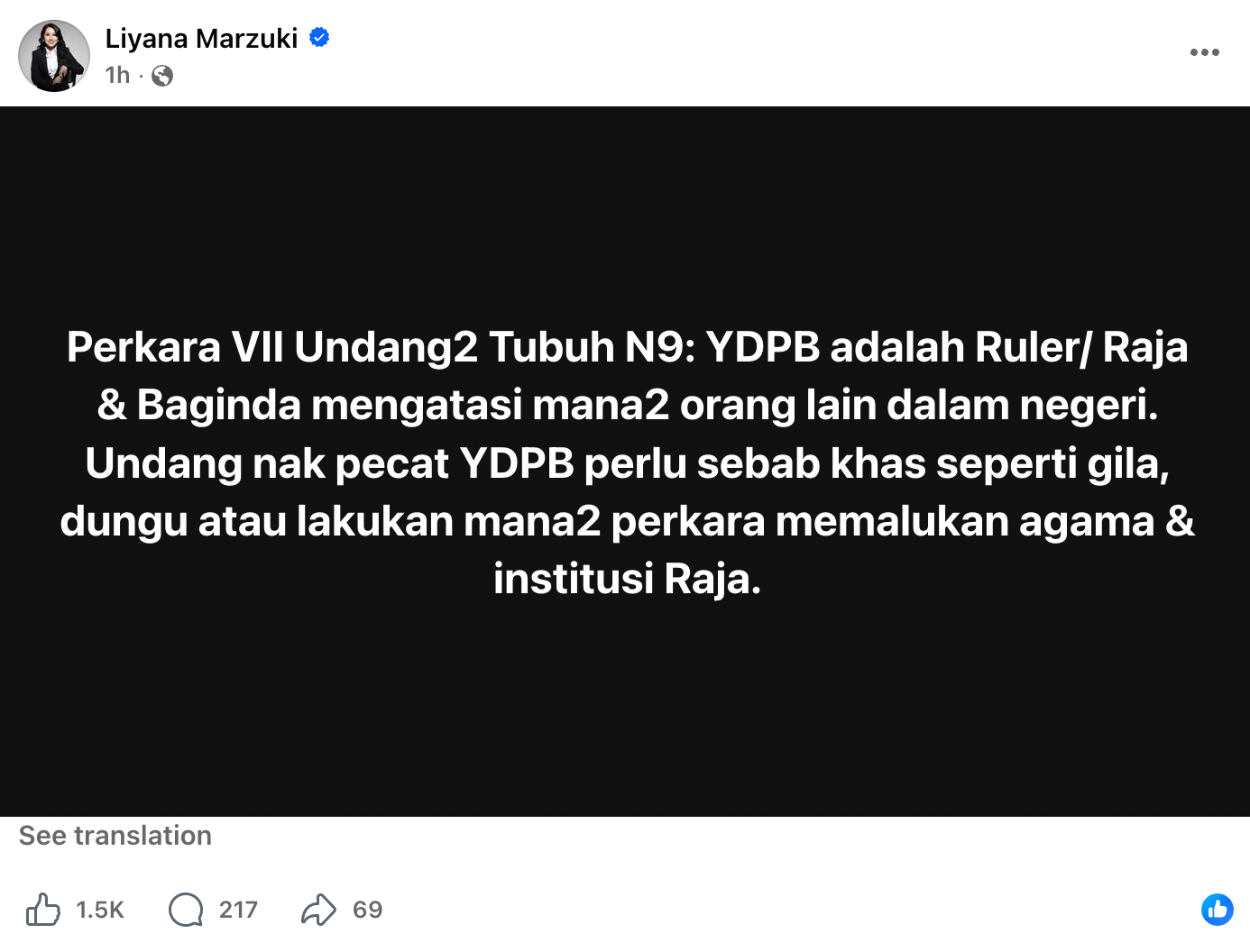
Former Deputy Public Prosecutor and Senior Federal Counsel Liyana Marzuki posted a constitutional analysis on Facebook today that cuts to the legal heart of the Negeri Sembilan crisis. Her post attracted over 1.5K likes and 200 comments within an hour.
Liyana holds a Master’s in Competition Law from King’s College London. She served as Deputy Public Prosecutor and Senior Federal Counsel at the Attorney General’s Chambers. She was Special Officer to the Minister of International Trade and Industry. She is a published author and verified public figure. When she posts constitutional text, you can expect that it is not worded lightly.
She posted two Articles from the Negeri Sembilan State Constitution 1959 directly.
Article 7: The Yang di-Pertuan Besar takes precedence
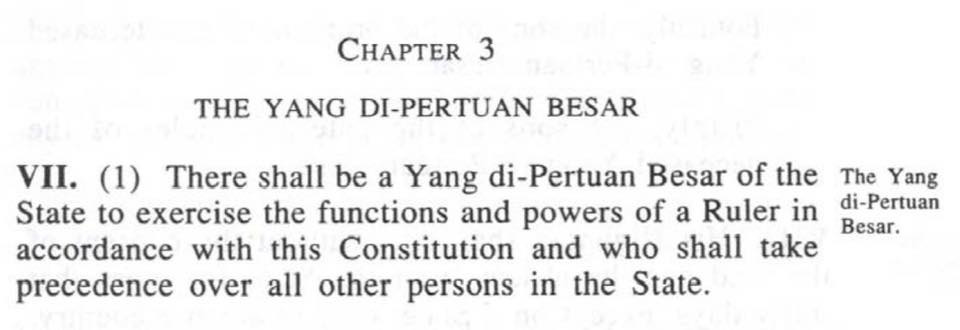
Article 7 establishes the primacy of the Yang di-Pertuan Besar. He is the Ruler of the State, exercising the functions and powers of a Ruler in accordance with the Constitution, and taking precedence over all other persons in Negeri Sembilan.
This is the constitutional foundation of Tuanku Muhriz’s position. He is not merely a ceremonial figure. He takes precedence over all other persons in the state.
Article 10: The grounds required to remove the Yang di-Pertuan Besar
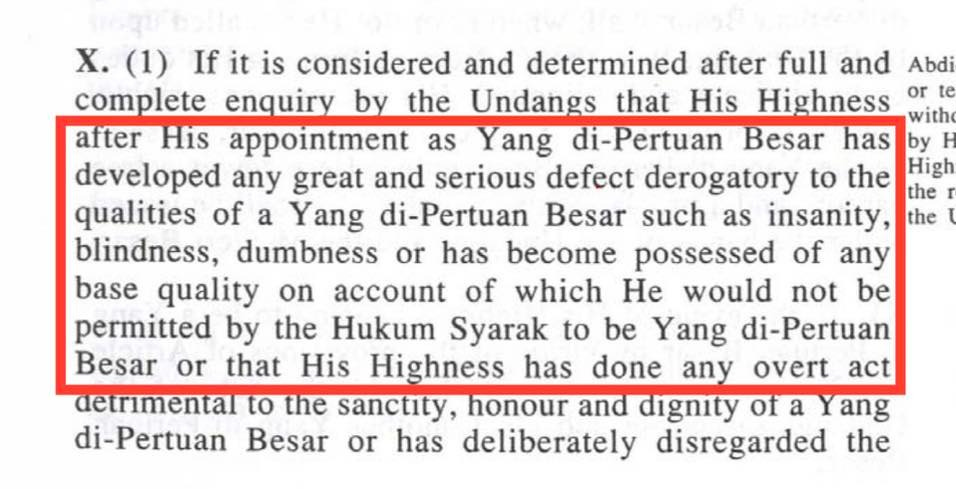
Article 10(1) sets out the only circumstances under which the Undang Yang Empat may remove a Yang di-Pertuan Besar. The grounds are specific and exhaustive.
After a full and complete inquiry, the Undangs may remove the YDPB only if he has developed any great and serious defect derogatory to the qualities of a Yang di-Pertuan Besar such as:
Insanity
Blindness
Dumbness
Possession of any base quality on account of which he would not be permitted by Hukum Syarak to be Yang di-Pertuan Besar
That His Highness has done any overt act detrimental to the sanctity, honour and dignity of a Yang di-Pertuan Besar
Or has deliberately disregarded the Constitution
Liyana’s summary in Malay is direct: “Undang nak pecat YDPB perlu sebab khas seperti gila, dungu atau lakukan mana-mana perkara memalukan agama dan institusi Raja.”
The Undangs need specific grounds to remove the YDPB. Those grounds are insanity, dumbness, or doing something shameful to religion and the royal institution.
What was named in the 19 April declaration
The 19 April declaration by three Undangs and Mubarak Dohak purported to remove Tuanku Muhriz as Yang di-Pertuan Besar. Multiple news reports confirmed that no specific misconduct against Tuanku Muhriz was named in the declaration itself.
If no specific Article 10(1) ground was cited, the declaration fails not only on procedural grounds (no complete inquiry as required by Article 10) but also on substantive grounds. The Constitution requires both a complete inquiry and a specific qualifying ground. Neither has been satisfied.
Two layers of constitutional failure
DAP Secretary-General Anthony Loke addressed the procedural failure at his press conference today. Article 10 requires a complete inquiry. In DAP’s view and in the view of multiple constitutional law experts, that inquiry was not completed before the declaration was made.
Liyana’s post adds the substantive layer. Even if a complete inquiry had been conducted, the Undangs must cite one of the specific Article 10(1) grounds: insanity, blindness, dumbness, a base quality disqualifying him under Hukum Syarak, an overt act detrimental to the sanctity, honour and dignity of the royal institution, or deliberate disregard of the Constitution.
No such ground was named in the 19 April declaration.
What this means
The Menteri Besar rejected the 19 April declaration on 20 April as unconstitutional under Articles 10 to 12 of the Negeri Sembilan State Constitution 1959. Former Court of Appeal judge Datuk Seri Mohd Hishamudin Yunus identified three grounds of invalidity. Malik Imtiaz Sarwar concluded in FMT that there was no constitutional basis for the declaration.
Liyana Marzuki’s post today adds a fourth layer to that legal analysis. The specific grounds required by Article 10(1) were not named. A declaration that cites no qualifying ground is not merely procedurally deficient. It has no constitutional foundation at all.
Liyana's post strips the question down to its constitutional skeleton: procedure, inquiry, specific grounds. Remove any one of these and the declaration collapses. The 19 April declaration satisfied none of them.
Based on the 1959 constitution, Tuanku Muhriz was unequivocally not removed by that declaration.
Read Next: Proper Processes Exist to Remove an MB and YDPB, They Were Not Followed: Anthony Loke
Footnote: The Constitution numbers its Articles in Roman numerals. This publication uses Arabic numerals for readability.
If you are new to this Substack and are not sure where to begin, visit our Start Here page, where we list all our articles organised by theme.
Related Posts:


Source:
Anak Nogori is independent commentary on the unfolding constitutional crisis in Negeri Sembilan, where centuries-old Adat Perpatih, royal succession law, and modern political manoeuvring are colliding in ways Malaysia has never seen before. If you find this useful, share it with someone who should be following this, or subscribe to receive the latest articles in your inbox.
