


The aim of this article is to walk readers through three provisions of the Federal Constitution most frequently cited to suggest co-ruler status between the Yang di-Pertuan Besar and the Undangs: Article 71, Article 160(2) and Article 181(1).
Readers who want commentary on how these provisions interact with the Negeri Sembilan Constitution 1959 should refer to this publication's earlier piece, Undangs Are Not Co-Rulers With Equal Status and Power.
Article 71: The Federation guarantees the right to hold office
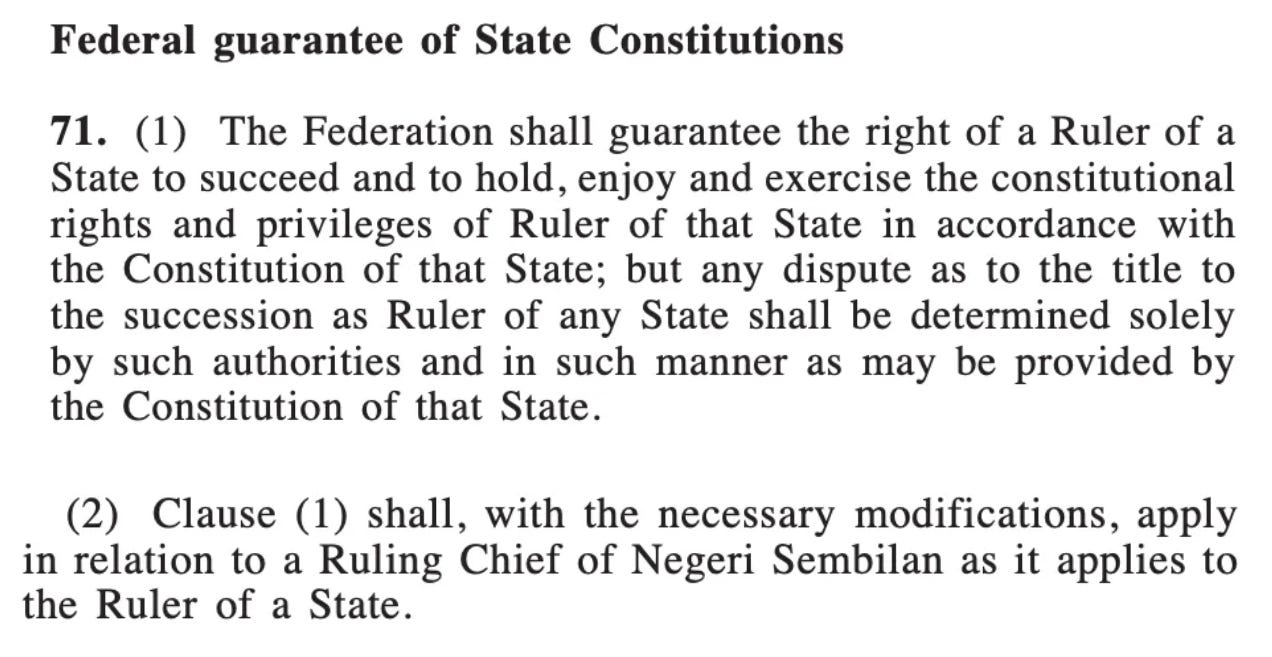
What Article 71 says
Article 71 states at federal level that the Yang di-Pertuan Besar has a right to hold office, as per the Negeri Sembilan Constitution 1959.
Article 71(2) extends the same guarantee to the Ruling Chiefs, meaning the Undangs, “with the necessary modifications”. It means Article 71(1) applies to the Undangs as well, so Article 71(2) guarantees the Undangs’ right to succeed to the office of Undang, to hold it and to exercise the rights and privileges of that office, all in accordance with the Negeri Sembilan Constitution 1959.
The key point here is that the two sub-articles tell the reader that the offices are distinct, each federally guaranteed by reference to the Negeri Sembilan Constitution that defines it.
Article 160(2): The interpretation clause
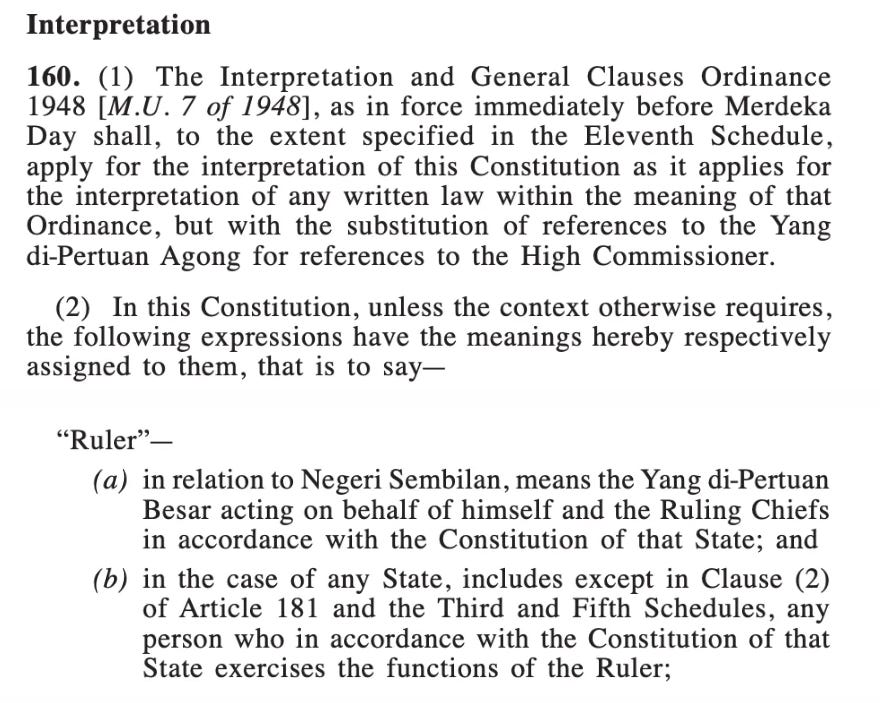
What Article 160(2) says
Article 160 is the Federal Constitution’s interpretation clause. Its job is to assign meanings to words used elsewhere in the document. The opening words of Article 160(2) make this clear: “In this Constitution, unless the context otherwise requires, the following expressions have the meanings hereby respectively assigned to them.” A definition tells the reader what a word means when it appears in a substantive Article. The substantive Articles are where the law sits.
The Negeri Sembilan definition definition is carefully worded. The Ruler “means the Yang di-Pertuan Besar acting on behalf of himself and the Ruling Chiefs”. The actor is the Yang di-Pertuan Besar. The Ruling Chiefs appear as the persons on whose behalf he acts. The definition ends by sending the reader back to “the Constitution of that State”, which is the Negeri Sembilan Constitution 1959.
The key point here is that Article 160(2) is a definitional clause. The constitutional position, powers, and offices of the Yang di-Pertuan Besar and the Undangs are defined by the Negeri Sembilan Constitution 1959.
Article 181(1): The saving of sovereignty
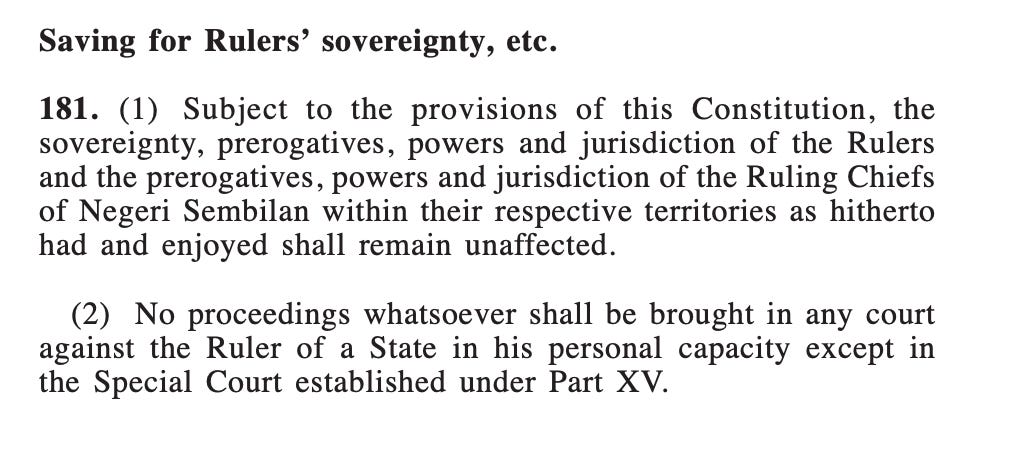
What Article 181(1) says
Article 181(1) is a saving provision. It preserves what existed before the Federal Constitution took effect, so that the federal arrangement does not silently strip away the rights and offices held at Merdeka. The provision covers two categories: the Rulers, whose sovereignty, prerogatives, powers and jurisdiction in the state are preserved, and the Ruling Chiefs of Negeri Sembilan, whose prerogatives, powers and jurisdiction within their respective territories are preserved.
The structure of the provision matters. The word “sovereignty” is used for the Rulers and omitted for the Ruling Chiefs. The distinction is deliberate. Article 181(1) preserves sovereignty for the Rulers, while preserving jurisdiction and prerogatives for the Ruling Chiefs within their respective territories. The Constitution uses different language because it recognises different constitutional positions.
The words “within their respective territories” are used for the Ruling Chiefs and omitted for the Rulers. The Rulers retain state-wide sovereignty. The Undangs retain prerogatives within their luak: Sungai Ujong, Jelebu, Johol or Rembau.
The provision also opens with “Subject to the provisions of this Constitution”, meaning where another provision of the Federal Constitution operates, Article 181(1) gives way to it.
How the three provisions fit together
Reading the three Federal Constitution provisions together produces a coherent picture.
Article 71 federally guarantees the right to hold office, with two sub-articles covering the Yang di-Pertuan Besar and the Undangs separately.
Article 160(2) is a definitional clause that groups the Yang di-Pertuan Besar and the Ruling Chiefs under a single term for interpretation purposes, with the conferral of power sitting in the Negeri Sembilan Constitution 1959.
Article 181(1) preserves what existed before Merdeka, with state-wide sovereignty for the Rulers and luak-bounded prerogatives for the Ruling Chiefs.
The Federal Constitution merely protects the offices of the Yang di-Pertuan Besar and the Undangs. The actual conferral of power, who holds office, how they are appointed, how they are removed and what decisions they can make, sits in the Negeri Sembilan Constitution 1959.
For that analysis, see this publication’s earlier piece, Undangs Are Not Co-Rulers With Equal Status and Power: What the Negeri Sembilan Constitution Actually Says.
But the Undangs elect the Yang di-Pertuan Besar. Does that not imply equal sovereignty?
This question is frequently raised and deserves direct attention.
The Undangs' role as electors of the Yang di-Pertuan Besar is a constitutional function under Article 11 of the Negeri Sembilan Constitution 1959, exercised from a defined pool of eligible candidates set by Article 7(3). Constitutional systems often distinguish between participating in the appointment of a superior office and holding equal status with that office. Election and equal status are separate matters.
The bottom line
Anyone arguing the Negeri Sembilan crisis from the Federal Constitution alone is reading half the document. The more important half lives in the Negeri Sembilan Constitution, where the procedures, the powers and the answers actually sit.
Read next: What Happened at the Seremban High Court Sitting on 13 May
If you are new to this Substack and are not sure where to begin, visit our Start Here page, where we list all our articles organised by theme.
Related Posts:


Sources:
Anak Nogori is independent commentary on the unfolding constitutional crisis in Negeri Sembilan, where centuries-old Adat Perpatih, royal succession law and modern political manoeuvring are colliding in ways Malaysia has never seen before. If you find this useful, share it with someone who should be following this, or subscribe to receive the latest articles in your inbox.
