


Over the last week, UMNO-aligned accounts have been circulating a claim widely across social media: that the Undang Yang Empat are constitutionally “co-rulers” of Negeri Sembilan.
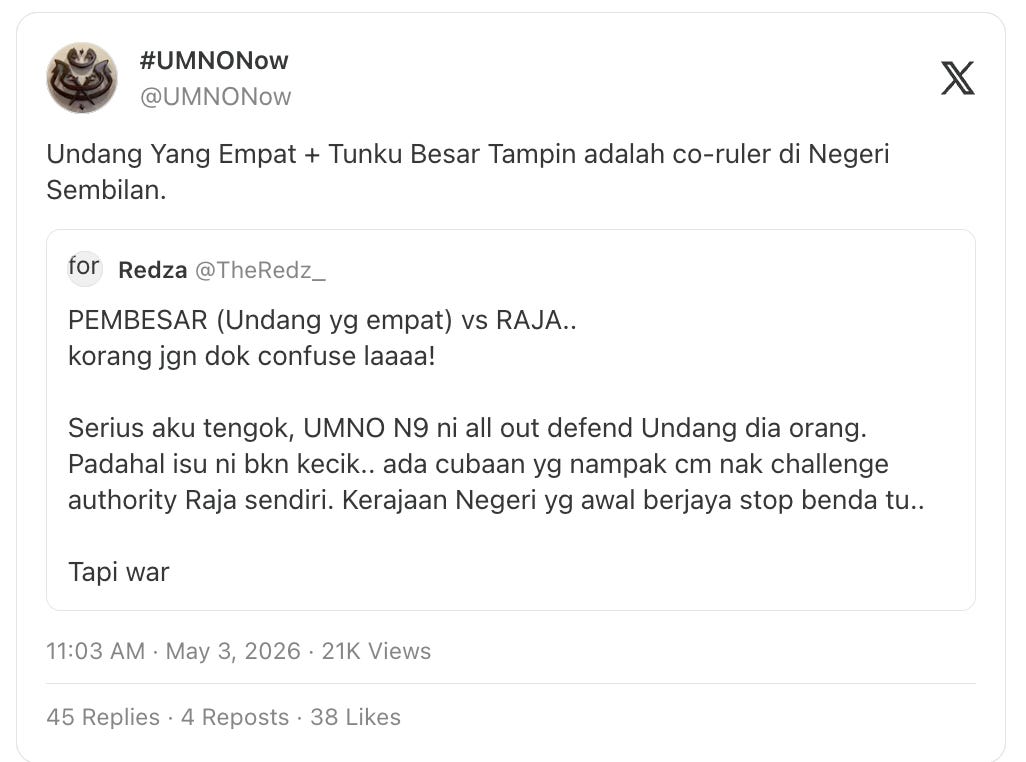
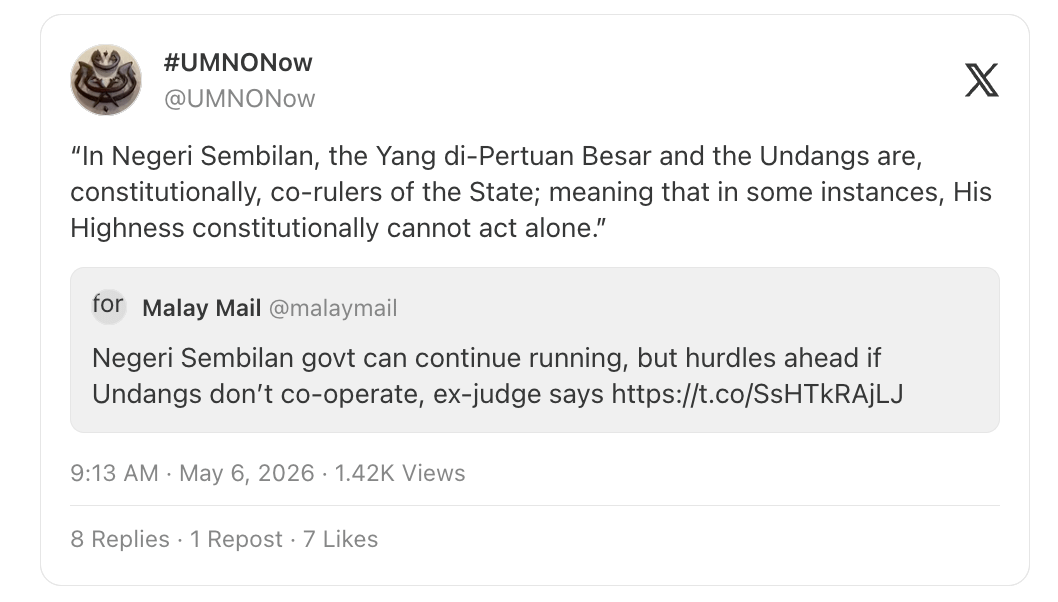
The framing is being repeated in tweets, replies, and infographics, often paired with selectively cropped passages from The Laws of the Constitution of Negeri Sembilan 1959.
Implicit in this framing is that the Undang Yang Empat hold equal rank and equal power to the Yang di-Pertuan Besar.
The account has since been suspended by X, but screenshots capture what they said.
What Article 7(1) says
Article 7(1) of the Negeri Sembilan Constitution 1959 establishes the Yang di-Pertuan Besar as the singular Ruler of the state, and is unambiguous about hierarchy:
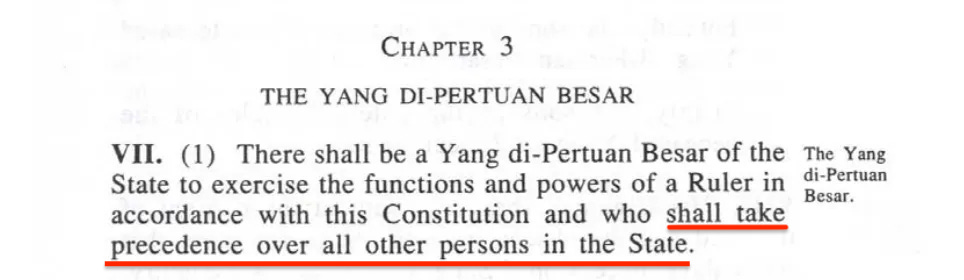
“All other persons” includes the Undangs.
Article 7(3) further restricts who may hold the position of Yang di-Pertuan Besar: only a male, Muslim, Malay descendant in the male line of Raja Radin ibni Raja Lenggang.

This means that the Undangs are constitutionally ineligible to hold the office of Yang di-Pertuan Besar, which Article 7 establishes as the singular office exercising the functions and powers of a Ruler.
What Article 28(1) says
The confusion being weaponised by UMNO comes from one provision: Article 28 in the General Provisions chapter. It defines “Ruler” for the purposes of Part Two of the Constitution.
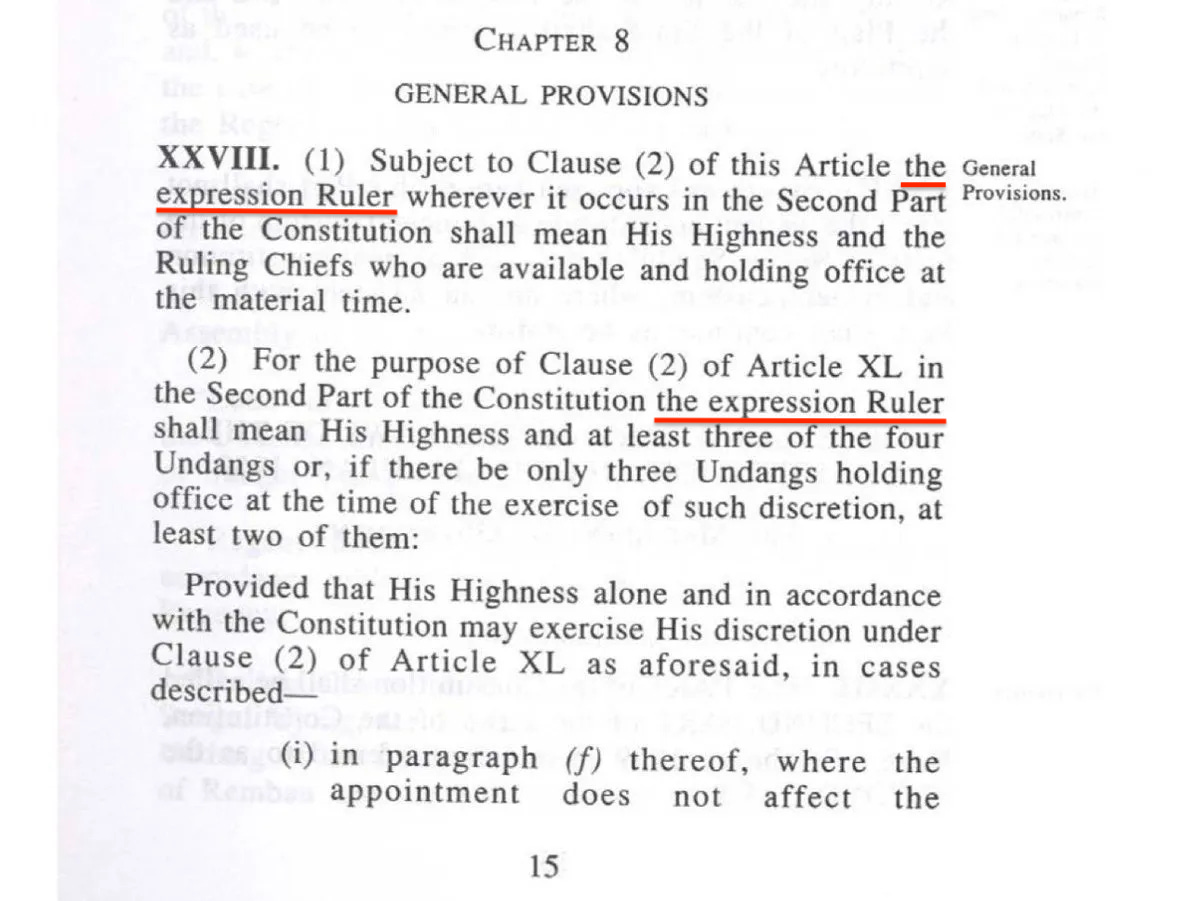
Article 28(1) states that wherever the word "Ruler" appears in the Second Part of the constitution, it means His Highness and the Ruling Chiefs who are available and holding office at the material time.
Article 28(2) says that for the purposes of Article 40(2), and for that clause only, the expression "Ruler" takes on a more specific meaning. It includes His Highness plus at least three of the four Undangs, or at least two if only three Undangs are currently in office.
What Article 40(2) says
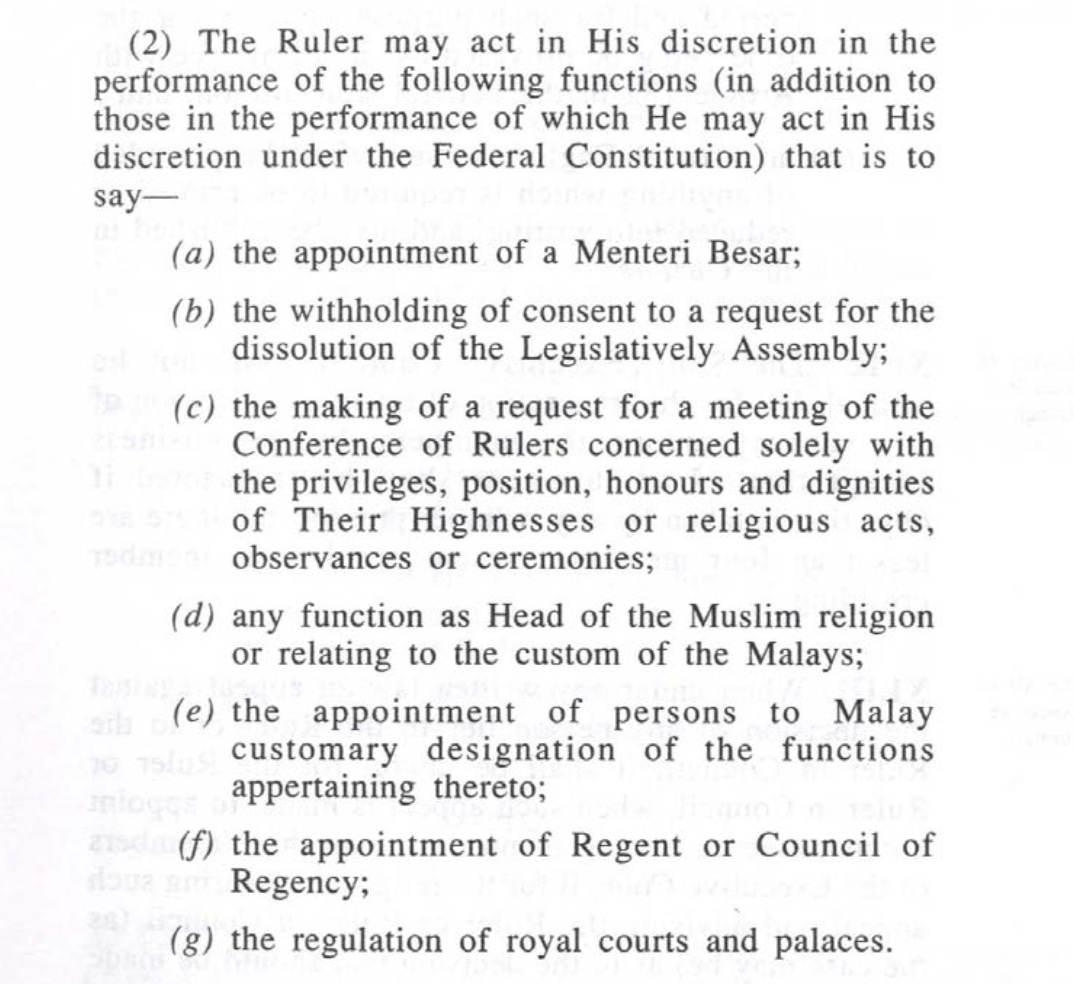
Article 40(2) lists seven discretionary functions:
(a) appointing a Menteri Besar
(b) withholding consent to dissolve the Legislative Assembly
(c) requesting a meeting of the Conference of Rulers
(d) functions as Head of the Muslim religion and matters of Malay custom
(e) appointments to Malay customary positions
(f) appointing a Regent or Council of Regency
(g) regulating royal courts and palaces
What this means is that in these instances, the Yang di-Pertuan Besar cannot constitutionally act alone. Does this mean the Undangs have the same power as the Yang di-Pertuan Besar in these situations? Can they be called co-rulers? From a semantic point of view, in this instance, for these seven discretionary functions, probably yes.
Note the words “the expression”. The constitution is defining a word, not conferring status. The word “Ruler” used here is just a collective term, a label used to group His Highness and the Undangs for how certain decisions are made together, not conferring the same powers of the Yang di-Pertuan Besar on the Undangs. It only confers power on the Undangs, specifically for the seven functions in Article 40(2).
The existence of Article 28(2) and Article 40(2) is itself the proof that Article 28(1) does not automatically grant the Undangs participation across all of Part 2. Article 40(2) is their only source of concurrence power for those seven functions. They could be called “co-rulers” in that context, but in that specific context only.
Ruling Chiefs, not co-rulers
The constitutional title given to the Undangs is “Ruling Chief”. That is the term used throughout the document.
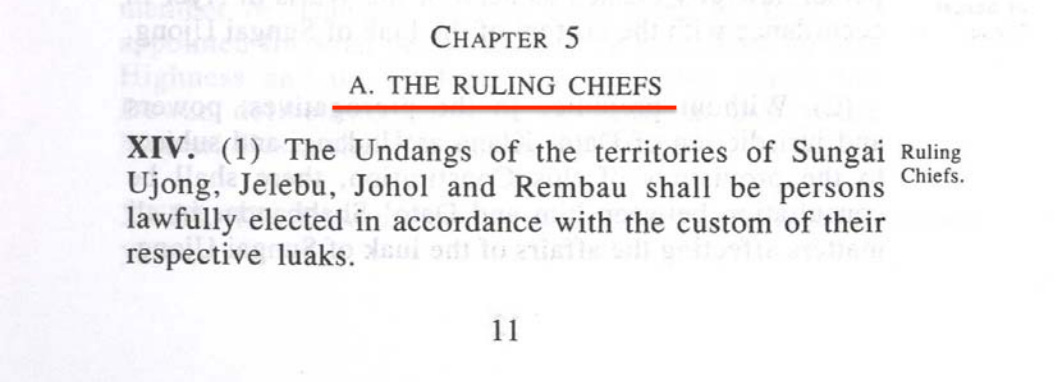

It is also the term used by the Negeri Sembilan state government’s own official portal, which describes the Undangs as leaders of the four luak: Rembau, Sungai Ujong, Johol, and Jelebu.
“Ruling Chief” is a position of significant constitutional weight. Under Article 14, the Undangs are appointed according to the customs of each luak. They sit on the Dewan Keadilan dan Undang. They participate in the election of a new Yang di-Pertuan Besar under Article 11. Under Article 10, in defined and exceptional circumstances, they may call upon the Yang di-Pertuan Besar to withdraw or abdicate, but only after a “full and complete enquiry.”
They were not named “co-rulers”. Constitutional documents use precise labels deliberately.
What does the Federal Constitution say?
Some social media users have cited Article 160(2) of the Federal Constitution, which defines "Ruler" in relation to Negeri Sembilan as "the Yang di-Pertuan Besar acting on behalf of himself and the Ruling Chiefs in accordance with the Constitution of that State."


Article 160 is a textbook interpretation clause. It exists to assign meanings to words used elsewhere in the document. It is not a substantive provision creating rights, status, or hierarchy.
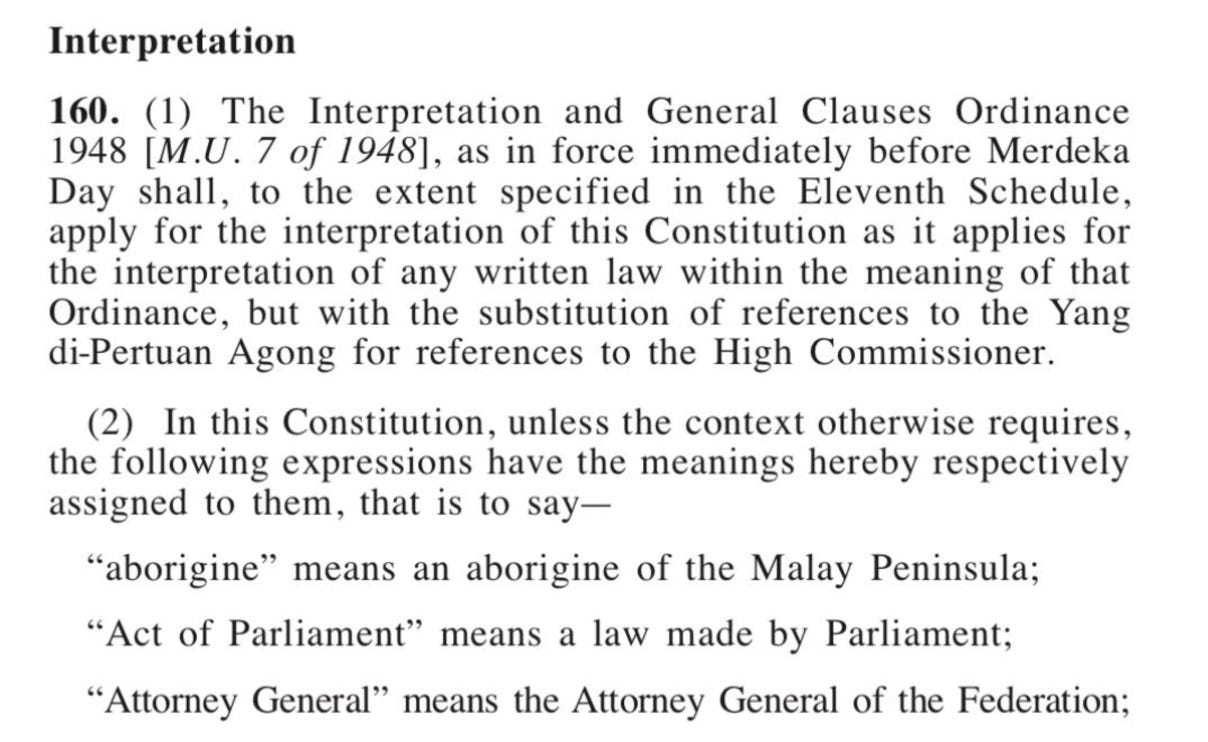
The clause itself is titled “Interpretation”, and its operative language (”the following expressions have the meanings hereby respectively assigned to them”) makes its function explicit: it is defining terms, not conferring offices.
The hierarchy is built into the institution itself
Two features of the constitution settle the question of who sits above whom.
First, the Yang di-Pertuan Besar chairs the Dewan Keadilan dan Undang. The DKU is the body that receives and acknowledges the appointment and removal of an Undang under Article 14. An Undang’s tenure is therefore answerable to a body presided over by the Yang di-Pertuan Besar himself. A peer cannot preside over the body that disciplines a peer. This is precisely what happened on 17 April 2026, when the DKU acknowledged the dismissal of Mubarak Dohak as the previous Undang of Sungai Ujong following a special sitting at Istana Besar Seri Menanti, presided over by Tuanku Muhriz.
Second, the titles themselves. The Undang Yang Empat carry the titles Dato’ Klana Petra (Sungai Ujong), Dato’ Mendika Menteri (Jelebu), Dato’ Johan Pahlawan Lela Perkasa Setiawan (Johol), and Dato’ Lela Maharaja or Dato’ Sedia Raja (Rembau, alternating between two noble houses). These are the titles of pembesar, of territorial chiefs. The title of the Yang di-Pertuan Besar is Duli Yang Maha Mulia. The state’s hierarchy of address has never treated these as equivalent.
Why this distinction matters right now
Some social media commentators have suggested that “co-rulers” is just a modern term used to replace “Ruling Chiefs.” Former Court of Appeal judge Datuk Seri Mohd Hishamudin Md Yunus, who himself used the term “co-rulers” in describing Negeri Sembilan’s governance, was explicit about its limits:
His use of the word “co-rulers” here refers only to the Yang di-Pertuan Besar’s constitutional functions in Part 2 of the state constitution, especially Article 40(2). The word ‘co-rulers’ is only used in this context. The word is not used in the context of the constitutional status of His Highness in relation to the Undangs. Statuswise, the State constitution confers upon His Highness a status higher than the Undangs (Malay Mail, 6 May 2026).
This publication believes that the “co-ruler” framing goes further, that it is being actively manipulated for both political and constitutional ends. If the Undangs are seen as co-rulers with parallel authority to the Yang di-Pertuan Besar, then the events of 19 April 2026, when four signatories declared the removal of Tuanku Muhriz, can be reframed as a collective decision by equals rather than what the constitution describes: an action that, on the face of the document, did not follow the procedures of Article 10 for removal at the Undangs’ request, nor those of Article 11 for electing a successor.
Constitutional lawyer Datuk Malik Imtiaz Sarwar and former Court of Appeal judge Datuk Seri Mohd Hishamudin Md Yunus have both stated that Tuanku Muhriz remains the Yang di-Pertuan Besar and that the 19 April declaration has no legal effect.
The bottom line
Much of the online debate has become a dispute about semantics. Whether the Undangs can technically be called "co-rulers" based on a narrowly defined constitutional label is, frankly, a distraction.
The more important questions are these:
Is there a singular Ruler? Yes. The Yang di-Pertuan Besar. The constitution explicitly states it in Article 7(1).
Do the Ruling Chiefs have the same rank as the Yang di-Pertuan Besar? No.
Article 7(1) places him above all other persons in the State,
Article 26, which opens the chapter on honours and dignities, makes him the fountain of all honours and dignities within the State and the sole authority who may confer titles,
Article 30 arranges the order of precedence for the Ruling Chiefs and other dignitaries “subject to the precedence of His Highness”, leaving the Undangs, the Tunku Besar Tampin, and other dignatories below him.
Do the Undangs have the same power as the Yang di-Pertuan Besar? No. Undang concurrence is required only for the seven functions listed in Article 40(2).
Is the term “co-ruler” being deliberately used to manipulate public perception into believing that they do? Very possibly yes.
UMNO-aligned accounts across Facebook, Twitter, and Threads have been pushing the “co-ruler” claim aggressively. If the public comes to believe that the Undangs hold equal rank and equal power, they will treat it as fact regardless of what the constitution says. Language shapes perception. Perception shapes the legitimacy of the institution. That is precisely why it is so important to make the distinction clear.
At best, UMNO is playing a semantic game with constitutional text. At worst, it is an attempt to manipulate public perception by stretching a narrow interpretive definition into a much broader claim of constitutional equality with the Yang di-Pertuan Besar through repeated use of the term “co-ruler”.
Words have consequences; they must be used carefully.
Read Next: The Co-Ruler Debate, Reignited
If you are new to this Substack and are not sure where to begin, visit our Start Here page, where we list all our articles organised by theme.
Related Posts:


Sources:
Federal Constitution (Reprint 2020), Attorney General’s Chambers of Malaysia
The Ruling Chiefs (Negeri Sembilan Government Official Portal)
Yang di-Pertuan Besar of Negeri Sembilan (Wikipedia, 28 April 2026)
Simplified: Why Tuanku Muhriz is legally still the Negeri Sembilan ruler (Malay Mail, 5 May 2026)
Anak Nogori is independent commentary on the unfolding constitutional crisis in Negeri Sembilan, where centuries-old Adat Perpatih, royal succession law, and modern political manoeuvring are colliding in ways Malaysia has never seen before. If you find this useful, share it with someone who should be following this, or subscribe to receive the latest articles in your inbox.
