


The co-rulership question returned to public view this week through three pieces in Free Malaysia Today. Faisal Tehrani refuted the framing on 14 May. An Anak Negeri essay (no relation to this publication, despite the similar pen name) was reprinted on 15 May. Dr Ikmal Hisham Md Tah and Mohd Khairil Hisham Mohd Ashaari replied on 16 May.
Across the three pieces, the debate touched on lineage, constitutional text and treaty history. Read together, they raise three distinct questions. This piece separates them and takes each on its own terms.
The Historical Question: What did Adat actually establish about the Undangs’ rank?
The first question is the oldest. Within Adat Perpatih, where do the Undang Yang Empat sit in relation to the Yang di-Pertuan Besar?
Faisal Tehrani, 14 May column in FMT
Faisal Tehrani, a Research Fellow at the Institut Alam dan Tamadun Melayu (ATMA), Universiti Kebangsaan Malaysia, addressed this directly. His 14 May column, “Menyanggah si ‘pakar adat’ dalam sebuah podkas” (Refuting the ‘adat expert’ in a podcast), opened with a podcast interview in which a veteran politician was repeatedly introduced as an “adat expert” by the hosts. The series has reportedly drawn over 100,000 views (Free Malaysia Today, 14 May 2026).
He argues that the “adat expert” was pushing a careless narrative: that the Undang of Sungei Ujong, Johol, Jelebu and Rembau are “somehow equal to, or a kind of co-ruler with, the Yang di-Pertuan Besar.”
Faisal refuted this using a book whose foreword the same “adat expert” had written. The book is Perlembagaan Purbakala Luak Jelebu (2026), authored by Mohd Arof Ishak.
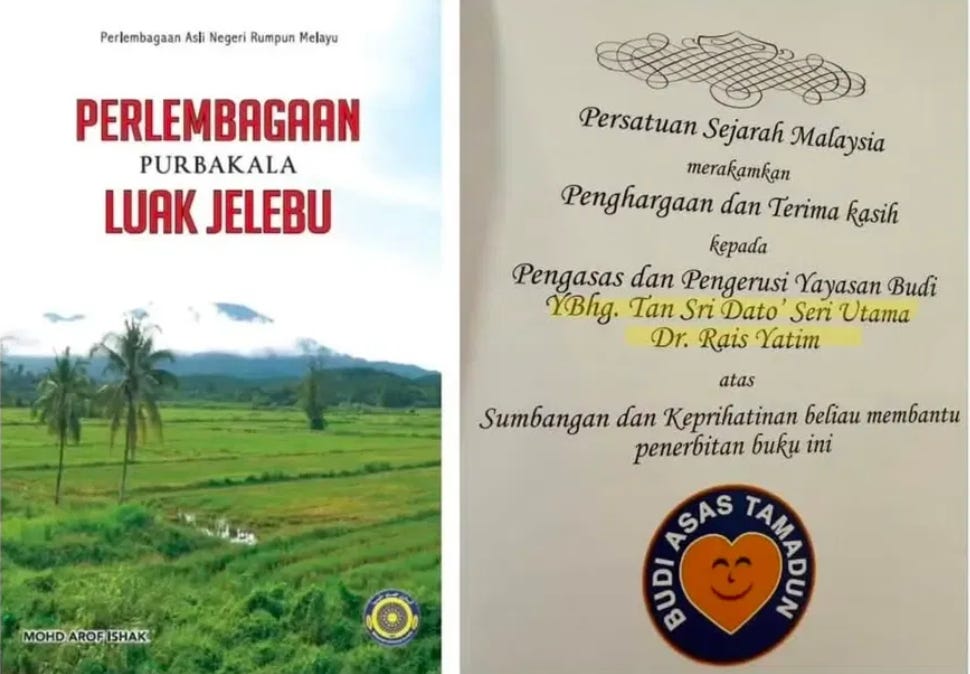
The passage Faisal quotes is worth reading in full:
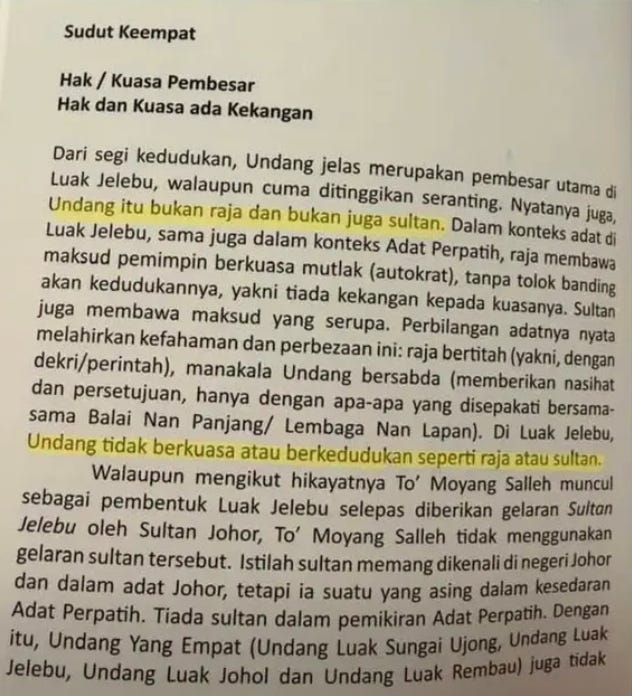
“In terms of position, the Undang is clearly the principal chief (pembesar utama) in Luak Jelebu, although only ‘raised one branch higher’ (ditinggikan seranting, an adat expression indicating elevation above others, but not absolute supremacy). It is also evident that the Undang is not a king and is not a sultan either. In the adat context of Luak Jelebu, as also in the context of Adat Perpatih, “raja” carries the meaning of a leader with absolute power (autocratic), without comparison in status, namely with no restraints upon his authority.
“Sultan” likewise carries a similar meaning. The adat perbilangan (customary sayings) clearly expresses this understanding and distinction: a king bertitah (decrees), whereas the Undang bersabda (gives counsel and consent, only with whatever has been mutually agreed together with the Balai Nan Panjang/Lembaga Nan Lapan). In Luak Jelebu, the Undang does not possess authority or standing like that of a king or sultan.”
As Faisal observes, with palpable irony: “Sukar untuk dihujahkan yang ‘pakar adat’ ini tidak membaca hasil kajian pengarang iaitu Mohd Arof Ishak.” It is difficult to argue that this ‘adat expert’ has not read the research findings of the author whose book he himself prefaced.
Faisal cross-references Prof Norhalim Ibrahim of UPM, who studied the Undang of Rembau in Negeri Yang Sembilan: Daerah Kecil Pesaka Adat Warisan Kerajaan Berdaulat (1995):
“The Penghulu of Rembau and other Penghulus are no longer on par with Sultans of other Malay states. They are ‘represented’ by the Yang di-Pertuan Besar, and therefore it is the Yang di-Pertuan Besar who is on par with other Malay Sultans. Indirectly, this means the Yang di-Pertuan Besar of Negeri Sembilan is higher in rank than the Penghulu/Undang.”
Faisal characterises the co-rulership narrative as “bukan sahaja salah, malahan satu bencana besar jika dibiar tanpa dibetulkan dan ditegur.” Not only wrong, but a great disaster if left uncorrected.
Essays by Anak Negeri
A second contribution to the historical question came the following day. A series of four essays under the pen name “Anak Negeri” (separate from this publication) has been circulating on WhatsApp in both English and Bahasa Melayu over the past two weeks. The fourth essay, “Ilusi pemerintahan bersama dalam kalangan pemegang amanah” (The Illusion of Co-Rule Among Trustees), was reprinted in FMT on 15 May (Free Malaysia Today, 15 May 2026).
The essay structures its argument around three claims. The first is constitutional: sovereignty in the Malay constitutional tradition rests with the nine Malay Rulers, and the office of Yang di-Pertuan Agong is reserved exclusively for them. The second is functional: chieftains are kingmakers and trustees of their Luak, with prestige and privilege flowing from the state, while their position is one of trust rather than sovereignty. The third is structural: the chieftains are the pillars of the Luak, while the Ruler is the roof over the entire negeri, and a pillar that pushes past the roof brings the whole house down.
The essay then narrows to the present moment, arguing that a chieftain who has lost the confidence of his own Luak cannot then invoke “co-ruler” status to bring down a Malay Ruler protected by the Constitution.
The adat scholarship cited here draws the distinction sharply: Raja bertitah, Undang bersabda. The Ruler commands; the Undang speaks. The verbs are different because the offices are different.
The Constitutional Question: What do Articles 71, 160 and 181 in the Federal Constitution say?
The second question is the one Dr Ikmal Hisham Md Tah, a constitutional law lecturer at UiTM, and Mohd Khairil Hisham Mohd Ashaari, curator at Galeri Tuanku Ja’afar Negeri Sembilan, took up in their 16 May reply to the Anak Negeri essay. They argue that the Undang Yang Empat are co-rulers, protected by Article 181 of the Federal Constitution and grounded in the confederation agreements of 1895, 1898 and 1934 (Free Malaysia Today, 16 May 2026).
The reply opens by refuting the Anak Negeri essay's characterisation of the Undangs as "rakyat biasa" (ordinary citizens). This appears to misread the term. There is no doubt that the Undangs hold an elevated rank within Adat Perpatih and the Negeri Sembilan Constitution 1959. Read in context, the Anak Negeri essay uses the phrase to mean the Undangs are not of royal lineage, which is a separate question from their constitutional standing.
The authors argue that Article 181(1) of the Federal Constitution preserves the sovereignty, prerogatives, powers and jurisdiction of both the Malay Rulers and the Ruling Chiefs of Negeri Sembilan, placing the Ruling Chiefs on par with the Malay Rulers in terms of constitutional protection.
Each cited provision deserves a careful reading.
On Article 71. The 16 May reply reads Article 71 as a federal recognition of the Undangs as Rulers alongside the Yang di-Pertuan Besar. A closer reading shows two distinct sub-articles. Article 71(1) protects the right of a Ruler to succeed and hold office. Article 71(2) extends a parallel federal protection to the constitutional position of the Ruling Chiefs. The two sub-articles tell the reader that the offices are distinct, each federally guaranteed by reference to the state constitution that defines it.
On Article 160(2). The reply reads Article 160(2) as conferring co-equal status by grouping the Yang di-Pertuan Besar and the Undangs under the term “Ruler”. Article 160(2) is a definitional clause. Its function is to assign meanings to words used elsewhere in the document. The substantive position, powers, and offices of the Yang di-Pertuan Besar and the Undangs remain defined by the Negeri Sembilan Constitution 1959, where Article 7(1) places the Yang di-Pertuan Besar above all other persons in the State, and Article 28 and Article 40(2) define a narrow set of seven discretionary functions in which Undang concurrence is required.
On Article 181(1). The reply reads Article 181(1) as preserving shared sovereignty between the Yang di-Pertuan Besar and the Undangs. The structure of the provision matters here. The word “sovereignty” is used for the Rulers and omitted for the Ruling Chiefs. Article 181(1) preserves sovereignty for the Rulers and preserves jurisdiction and prerogatives for the Ruling Chiefs within their respective territories. On our reading, the Constitution uses different language because it recognises different constitutional positions. The Rulers retain state-wide sovereignty and the Undangs retain prerogatives within their Luak: Sungei Ujong, Jelebu, Johol or Rembau.
A fuller walkthrough of these three Federal Constitution articles sits in a separate reference piece: What the Federal Constitution Says About Negeri Sembilan: Articles 71, 160, 181.
On the 1895, 1898 and 1934 confederation agreements. The 1895 Treaty of Federation, the 1898 supplementary agreement and the 1934 reorganisation each defined the relationship between the Yang di-Pertuan Besar and the chiefs of the constituent Luak. These instruments establish that the chiefs participate in the election of the Yang di-Pertuan Besar and hold defined authority within their Luak, while stopping short of establishing parity of rank or shared state-wide sovereignty.
The constitutional question admits more than one reading. Reasonable lawyers can read these provisions differently. We believe the text supports a hierarchy in which the Yang di-Pertuan Besar holds state-wide sovereignty and the Undangs hold defined prerogatives within their Luak. Two textual asymmetries support this reading: the word "sovereignty" appears for the Rulers and is omitted for the Ruling Chiefs, and the words "within their respective territories" appear for the Ruling Chiefs and are omitted for the Rulers.
The Procedural Question: Was 19 April compliant with Article 10?
Tucked within the FMT piece is a concession that warrants close reading. The authors write: “keengganan menteri besar menandatangani proklamasi tersebut telah menjadi polemik perlembagaan sehingga hari ini.” The Menteri Besar’s refusal to sign the 19 April proclamation has become a constitutional polemic to this day.
Article 10 of the Negeri Sembilan Constitution 1959 sets out the only mechanism by which the Undang Yang Empat may call upon the Yang di-Pertuan Besar to withdraw or abdicate. Senior constitutional lawyer Malik Imtiaz Sarwar identified the requirements as follows (Free Malaysia Today, 23 April 2026):
A Yang di-Pertuan Besar can only be suspended or removed where said ruler can objectively be said to have acted in a manner that can reasonably be understood as amounting to a “great and serious defect”,
A full and complete enquiry into the impugned conduct,
The Ruler’s right to be heard on specific allegations,
An objective determination that a qualifying ground under Article 10(1) is made out,
A proclamation signed by the Undang Yang Empat and the Menteri Besar.
Having acknowledged the procedural defect, the authors pivot to the co-rulership argument, which cannot cure the 19 April procedural defect. Whether the Undangs are co-rulers, ruling chiefs or principal chiefs raised one branch higher does not alter any of this.
There is a further point that the historical and constitutional questions cannot dispute. On 17 April 2026, the Dewan Keadilan dan Undang (DKU) acknowledged the removal of the Undang of Sungei Ujong, Mubarak Dohak, his removal having occurred under the custom of the Luak. Under Article 16(3) of the Negeri Sembilan Constitution 1959, DKU advice on such questions is final and cannot be challenged in any court. Two days later, Mubarak signed the 19 April declaration as Undang Luak Sungei Ujong. The declaration is therefore signed by a person who is no longer an Undang.
What the three questions tell us when read together
The historical question is largely answered by adat’s own texts. The Undang is pembesar utama, ditinggikan seranting, raised one branch higher within the Luak. The Yang di-Pertuan Besar holds the office that is on par with the Malay Sultans, and the Undangs are represented by him in that capacity. The adat scholarship cited by Faisal Tehrani, and the structural argument set out in the Anak Negeri essay, both point the same way: pillars hold up the Luak, the roof shelters the negeri, and the two offices serve different functions.
The constitutional question arguably admits more than one reading. The Federal Constitution can be interpreted differently by reasonable lawyers, and the Negeri Sembilan Constitution 1959 confers a narrow concurrence power on the Undangs for seven discretionary functions under Article 40(2). Calling that concurrence “co-rulership” is a semantic debate; however calling it parity of rank or shared sovereignty is a stretch the text does not support.
The procedural question stands apart from the other two. Article 10 of the Negeri Sembilan Constitution 1959 requires a full and complete enquiry, the Menteri Besar's signature, and the agreement of all four Undangs. The 19 April declaration met none of those requirements. The procedure was flawed regardless of how one reads the Federal Constitution, debates Adat Perpatih, or interprets treaty history.
Summary
The co-rulership argument is intellectually interesting and semantically debatable, within constraints. The procedural defects of the 19 April declaration are not contestable. They render it invalid regardless of how the co-rulership question is resolved.
Read next: What the Federal Constitution Says About Negeri Sembilan: Articles 71, 160, 181
If you are new to this Substack and are not sure where to begin, visit our Start Here page, where we list all our articles organised by theme.
Related Posts:


Sources:
Negeri Yang Sembilan: Daerah Kecil Pesaka Adat Warisan Kerajaan Berdaulat, Prof Norhalim Ibrahim (UPM), 1995
The Laws of the Constitution of Negeri Sembilan 1959, (Negeri Sembilan State Government)
Perlembagaan Purbakala Luak Jelebu, Mohd Arof Ishak, 2026
Why Negeri Sembilan is not in a constitutional crisis, (Free Malaysia Today), 23 April 2026
Menyanggah si ‘pakar adat’ dalam sebuah podkas, Faisal Tehrani, (Free Malaysia Today), 14 May 2026
Anak Nogori is independent commentary on the unfolding constitutional crisis in Negeri Sembilan, where centuries-old Adat Perpatih, royal succession law, and modern political manoeuvring are colliding in ways Malaysia has never seen before. If you find this useful, share it with someone who should be following this, or subscribe to receive the latest articles in your inbox.
