


Article 36 sits in Chapter 2 of the Second Part of the Constitution, under the heading “Executive” and explains how the Ruler appoints the person who will run the government day to day: the Menteri Besar.
(Note: Based on Article 28(2), “Ruler” here refers to His Highness and at least three of the four Undangs, or at least two if only three Undangs hold office.)
How the Ruler decides whom to pick as Menteri Besar is set in Article 38(2)(a).
Article 36 covers three things instead: the paperwork the appointment must take, the qualifications the appointee must meet, and a narrow power the Ruler holds to waive those qualifications.
What each clause means
Article 36(1): The Instrument of appointment, and the Article 38(2)(a) test it follows
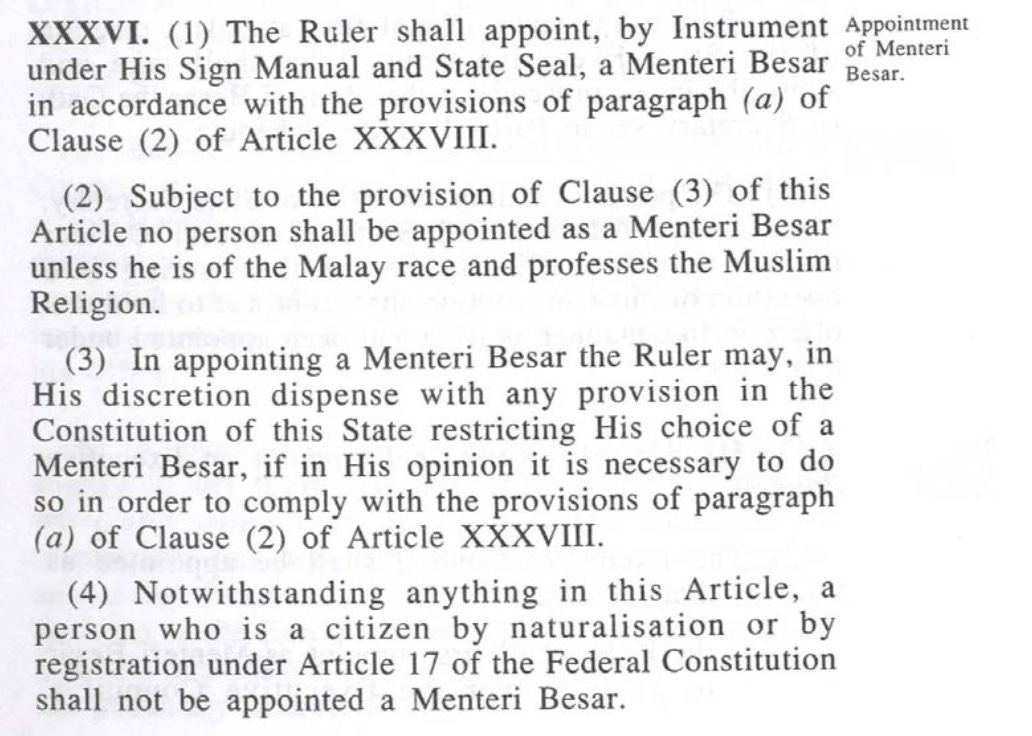
(1) The Ruler shall appoint, by Instrument under His Sign Manual and State Seal, a Menteri Besar in accordance with the provisions of paragraph (a) of Clause (2) of Article XXXVIII.
Two things happen in this clause. First, it fixes the form the appointment must take: a formal Instrument, executed under the Ruler’s Sign Manual and State Seal. This represents the paperwork.
Second, it ties that Instrument to a condition (a confidence test) defined in Article 38(2)(a): the Ruler must first appoint, as Menteri Besar, a member of the Legislative Assembly who in his judgment is likely to command the confidence of the majority of the Assembly’s members.
Article 36(2): The race and religion qualification for the office
(2) Subject to the provision of Clause (3) of this Article no person shall be appointed as a Menteri Besar unless he is of the Malay race and professes the Muslim Religion.
The rule limits the office to a person who is of the Malay race and a Muslim. The clause opens with “Subject to the provision of Clause (3)”, which signals that the restriction is not absolute. The next clause supplies the exception.
Article 36(3): The Ruler’s power to waive the qualification
(3) In appointing a Menteri Besar the Ruler may, in His discretion dispense with any provision in the Constitution of this State restricting His choice of a Menteri Besar, if in His opinion it is necessary to do so in order to comply with the provisions of paragraph (a) of Clause (2) of Article XXXVIII.
This power is narrow. The Ruler may set aside a rule that limits his choice of Menteri Besar, including the race and religion rule in Article 36(2), but only if he must do so to satisfy the confidence test in Article 38(2)(a).
The waiver serves one purpose: it covers the case where the person who commands the majority is not Malay or Muslim. The Constitution leaves the details to the Ruler’s judgment and describes no further conditions.
Article 36(4): The bar on naturalised and registered citizens
(4) Notwithstanding anything in this Article, a person who is a citizen by naturalisation or by registration under Article 17 of the Federal Constitution shall not be appointed a Menteri Besar.
Clause (4) opens with “Notwithstanding anything in this Article”, placing it outside the reach of the Article 36(3) discretion. A citizen by naturalisation, or by registration under Article 17 of the Federal Constitution, cannot be appointed Menteri Besar, and the Ruler’s power under Article 36(3) to dispense with restrictions does not extend to this bar.
What Article 36 does not say
It leaves the test for choosing among candidates to Article 38(2)(a). Article 36 handles the paperwork and the qualifications; the judgment about who commands the majority belongs to Article 38(2)(a).
It applies the meaning of “Ruler” to Article 28. This Menteri Besar appointment requires His Highness and at least three of the four Undangs, or at least two if only three Undangs hold office to make the decision.
It sets no deadline. The Constitution stays silent on how quickly the appointment must follow an election, a resignation, or a loss of confidence.
It does not require the appointee to belong to any particular party. The test asks whether a member holds majority confidence in the Assembly, whatever party that member comes from.
It gives no procedure for how the Ruler forms his judgment. Beyond the signature and seal on the Instrument itself, the Constitution stays silent on whether the Ruler consults, counts signed statements of support, or follows some other practice. This has been left to convention.
Why Article 36 matters
The Article came into live operation after the 1 August 2026 state election, in which BN won 18 seats, PN 7 and PH 11, giving the BN-PN alliance 25 of 36 (Bernama, 2 August 2026).
The sequence as it unfolded is covered in Who Appoints the Menteri Besar After the Negeri Sembilan Election?. Through the campaign, replies and quote posts on social media kept circling one question: with two men claiming the office of Yang di-Pertuan Besar, before whom would a new Menteri Besar be sworn in, and whose signature would sit on the appointment?
By polling day the question had reached the mainstream press, with Malaysiakini reporting rumours of a swearing-in before the rival claimant at Istana Serting, denied by Umno's deputy president the same day (Malaysiakini, 1 August 2026).
BN's answer came within hours of the count, when its chairman Ahmad Zahid Hamidi handed Tuanku Muhriz a letter carrying three names for the post. Asked whether outgoing Menteri Besar Aminuddin Harun should vacate the official residence immediately, Zahid said there was no urgency, that Aminuddin should be given time, and that "we must have a sense of humanity and respect" for the departing side (The Star, 2 August 2026).
Summary
Read alone, Article 36 looks procedural. Read with Article 38(2)(a), it becomes the final step in a longer sequence that starts with the composition of a newly elected Assembly and ends in a single signature.
Read next: What is Article 38 of the Negeri Sembilan Constitution 1959?
Footnote: The Constitution numbers its Articles in Roman numerals. This publication uses Arabic numerals for readability.
Our posts referencing Article 36 or the Menteri Besar
Proper Processes Exist to Remove a MB and YDPB, They Were Not Followed: Anthony Loke
Who Appoints the Menteri Besar After the Negeri Sembilan Election?
Sources:
Lawyer: New N Sembilan MB must take oath before Tuanku Muhriz (Malaysiakini, 1 August 2026)
Official Results: Negeri Sembilan Polls 2026 (Bernama, 2 August 2026)
Three names submitted for Negri Mentri Besar post (The Star, 2 August 2026)
Anak Nogori is independent commentary on the unfolding constitutional crisis in Negeri Sembilan, where centuries-old Adat Perpatih, royal succession law, and modern political manoeuvring are colliding in ways Malaysia has never seen before. If you find this useful, share it with someone who should be following this, or subscribe to receive the latest articles in your inbox.
