


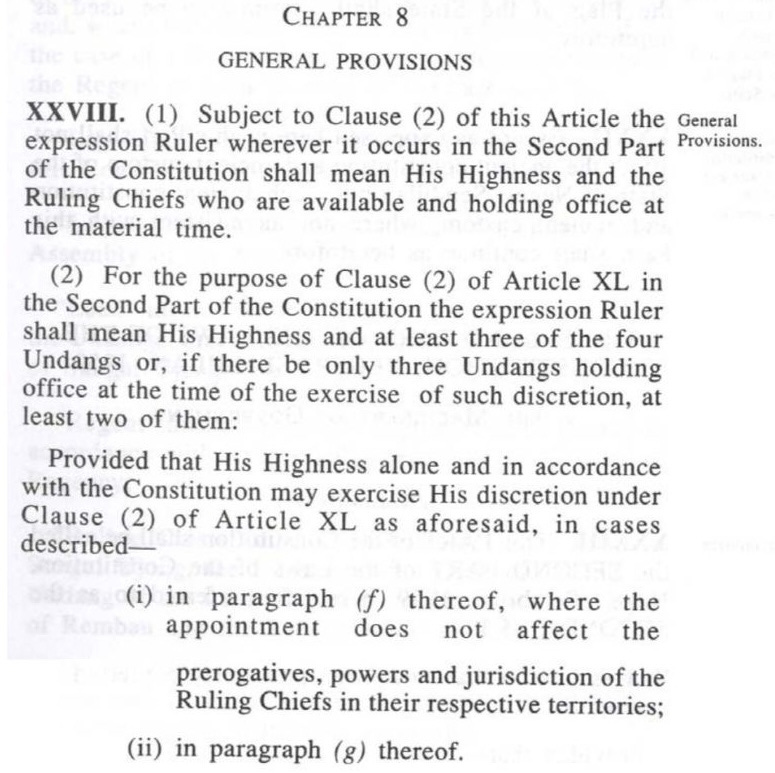
Article 28 sits in Chapter 8, under the heading “General Provisions”, and defines the expression “Ruler” whenever that word appears in the Second Part of the Constitution, which establishes the machinery of government.
What each clause means
Article 28(1): The general meaning of “Ruler” for the Second Part of the Constitution
(1) Subject to Clause (2) of this Article the expression Ruler wherever it occurs in the Second Part of the Constitution shall mean His Highness and the Ruling Chiefs who are available and holding office at the material time.
For most purposes in the Second Part, “Ruler” means His Highness together with the Ruling Chiefs who are available and holding office at the time. This is the general definition that applies unless Article 28(2) provides otherwise.
Article 34 defines the Ruling Chiefs as the four Undangs of Sungai Ujong, Jelebu, Johol and Rembau together with the Tunku Besar Tampin. Article 28(1) then imposes an additional limitation: only those who are both holding office and available count towards the definition. Someone who has vacated office, or who is unavailable at the relevant time, therefore falls outside Article 28(1).
Article 28(2): The three-Undang threshold for Article 40(2) discretionary decisions
(2) For the purpose of Clause (2) of Article XL in the Second Part of the Constitution the expression Ruler shall mean His Highness and at least three of the four Undangs or, if there be only three Undangs holding office at the time of the exercise of such discretion, at least two of them:
Article 28(2) sets a more specific definition. It applies only to Article 40(2), the provision that lists the matters on which the “Ruler” may act in discretion rather than on the advice of the Executive Council.
Article 40(2) lists seven discretionary functions:
(a) appointing a Menteri Besar
(b) withholding consent to dissolve the Legislative Assembly
(c) requesting a meeting of the Conference of Rulers
(d) functions as Head of the Muslim religion and matters of Malay custom
(e) appointments to Malay customary positions
(f) appointing a Regent or Council of Regency
(g) regulating royal courts and palaces
For that narrower purpose, “Ruler” means His Highness together with at least three of the four Undangs. If only three Undangs are in office at the time, the threshold drops to at least two of them.
The drafting is also notable for what it excludes. Although the Tunku Besar Tampin is one of the Ruling Chiefs for the general definition in Article 28(1), he is omitted from the special definition in clause (2). That omission is express, not accidental. Article 28(2) speaks only of Undangs, a narrower category than the Ruling Chiefs defined generally in Article 28(1) and Article 34.
This is the clause most often invoked in the co-ruler debate. It does not create a new office or elevate the Undangs to equal status with the Yang di-Pertuan Besar.
Instead, it defines who constitutes “the Ruler” for exercising the seven discretionary powers in Article 40(2), requiring the participation of His Highness together with the prescribed number of Undangs.
Article 28(2), proviso: The two matters the Yang di-Pertuan Besar may decide alone
Provided that His Highness alone and in accordance with the Constitution may exercise His discretion under Clause (2) of Article XL as aforesaid, in cases described:
(i) in paragraph (f) thereof, where the appointment does not affect the prerogatives, powers and jurisdiction of the Ruling Chiefs in their respective territories;
(ii) in paragraph (g) thereof.
The threshold in Article 28(2) is subject to a proviso. His Highness may exercise two of the seven Article 40(2) discretionary functions alone, without the three-Undang quorum:
(f) appointing a Regent or Council of Regency, where the appointment does not affect the prerogatives, powers and jurisdiction of the Ruling Chiefs in their own territories.
(g) regulating of royal courts and palaces.
What Article 28 does not say
Article 28 does not create a joint office of “Ruler” shared equally between the Yang di-Pertuan Besar and the Undangs. It defines a word for the purposes of interpreting other Articles. That is because Article 28 is performing an interpretive rather than a substantive function.
Article 28 does not say what happens if fewer than the required number of Undangs are available or willing to participate in a decision under Article 40(2). It sets a threshold but does not specify a mechanism for resolving deadlock, disagreement, or the absence of a Luak’s representative from the process.
Article 28 does not touch the removal or appointment of an Undang. That question sits with the custom of the Luak under Article 14, and with the advisory role of the Dewan Keadilan dan Undang (DKU) under Article 16.
Article 28 does not extend the three-Undang threshold to matters outside Article 40(2). Ordinary executive functions, including most day-to-day decisions of the Executive Council, are governed by Article 40(1), under which the Yang di-Pertuan Besar acts on the advice of the Executive Council rather than any composite “Ruler”.
2026 co-ruler controversy
Article 28’s status as an interpretation clause has been subject to fierce debate in 2026 with several groups (including UMNO, Rais Yatim, academics) arguing that Undangs are co-rulers in Negeri Sembilan. Different readings have surfaced in at least three places.
In Free Malaysia Today on 14 May 2026, Faisal Tehrani of UKM’s Institut Alam dan Tamadun Melayu cited several books for the reading that an Undang ‘is not a king and is not a sultan’ (Free Malaysia Today, 14 May 2026).
On 16 May 2026, Dr Ikmal Hisham Md Tah and Mohd Khairil Hisham Mohd Ashaari argued that the relationship between the Yang di-Pertuan Besar and the Undang Yang Empat is not subordinate but symbiotic, anchored in Article 181 of the Federal Constitution and Chapters 3 and 5 of the Negeri Sembilan Constitution 1959, and that denying any element of ‘pemerintahan bersama’ (co-rulership) between them is ‘misguided’ (Free Malaysia Today, 16 May 2026).
The exchange continued in Malaysiakini. On 9 July 2026, Dr Ikmal Hisham argued directly that an Undang ‘ialah raja’ (is a raja) within his own Luak, again in reply to Faisal Tehrani (Malaysiakini, 9 July 2026).
The following day, writing with Mohd Khairil Hisham Mohd Ashaari, he separately argued that the caretaker state government had exceeded the limits of its authority by proceeding with Undang installations and the Rembau eviction after the Legislative Assembly’s dissolution (Malaysiakini, 10 July 2026).
The claim has also reached Malay Wikipedia. As of late July 2026, the page for Undang Luak Johol cites Article 28 of the Negeri Sembilan Constitution 1959 directly, alongside Article 160(2) of the Federal Constitution, describing the Undang as ‘Pembesar Memerintah dan Raja bersama’ (ruling chief and co-ruler or joint Raja) and Negeri Sembilan as having a ‘pemerintah berbentuk kolektif’ (collective monarchy) (Wikipedia Bahasa Melayu, accessed 30 July 2026). Comparable wording appears on the pages for the other three Undangs.
On 30 July 2026, Tuanku Muhriz stripped Rais Yatim, a former Menteri Besar of Negeri Sembilan (1978 to 1982), of his two Negeri Sembilan royal titles, two days before the state election, with state secretary Zafir Ibrahim citing the need to preserve “the majesty, sanctity and dignity of Negeri Sembilan’s royal institution”. According to palace sources cited by The Straits Times, Rais Yatim's role dates back to 2022, when he encouraged the Undang of Jelebu to refer to himself as “Sultan”, a title the Negeri Sembilan Constitution 1959 does not confer on any Undang. (The Straits Times, 30 July 2026).
Why this matters
None of these interpretations change what Article 28 itself provides. The clause defines who is meant by “Ruler” in two specific contexts, His Highness with the Ruling Chiefs generally under Article 28(1), His Highness with a quorum of Undangs for the seven Article 40(2) functions under Article 28(2). It does not extend either definition into a claim of equal rank.
The co-ruler debate, where it is made, rests on other provisions: Article 181 and Article 160(2) of the Federal Constitution, and, in the Malaysiakini and FMT pieces above, on takinga customary view of Adat philosophy rather than the state Constitution’s own text.
Two new Undangs were recently chosen by their Luaks, and officially installed before the throne. This, however, came after Sungei Ujong had three concurrent claimants, and Rembau had two.
Two former Undangs still act as though they have sitting power. On 5 June 2026, the removed Undang of Sungei Ujong, Mubarak, and disputed Undang of Rembau, Abdul Rahim, the Undang of Jelebu, the Undang of Johol, the Tunku Besar Tampin led by Rais Yatim, proclaimed Tunku Nadzaruddin as a rival Yang di-Pertuan Besar at a hotel in Alor Gajah, Melaka, with the proclamation read by the Undang of Jelebu, Datuk Maarof Mat Rashad (Free Malaysia Today, 6 June 2026). The Negeri Sembilan Royal Household later declared the ceremony invalid and without legal effect under the state's constitution, laws and customs (Malay Mail, 9 June 2026).
The question has real implications as of July 2026. Polling day for the Negeri Sembilan state election falls on 1 August 2026, after which the Menteri Besar will need to be appointed under Article 40(2)(a), one of the seven functions requiring the Article 28(2) quorum.
While there are rival factions recognising different individuals as Undang in more than one Luak, and different "Undangs" recognising different Yang di-Pertuan Besars, the constitutional position on who counts towards the quorum is clear.
Public understanding of that position, however, is considerably less so, as competing narratives have obscured that constitutional reality.
Summary
As the Adat saying goes, duduk sama rendah, berdiri sama tinggi: sit at the same level, stand at the same height. Article 28 is an interpretation clause. It defines who is meant by “the Ruler” in different contexts. It does not create new constitutional powers or alter the distribution of powers established elsewhere in the Constitution.
Footnote: The Constitution numbers its Articles in Roman numerals. This publication uses Arabic numerals for readability.
Our posts referencing Article 28:
Does Article 79 Let the Ruling Chiefs Convene a DKU Sitting on 5 June?
Why Do Several Wikipedia Pages Now Call the Undangs ‘Rajas’ of Negeri Sembilan?
Sources:
Menyanggah si ‘pakar adat’ dalam sebuah podkas (Free Malaysia Today, 14 May 2026)
Kedaulatan Negeri Sembilan: Antara Perlembagaan, realiti adat (Free Malaysia Today, 16 May 2026)
Ruling chiefs proclaim Nadzaruddin new Negri ruler, says Rais (The Star, 5 June 2026)
ULASAN | Undang ialah raja: Menyanggah Faisal Tehrani (Malaysiakini, 9 July 2026)
ULASAN | Pertikaian adat: K’jaan sementara NS perlu hormati had kuasa (Malaysiakini, 10 July 2026)
Undang Luak Johol (Wikipedia Bahasa Melayu, accessed 30 July 2026)
Anak Nogori is independent commentary on the unfolding constitutional crisis in Negeri Sembilan, where centuries-old Adat Perpatih, royal succession law, and modern political manoeuvring are colliding in ways Malaysia has never seen before. If you find this useful, share it with someone who should be following this, or subscribe to receive the latest articles in your inbox.
