


What follows is a translation of the commentary issued on 5 October 2026 in the name of the Undang Yang Empat¹ and the Tunku Besar Tampin. The allegations in it are the signatories’ alone. The commentary replies to the Official Statement issued by the Secretary of the Dewan Keadilan dan Undang (DKU) on 4 October 2026, which was itself a response to the signatories’ statement of 2 October 2026.
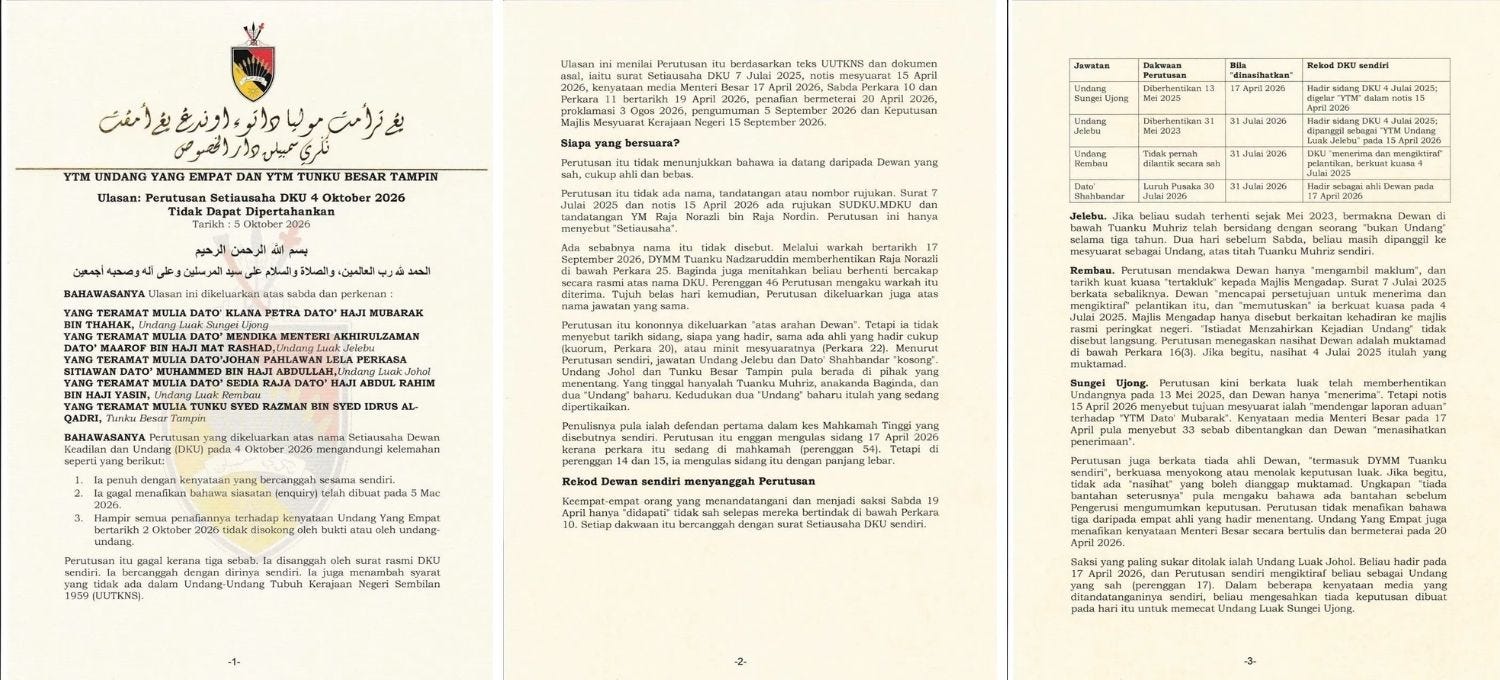
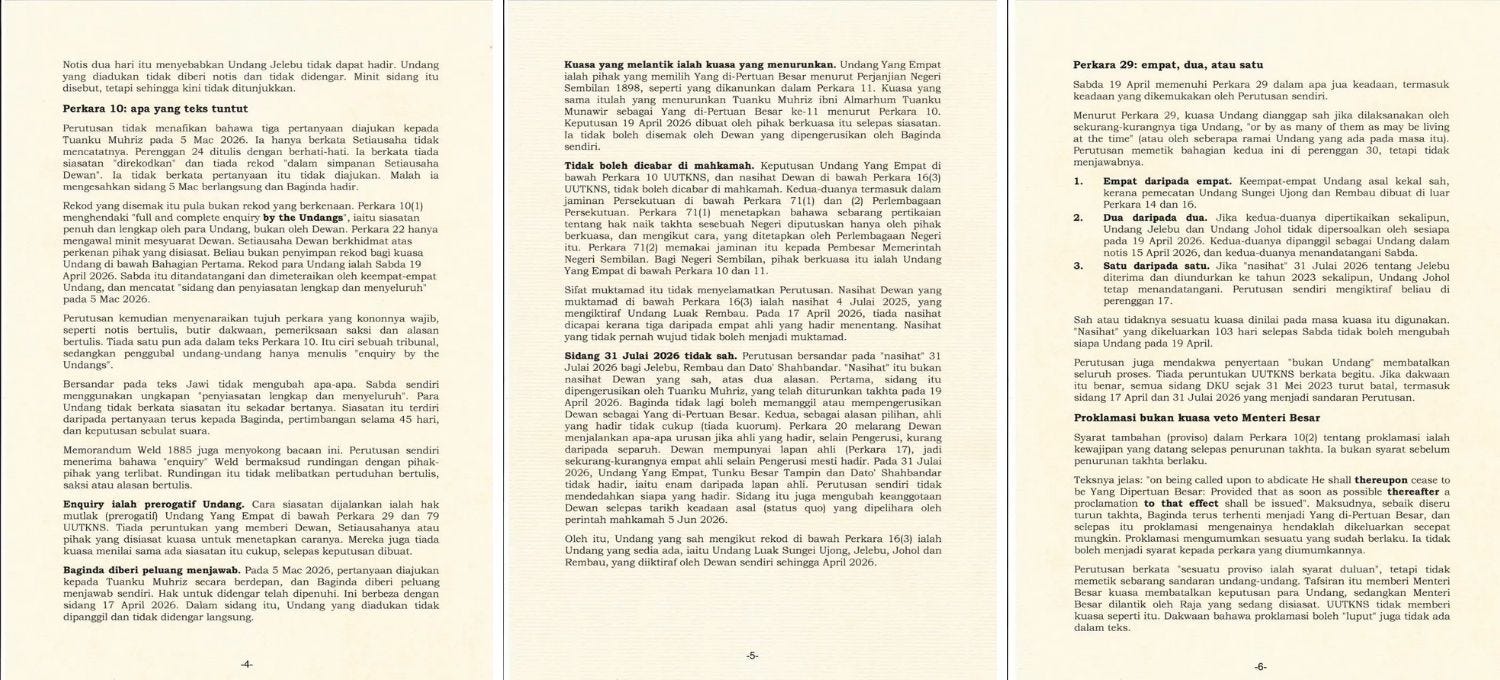
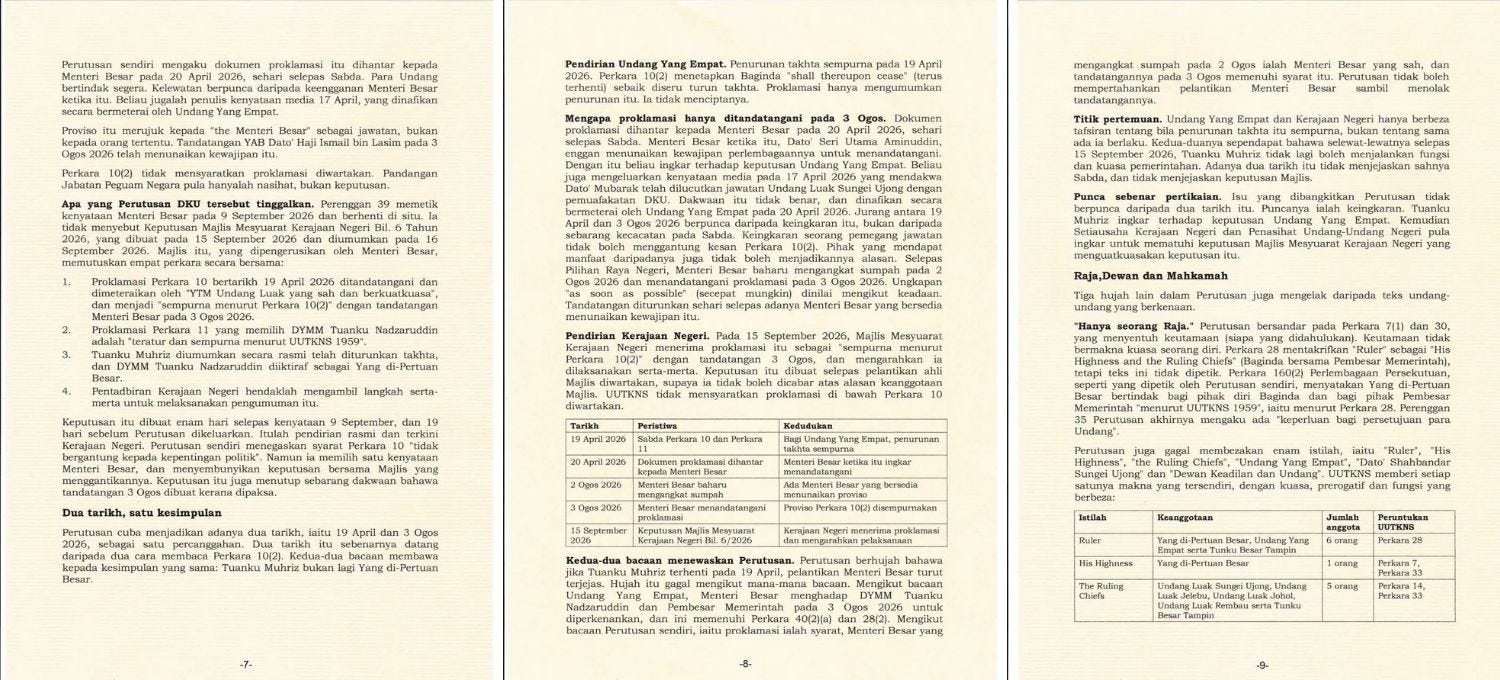
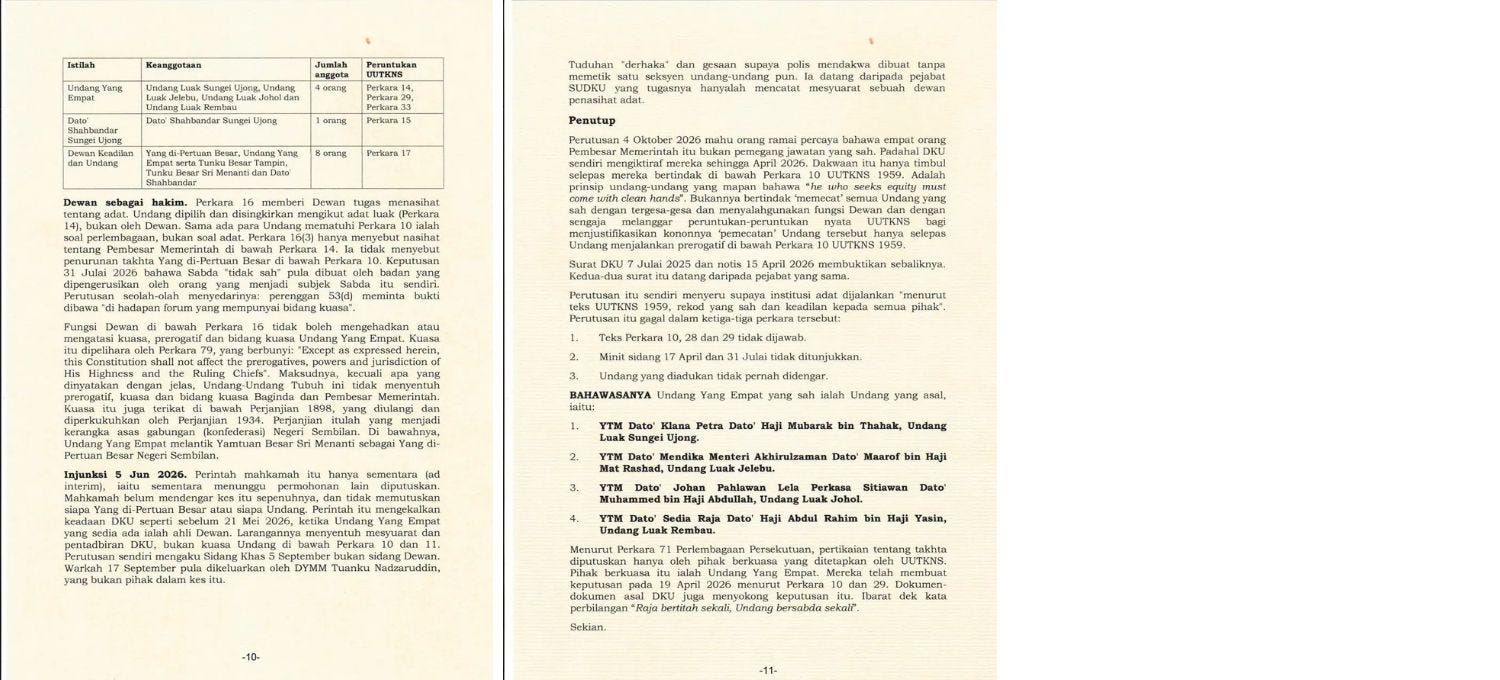
The original Malay statement runs to 11 pages. To keep this page readable, the English translation appears first and the original Malay pages are reproduced in full at the bottom. Where there is any difference in wording or interpretation, the Malay original is authoritative. Names and titles are given as they appear in the original, and the short English glosses in brackets have been added by this publication.
YTM UNDANG YANG EMPAT AND YTM TUNKU BESAR TAMPIN
STATEMENT OF THE DKU SECRETARY OF 4 OCTOBER 2026 CANNOT BE DEFENDED
Date: 5 October 2026
In the name of Allah, the Most Gracious, the Most Merciful.
All praise be to Allah, Lord of the worlds, and peace and blessings upon the master of the Messengers, and upon his family and all his companions.
WHEREAS this Commentary is issued by the decree and consent of:
YANG TERAMAT MULIA DATO’ KLANA PETRA DATO’ HAJI MUBARAK BIN THAHAK, Undang Luak Sungei Ujong
YANG TERAMAT MULIA DATO’ MENDIKA MENTERI AKHIRULZAMAN DATO’ MAAROF BIN HAJI MAT RASHAD, Undang Luak Jelebu
YANG TERAMAT MULIA DATO’ JOHAN PAHLAWAN LELA PERKASA SITIAWAN DATO’ MUHAMMED BIN HAJI ABDULLAH, Undang Luak Johol
YANG TERAMAT MULIA DATO’ SEDIA RAJA DATO’ HAJI ABDUL RAHIM BIN HAJI YASIN, Undang Luak Rembau
YANG TERAMAT MULIA TUNKU SYED RAZMAN BIN SYED IDRUS AL-QADRI, Tunku Besar Tampin
WHEREAS the Statement issued in the name of the Secretary of the Dewan Keadilan dan Undang (DKU) on 4 October 2026 contains the following weaknesses:
It is full of statements that contradict one another.
It fails to deny that an investigation (enquiry) was carried out on 5 March 2026.
Almost all of its denials of the statement of the Undang Yang Empat dated 2 October 2026 are not supported by evidence or by law.
The Statement fails for three reasons. It is refuted by the DKU’s own official letters. It contradicts itself. It also adds conditions that do not exist in the Constitution of the State of Negeri Sembilan 1959 (UUTKNS).
This Commentary assesses the Statement on the basis of the text of the UUTKNS and the original documents, namely the DKU Secretary’s letter of 7 July 2025, the meeting notice of 15 April 2026, the Menteri Besar’s media statement of 17 April 2026, the Sabda (royal decree) on Article 10 and Article 11 dated 19 April 2026, the sealed denial of 20 April 2026, the proclamation of 3 August 2026, the announcement of 5 September 2026 and the Decision of the State Executive Council of 15 September 2026.
Who is speaking?
The Statement does not show that it comes from a Dewan that is lawful, quorate and independent.
The Statement has no name, signature or reference number. The letter of 7 July 2025 and the notice of 15 April 2026 carry the reference SUDKU.MDKU and the signature of YM Raja Norazli bin Raja Nordin. This Statement only says “Secretary”.
There is a reason that name is not mentioned. By a warkah (royal letter) dated 17 September 2026, DYMM Tuanku Nadzaruddin dismissed Raja Norazli under Article 25. His Majesty also commanded him to stop speaking officially in the name of the DKU. Paragraph 46 of the Statement admits that the warkah was received. Seventeen days later, the Statement was nevertheless issued in the name of the same office.
The Statement was supposedly issued “on the direction of the Dewan”. But it does not mention the date of the sitting, who attended, whether the members present were sufficient (quorum, Article 20), or its minutes (Article 22). According to the Statement itself, the offices of Undang of Jelebu and Dato’ Shahbandar are “vacant”. The Undang of Johol and the Tunku Besar Tampin are on the opposing side. All that remains is Tuanku Muhriz, His Majesty’s son, and two new “Undang”. The position of those two new “Undang” is precisely what is being disputed.
Its writer, moreover, is the first defendant in the High Court case that it itself mentions. The Statement refuses to comment on the sitting of 17 April 2026 because the matter is in court (paragraph 54). But in paragraphs 14 and 15, it comments on that sitting at great length.
The Dewan’s own records refute the Statement
All four persons who signed and witnessed the Sabda of 19 April were only “found” to be invalid after they acted under Article 10. Every one of those claims contradicts the DKU Secretary’s own letters.
Undang of Sungei Ujong
Claim in the Statement: removed 13 May 2025
When “advised”: 17 April 2026
The DKU’s own record: attended the DKU sitting of 4 July 2025; styled “YTM” in the notice of 15 April 2026
Undang of Jelebu
Claim in the Statement: removed 31 May 2023
When “advised”: 31 July 2026
The DKU’s own record: attended the DKU sitting of 4 July 2025; called as “YTM Undang Luak Jelebu” on 15 April 2026
Undang of Rembau
Claim in the Statement: never lawfully appointed
When “advised”: 31 July 2026
The DKU’s own record: the DKU “accepted and recognised” the appointment, effective 4 July 2025
Dato’ Shahbandar
Claim in the Statement: Luruh Pusaka (forfeiture of hereditary office) on 30 July 2026
When “advised”: 31 July 2026
The DKU’s own record: attended as a member of the Dewan on 17 April 2026
Jelebu. If he had ceased to hold office since May 2023, it means the Dewan under Tuanku Muhriz had sat with a “non-Undang” for three years. Two days before the Sabda, he was still being called to the meeting as Undang, by the command of Tuanku Muhriz himself.
Rembau. The Statement claims the Dewan only “took note”, and that the effective date was “subject to” the Majlis Mengadap (formal audience). The letter of 7 July 2025 says the opposite. The Dewan “reached agreement to accept and recognise” the appointment, and “decided” that it took effect on 4 July 2025. The Majlis Mengadap is mentioned only in connection with attendance at official state-level functions. The “Istiadat Menzahirkan Kejadian Undang” (ceremony manifesting the making of the Undang) is not mentioned at all. The Statement asserts that the Dewan’s advice is final under Article 16(3). If so, the advice of 4 July 2025 is the one that is final.
Sungei Ujong. The Statement now says the Luak had removed its Undang on 13 May 2025, and the Dewan merely “accepted”. But the notice of 15 April 2026 states that the purpose of the meeting was “to hear a report of complaints” against “YTM Dato’ Mubarak”. The Menteri Besar’s media statement on 17 April also says 33 reasons were tabled and the Dewan “advised acceptance”.
The Statement also says that no member of the Dewan, “including DYMM Tuanku himself”, has the power to support or reject the decision of the Luak. If so, there is no “advice” that can be regarded as final. The phrase “no further objection” moreover admits that there were objections before the Chairman announced the decision. The Statement does not deny that three of the four members present opposed. The Undang Yang Empat also denied the Menteri Besar’s statement in writing and under seal on 20 April 2026.
The witness hardest to reject is the Undang of Luak Johol. He attended on 17 April 2026, and the Statement itself recognises him as a lawful Undang (paragraph 17). In several media statements signed by himself, he confirmed that no decision was made on that day to dismiss the Undang of Luak Sungei Ujong.
The two days’ notice meant the Undang of Jelebu was unable to attend. The Undang complained against was not given notice and was not heard. The minutes of that sitting have been mentioned, but to this day have not been shown.
Article 10: what the text demands
The Statement does not deny that three questions were put to Tuanku Muhriz on 5 March 2026. It only says the Secretary did not record them. Paragraph 24 was written carefully. It says no investigation was “recorded” and that there is no record “in the custody of the Secretary of the Dewan”. It does not say the questions were not put. In fact, it confirms that the sitting of 5 March took place and that His Majesty attended.
The records that were checked, moreover, are not the relevant records. Article 10(1) requires “full and complete enquiry by the Undangs”, that is, a full and complete investigation by the Undangs, not by the Dewan. Article 22 only governs the minutes of the Dewan’s meetings. The Secretary of the Dewan serves at the pleasure of the party being investigated. He is not the keeper of records for the powers of the Undang under Part One. The Undangs’ record is the Sabda of 19 April 2026. That Sabda was signed and sealed by all four Undang, and records “a full and comprehensive sitting and investigation” on 5 March 2026.
The Statement then lists seven matters that are supposedly mandatory, such as written notice, particulars of allegations, examination of witnesses and written reasons. Not one of them is in the text of Article 10. Those are the features of a tribunal, whereas the drafters of the law wrote only “enquiry by the Undangs”.
Relying on the Jawi text does not change anything. The Sabda itself uses the expression penyiasatan lengkap dan menyeluruh (full and comprehensive investigation). The Undangs do not say that the investigation was merely asking. The investigation consisted of direct questions to His Majesty, deliberation over 45 days, and a unanimous decision.
The Weld Memorandum of 1885 also supports this reading. The Statement itself accepts that Weld’s “enquiry” means consultation with the parties involved. That consultation did not involve written charges, witnesses or written reasons.
Enquiry is the Undangs’ prerogative. The manner in which the investigation is conducted is the absolute right (prerogative) of the Undang Yang Empat under Articles 29 and 79 of the UUTKNS. There is no provision that gives the Dewan, its Secretary or the party being investigated the power to determine the manner. Nor do they have power to assess whether the investigation was sufficient, after the decision has been made.
His Majesty was given the opportunity to answer. On 5 March 2026, the questions were put to Tuanku Muhriz face to face, and His Majesty was given the opportunity to answer personally. The right to be heard was fulfilled. This differs from the sitting of 17 April 2026. At that sitting, the Undang complained against was not called and not heard at all.
The power that appoints is the power that deposes. The Undang Yang Empat are the party that elects the Yang di-Pertuan Besar under the Negeri Sembilan Agreement 1898, as enshrined in Article 11. That same power is the one that deposed Tuanku Muhriz ibni Almarhum Tuanku Munawir as the 11th Yang di-Pertuan Besar under Article 10. The decision of 19 April 2026 was made by that authority after an investigation. It cannot be reviewed by a Dewan chaired by His Majesty himself.
Cannot be challenged in court. The decision of the Undang Yang Empat under Article 10 of the UUTKNS, and the advice of the Dewan under Article 16(3) of the UUTKNS, cannot be challenged in court. Both fall within the Federal guarantee under Article 71(1) and (2) of the Federal Constitution. Article 71(1) provides that any dispute as to the right of succession to the throne of a State shall be determined only by the authority, and in the manner, provided by the Constitution of that State. Article 71(2) applies that guarantee to the Ruling Chiefs of Negeri Sembilan. For Negeri Sembilan, that authority is the Undang Yang Empat under Articles 10 and 11.
That finality does not save the Statement. The final advice of the Dewan under Article 16(3) is the advice of 4 July 2025, which recognised the Undang of Luak Rembau. On 17 April 2026, no advice was reached because three of the four members present opposed. Advice that never existed cannot become final.
The sitting of 31 July 2026 is invalid. The Statement relies on the “advice” of 31 July 2026 on Jelebu, Rembau and the Dato’ Shahbandar. That “advice” is not lawful advice of the Dewan, on two grounds. First, the sitting was chaired by Tuanku Muhriz, who had been deposed on 19 April 2026. His Majesty could no longer summon or chair the Dewan as Yang di-Pertuan Besar. Second, as an alternative ground, the members present were insufficient (no quorum). Article 20 prohibits the Dewan from conducting any business if the members present, other than the Chairman, are fewer than half. The Dewan has eight members (Article 17), so at least four members other than the Chairman must be present. On 31 July 2026, the Undang Yang Empat, the Tunku Besar Tampin and the Dato’ Shahbandar did not attend, that is, six of the eight members. The Statement itself does not disclose who attended. That sitting also changed the membership of the Dewan after the date of the original position (status quo) preserved by the court order of 5 June 2026.
Therefore, the lawful Undang according to the record under Article 16(3) are the existing Undang, namely the Undang of Luak Sungei Ujong, Jelebu, Johol and Rembau, who were recognised by the Dewan itself until April 2026.
Article 29: four, two, or one
The Sabda of 19 April satisfies Article 29 in any circumstances, including the circumstances put forward by the Statement itself.
Under Article 29, the power of the Undang is deemed valid if exercised by at least three Undang, “or by as many of them as may be living at the time” (or by as many Undang as there are at that time). The Statement quotes this second part in paragraph 30, but does not answer it.
Four of four. All four original Undang remain valid, because the dismissal of the Undang of Sungei Ujong and of Rembau was carried out outside Articles 14 and 16.
Two of two. Even if both of them are disputed, the Undang of Jelebu and the Undang of Johol were not questioned by anyone on 19 April 2026. Both were called as Undang in the notice of 15 April 2026, and both signed the Sabda.
One of one. Even if the “advice” of 31 July 2026 on Jelebu is accepted and backdated to 2023, the Undang of Johol still signed. The Statement itself recognises him in paragraph 17.
Whether a power is valid or not is assessed at the time the power is exercised. “Advice” issued 103 days after the Sabda cannot change who was Undang on 19 April.
The Statement also claims that the participation of a “non-Undang” invalidates the whole process. No provision of the UUTKNS says so. If that claim were true, all DKU sittings since 31 May 2023 would also be void, including the sittings of 17 April and 31 July 2026 on which the Statement relies.
The proclamation is not a veto power of the Menteri Besar
The additional condition (proviso) in Article 10(2) concerning the proclamation is an obligation that comes after the deposition. It is not a condition before the deposition takes place.
The text is clear: “on being called upon to abdicate He shall thereupon cease to be Yang Dipertuan Besar: Provided that as soon as possible thereafter a proclamation to that effect shall be issued”. That is, as soon as he is called upon to abdicate, His Majesty immediately ceases to be Yang di-Pertuan Besar, and thereafter a proclamation about it must be issued as soon as possible. A proclamation announces something that has already happened. It cannot become a condition for the thing it announces.
The Statement says “a proviso is a condition precedent”, but does not cite any legal authority. That interpretation gives the Menteri Besar the power to annul the decision of the Undangs, when the Menteri Besar is appointed by the Ruler who is being investigated. The UUTKNS does not confer such a power. The claim that the proclamation can “lapse” is also not in the text.
The Statement itself admits that the proclamation document was sent to the Menteri Besar on 20 April 2026, the day after the Sabda. The Undangs acted immediately. The delay stemmed from the refusal of the Menteri Besar at that time. He was also the writer of the media statement of 17 April, which was denied under seal by the Undang Yang Empat.
The proviso refers to “the Menteri Besar” as an office, not to a particular person. The signature of YAB Dato’ Haji Ismail bin Lasim on 3 August 2026 fulfilled that obligation.
Article 10(2) does not require the proclamation to be gazetted. The view of the Attorney General’s Chambers, meanwhile, is only advice, not a decision.
What the said DKU Statement leaves out. Paragraph 39 quotes the Menteri Besar’s statement of 9 September 2026 and stops there. It does not mention Decision of the State Executive Council No. 6 of 2026, made on 15 September 2026 and announced on 16 September 2026. That Council, chaired by the Menteri Besar, decided four matters jointly:
The Article 10 Proclamation dated 19 April 2026 was signed and sealed by the “lawful YTM Undang Luak, holding authority”, and became “complete under Article 10(2)” with the Menteri Besar’s signature on 3 August 2026.
The Article 11 Proclamation electing DYMM Tuanku Nadzaruddin is “in order and complete under the UUTKNS 1959”.
Tuanku Muhriz is officially announced as having been deposed, and DYMM Tuanku Nadzaruddin is recognised as Yang di-Pertuan Besar.
The State Government Administration shall take immediate steps to implement the announcement.
That decision was made six days after the statement of 9 September, and 19 days before the Statement was issued. That is the official and latest position of the State Government. The Statement itself asserts that the requirements of Article 10 “do not depend on political interests”. Yet it chose one statement of the Menteri Besar, and hid the joint decision of the Council that replaced it. That decision also closes off any claim that the signature of 3 August was made under coercion.
Two dates, one conclusion
The Statement tries to turn the existence of two dates, namely 19 April and 3 August 2026, into a contradiction. Those two dates in fact come from two ways of reading Article 10(2). Both readings lead to the same conclusion: Tuanku Muhriz is no longer Yang di-Pertuan Besar.
The position of the Undang Yang Empat. The deposition was complete on 19 April 2026. Article 10(2) provides that His Majesty “shall thereupon cease” (ceases immediately) as soon as he is called upon to abdicate. The proclamation only announces that deposition. It does not create it.
Why the proclamation was only signed on 3 August. The proclamation document was sent to the Menteri Besar on 20 April 2026, the day after the Sabda. The Menteri Besar at that time, Dato’ Seri Utama Aminuddin, refused to perform his constitutional obligation to sign. By that, he defied the decision of the Undang Yang Empat. He also issued a media statement on 17 April 2026 claiming that Dato’ Mubarak had been stripped of the office of Undang of Luak Sungei Ujong with the pemuafakatan (consensus) of the DKU. That claim is untrue, and was denied under seal by the Undang Yang Empat on 20 April 2026. The gap between 19 April and 3 August 2026 stems from that defiance, not from any defect in the Sabda. The defiance of an office-holder cannot suspend the effect of Article 10(2). Nor can the party that benefits from it make it an excuse. After the State Election, the new Menteri Besar took the oath on 2 August 2026 and signed the proclamation on 3 August 2026. The phrase “as soon as possible” (secepat mungkin) is assessed according to the circumstances. The signature was affixed one day after there was a Menteri Besar willing to perform that obligation.
The position of the State Government. On 15 September 2026, the State Executive Council accepted the proclamation as “complete under Article 10(2)” with the signature of 3 August, and directed that it be implemented immediately. That decision was made after the appointment of the Council’s members was gazetted, so that it could not be challenged on the ground of the Council’s membership. The UUTKNS does not require a proclamation under Article 10 to be gazetted.
19 April 2026: Sabda on Article 10 and Article 11. Position: for the Undang Yang Empat, the deposition is complete.
20 April 2026: Proclamation document sent to the Menteri Besar. Position: the Menteri Besar at that time defied by refusing to sign.
2 August 2026: New Menteri Besar takes the oath. Position: there is a Menteri Besar willing to fulfil the proviso.
3 August 2026: Menteri Besar signs the proclamation. Position: the proviso of Article 10(2) is completed.
15 September 2026: Decision of the State Executive Council No. 6/2026. Position: the State Government accepts the proclamation and directs its implementation.
Both readings defeat the Statement. The Statement argues that if Tuanku Muhriz ceased on 19 April, the appointment of the Menteri Besar is also affected. That argument fails under any reading. Under the reading of the Undang Yang Empat, the Menteri Besar had an audience with DYMM Tuanku Nadzaruddin and the Ruling Chiefs on 3 August 2026 to receive royal consent, and this satisfies Articles 40(2)(a) and 28(2). Under the Statement’s own reading, namely that the proclamation is a condition, the Menteri Besar who took the oath on 2 August is the lawful Menteri Besar, and his signature on 3 August fulfils that condition. The Statement cannot defend the appointment of the Menteri Besar while rejecting his signature.
Point of convergence. The Undang Yang Empat and the State Government differ only in their interpretation of when the deposition was complete, not of whether it happened. Both agree that, at the latest after 15 September 2026, Tuanku Muhriz can no longer exercise the functions and powers of government. The existence of the two dates does not affect the validity of the Sabda, and does not affect the decision of the Council.
The real cause of the dispute. The issue raised by the Statement does not stem from the two dates. Its cause is defiance. Tuanku Muhriz defied the decision of the Undang Yang Empat. Then the State Secretary and the State Legal Adviser in turn defiantly refused to comply with the decision of the State Executive Council that gave effect to that decision.
The Ruler, the Dewan and the Court
Three other arguments in the Statement also evade the relevant legal text.
“Only one Ruler.” The Statement relies on Articles 7(1) and 30, which concern precedence (who takes precedence). Precedence does not mean sole power. Article 28 defines “Ruler” as “His Highness and the Ruling Chiefs” (His Majesty together with the Ruling Chiefs), but this text is not quoted. Article 160(2) of the Federal Constitution, as quoted by the Statement itself, states that the Yang di-Pertuan Besar acts on his own behalf and on behalf of the Ruling Chiefs “in accordance with UUTKNS 1959”, that is, in accordance with Article 28. Paragraph 35 of the Statement finally admits that there is a “requirement for the consent of the Undang”.
The Statement also fails to distinguish six terms, namely “Ruler”, “His Highness”, “the Ruling Chiefs”, “Undang Yang Empat”, “Dato’ Shahbandar Sungei Ujong” and “Dewan Keadilan dan Undang”. The UUTKNS gives each of them its own meaning, with different powers, prerogatives and functions:
Ruler
Membership: Yang di-Pertuan Besar, Undang Yang Empat and Tunku Besar Tampin
Number of members: 6 persons
UUTKNS provision: Article 28
His Highness
Membership: Yang di-Pertuan Besar
Number of members: 1 person
UUTKNS provision: Article 7, Article 33
The Ruling Chiefs
Membership: Undang Luak Sungei Ujong, Undang Luak Jelebu, Undang Luak Johol, Undang Luak Rembau and Tunku Besar Tampin
Number of members: 5 persons
UUTKNS provision: Article 14, Article 33
Undang Yang Empat
Membership: Undang Luak Sungei Ujong, Undang Luak Jelebu, Undang Luak Johol and Undang Luak Rembau
Number of members: 4 persons
UUTKNS provision: Article 14, Article 29, Article 33
Dato’ Shahbandar Sungei Ujong
Membership: Dato’ Shahbandar Sungei Ujong
Number of members: 1 person
UUTKNS provision: Article 15
Dewan Keadilan dan Undang
Membership: Yang di-Pertuan Besar, Undang Yang Empat and Tunku Besar Tampin, Tunku Besar Sri Menanti and Dato’ Shahbandar
Number of members: 8 persons
UUTKNS provision: Article 17
The Dewan as judge. Article 16 gives the Dewan the duty of advising on custom. The Undang are elected and removed according to the custom of the Luak (Article 14), not by the Dewan. Whether the Undangs complied with Article 10 is a constitutional question, not a question of custom. Article 16(3) refers only to advice concerning the Ruling Chiefs under Article 14. It does not refer to the deposition of the Yang di-Pertuan Besar under Article 10. The decision of 31 July 2026 that the Sabda is “invalid” was, moreover, made by a body chaired by the very person who is the subject of the Sabda. The Statement seems to realise this: paragraph 53(d) asks for evidence to be brought “before a forum of competent jurisdiction”.
The function of the Dewan under Article 16 cannot limit or override the powers, prerogatives and jurisdiction of the Undang Yang Empat. Those powers are preserved by Article 79, which reads: “Except as expressed herein, this Constitution shall not affect the prerogatives, powers and jurisdiction of His Highness and the Ruling Chiefs”. That is, except as expressly stated, this Constitution does not touch the prerogatives, powers and jurisdiction of His Majesty and the Ruling Chiefs. Those powers are also bound under the 1898 Agreement, which was repeated and reaffirmed by the 1934 Agreement. That Agreement is the basic framework of the union (confederation) of Negeri Sembilan. Under it, the Undang Yang Empat appoint the Yamtuan Besar Sri Menanti as Yang di-Pertuan Besar of Negeri Sembilan.
The injunction of 5 June 2026. The court order is only temporary (ad interim), that is, temporary pending the determination of other applications. The court has not yet heard the case in full, and did not decide who is Yang di-Pertuan Besar or who is Undang. The order preserves the state of the DKU as it was before 21 May 2026, when the existing Undang Yang Empat were members of the Dewan. Its prohibition concerns the meetings and administration of the DKU, not the powers of the Undang under Articles 10 and 11. The Statement itself admits that the Special Sitting of 5 September was not a sitting of the Dewan. The warkah of 17 September, for its part, was issued by DYMM Tuanku Nadzaruddin, who is not a party to the case.
The accusation of derhaka (treason against the Ruler) and the call for the police to prosecute were made without citing a single section of law. They come from the office of the SUDKU (Secretary of the DKU), whose duty is only to record the meetings of a customary advisory council.
Closing
The Statement of 4 October 2026 wants the public to believe that the four Ruling Chiefs are not lawful office-holders. Yet the DKU itself recognised them until April 2026. That claim arose only after they acted under Article 10 of UUTKNS 1959. It is an established principle of law that “he who seeks equity must come with clean hands”. Not by acting hastily to ‘dismiss’ all the lawful Undang, abusing the function of the Dewan and deliberately breaching the express provisions of the UUTKNS to justify the supposed ‘dismissal’ of those Undang only after the Undang exercised their prerogative under Article 10 of UUTKNS 1959.
The DKU letter of 7 July 2025 and the notice of 15 April 2026 prove otherwise. Both letters come from the same office.
The Statement itself calls for the institution of custom to be carried out “in accordance with the text of UUTKNS 1959, the lawful record and justice to all parties”. The Statement fails on all three of those matters:
The text of Articles 10, 28 and 29 is not answered.
The minutes of the sittings of 17 April and 31 July are not shown.
The Undang complained against was never heard.
WHEREAS the lawful Undang Yang Empat are the original Undang, namely:
YTM Dato’ Klana Petra Dato’ Haji Mubarak bin Thahak, Undang Luak Sungei Ujong.
YTM Dato’ Mendika Menteri Akhirulzaman Dato’ Maarof bin Haji Mat Rashad, Undang Luak Jelebu.
YTM Dato’ Johan Pahlawan Lela Perkasa Sitiawan Dato’ Muhammed bin Haji Abdullah, Undang Luak Johol.
YTM Dato’ Sedia Raja Dato’ Haji Abdul Rahim bin Haji Yasin, Undang Luak Rembau.
Under Article 71 of the Federal Constitution, disputes about the throne are decided only by the authority provided by the UUTKNS. That authority is the Undang Yang Empat. They made their decision on 19 April 2026 under Articles 10 and 29. The original documents of the DKU also support that decision. As the perbilangan (Adat saying) has it, “Raja bertitah sekali, Undang bersabda sekali” (the Ruler commands once, the Undang decree once).
That is all.

Footnote:
The allegations in this commentary are those of its signatories.
¹ This publication uses the term “Undang Yang Empat” to refer to the four chieftains who signed the 19 April declaration. Mubarak Dohak ceased to hold office as Undang of Luak Sungei Ujong on 17 April 2026, his removal having occurred under the custom of the Luak and acknowledged by the Dewan Keadilan dan Undang (DKU) under Article 16 of the Negeri Sembilan Constitution 1959. The DKU has since acknowledged the removal of Maarof Mat Rashad as Undang of Luak Jelebu and maintains that the appointment of Abdul Rahim Yasin as Undang of Luak Rembau was never completed. Under Article 16(3), DKU advice on such questions is final and cannot be challenged in any court.
If you are new to this Substack and are not sure where to begin, visit our Start Here page, where we list all our articles organised by theme.
Anak Nogori is independent commentary on the unfolding constitutional crisis in Negeri Sembilan, where centuries-old Adat Perpatih, royal succession law, and modern political manoeuvring are colliding in ways Malaysia has never seen before. If you find this useful, share it with someone who should be following this, or subscribe to receive the latest articles in your inbox.
