


Who is Rais Yatim
Tan Sri Dr Rais bin Yatim, born 1942 in Kampung Gagu, Jelebu, Negeri Sembilan, is a veteran Malaysian politician, lawyer and self-described scholar of Adat Perpatih. He served as the 8th Menteri Besar (MB) of Negeri Sembilan from 1978 to 1982, and went on to hold several federal cabinet positions including Foreign Minister and Minister of Information.
A longtime UMNO member, he has written extensively on Adat, including Adat: The Legacy of Minangkabau (2015).
What Has Rais Yatim Been Saying During This Crisis
On the validity of the 19 April declaration, Rais told Malaysiakini that the Undang Yang Empat1 had the right to remove the Yang di-Pertuan Besar under Article 10 of the Negeri Sembilan State Constitution 1959, provided two conditions were met: a complete report must exist, and the grounds must be listed. (Malaysiakini, 21 April 2026)
Rais later appeared to contradict this position. In a video interview on Keluar Sekejap with Shahril Hamdan, he argued that the Yang di-Pertuan Besar's conduct during the 17 April Dewan Keadilan dan Undang (DKU) sitting was itself an overt act visible to all present, and that this rendered a formal written enquiry unnecessary.
He also characterised the events of 17 April as Tuanku personally ordering Mubarak’s removal, stating that “Tuanku commanded that the Undang Luak Sungei Ujong step down and be stopped.”
(Note: This characterisation is constitutionally inaccurate. The removal of an Undang is a luak decision. The DKU merely hears and acknowledges the decision, it is not a unilateral royal command.)
Shahril pushed back, noting that the word "enquiry" appears explicitly in the State Constitution and that natural justice principles could not simply be set aside. Rais acknowledged the point, conceding that "both sides have their shortcomings and their merits." (Keluar Sekejap, Facebook Reel, 30 April 2026)
On Mubarak’s dismissal, he took the opposite position. Rais told Malaysiakini that the termination of Mubarak’s position at the DKU special sitting on 17 April was not valid. (Malaysiakini, 21 April 2026)
On the MB’s handling of the crisis, Rais said that evicting the Undang Luak Sungei Ujong from the Balai Sungai Ujong and his official residence was deeply regrettable and carried larger implications, adding that the MB should have taken positive steps and not gone too far before the situation became irreversible. (Malaysiakini, 30 April 2026)
On the path forward, Rais called for an inquiry into both Mubarak’s dismissal and the Undang Yang Empat’s¹ declaration, and asked the MB to refrain from taking further action until that inquiry was concluded. (Sinar Harian, 30 April 2026)
A List of Allegations Against Rais Yatim
On 2 May 2026, a lengthy post written by Kamaruzaman Kamdias and forwarded many times via Whatsapp accused Rais of something more troubling: that he is not a neutral observer of this crisis, but one of its original architects. The post is written in Malay, with several passages in full capitals, in a voice of sustained outrage. What follows is a full translation, with commentary below.
The original post was written in Malay with certain passages in full capitals for emphasis. This translation renders those passages in bold.
The post, translated in full
“This is the figure who is highly skilled at moving the goalposts every time his own goal is scored, and whenever the opponent’s goal is attacked.” #raisyatim
This is the figure who amended the Negeri Sembilan State Constitution, which gave rights and space for a Menteri Besar (MB) to be consulted within the Dewan Keadilan dan Undang (DKU).
That amendment was made solely to enable him to interfere in matters of adat and inheritance in Luak Jelebu.
The consequences of that amendment to the Negeri Sembilan State Constitution can be seen in the dismissal of 7 out of 8 Dato Lembaga nan Delapan at the Balai Undang Jelebu.
All of this happened because of his subtle manoeuvring to elevate his chosen Undang.
This same figure also overstepped his bounds by presumptuously announcing and confirming the appointment of Maarof as Undang Jelebu.
Many have been lulled, distracted, and captivated by the gentleness of this figure — in the way he moves and speaks — as he advances his hidden agenda over time.
When it comes near his eye, he squints. When it comes towards his stomach, he sucks it in. (An idiom suggesting instinctive, defensive reactions depending on where the “blow” lands.)
This is the figure named Rais bin Yatim, who originates from the suku anak dagang under Tok Ompek, which is not listed among the Dato Lembaga nan Delapan in the Balai Undang.
In both instances of the appointment of Undang Jelebu, he claimed the MB had the right to intervene and finalise matters of adat.
But when the issue of the dismissal of Dato Mubarak Dohak arose, the same figure claimed the MB had acted in violation of the State Constitution (UUTKNS) and interfered in others’ affairs.
Rais even attempted to create the public impression that it was Tuanku Muhriz who dismissed Dato Mubarak Dohak.
“Cane the child to rebuke the son-in-law.” (A proverb meaning to criticise one party indirectly by targeting another.) Accusing the MB of wrongdoing is effectively the same as accusing the Yang di-Pertuan Besar of wrongdoing, given his role as Head of the Dewan Keadilan dan Undang.
Attempting to damage the MB’s credibility in this controversy is equivalent to attempting to tarnish the credibility of the Yang di-Pertuan Besar.
Is what the MB is doing now not the same as what Rais himself did when he was MB?
In fact, his conduct at that time was even more blatant and brazen.
He is the pioneer and trailblazer who caused the system of adat and inheritance in Negeri Sembilan to be contaminated by the hands of political powerholders.
In short, he is the one who corrupted and reversed the adat system from roots to crown, transforming it into a top-down system in the selection and dismissal of the Dato Undangs and Dato Adats.
Since the constitutional amendments he introduced, a culture of dismissing adat leaders from the top has taken root.
The adat system has been ruined and thrown into disarray as a result of the actions of this suku anak dagang.
The most serious and malicious allegation made by Rais Yatim is that he claimed that the role of the Ibu Soko in adat and inheritance is only minimal.
Rais Yatim is obligated to correct this false statement, which has caused great slander and public misunderstanding about the matrilineal system that is the very foundation of the adat and inheritance order in Negeri Sembilan.
Kamaruzaman Kamdias, 2 May 2026
Kamaruzaman’s core accusation is one of hypocrisy calibrated to the present moment: that Rais, when he was MB, used the same mechanism he now condemns, specifically the MB’s access to DKU proceedings, to intervene in Jelebu’s adat affairs and install his preferred Undang.
The specific constitutional amendment Kamaruzaman references has not yet been independently verified by this publication, and Rais has not, at time of writing, responded to these allegations directly.
What the National Archives Confirm
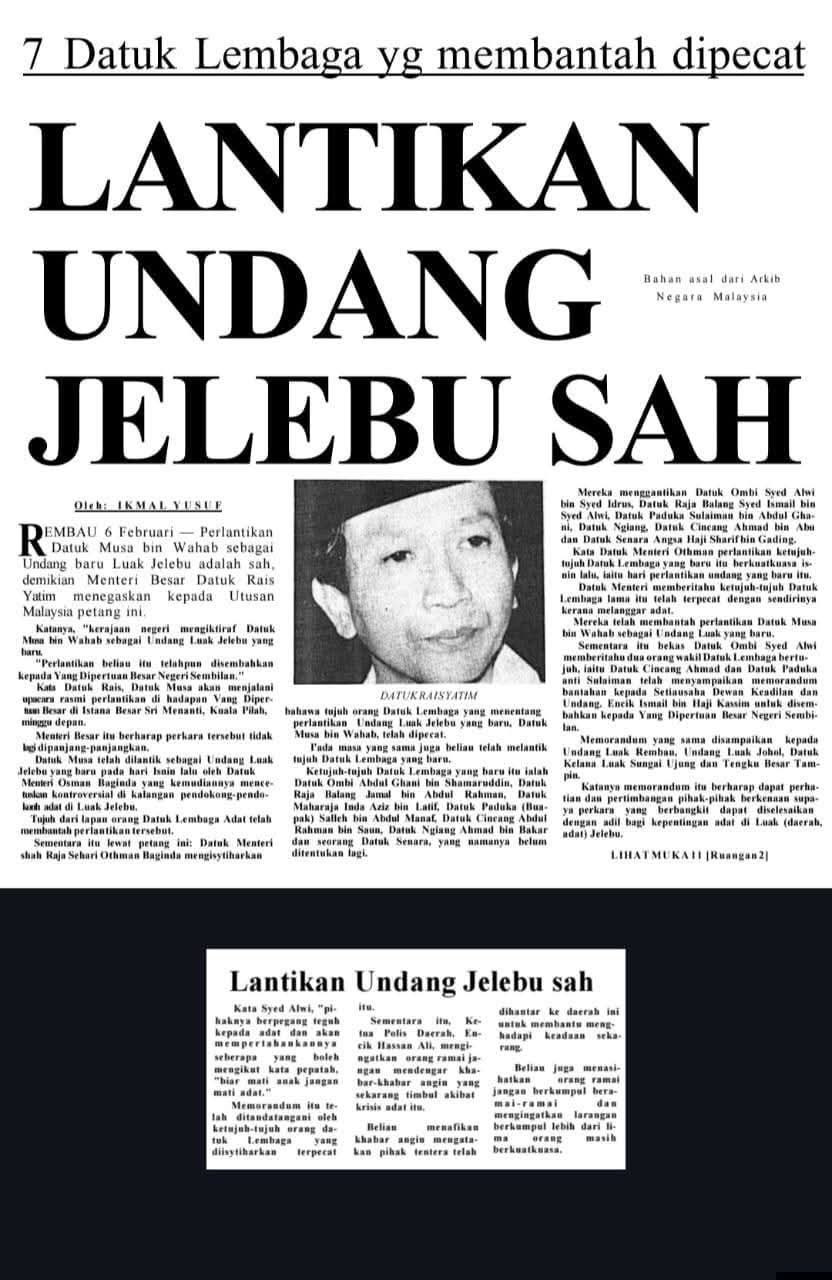
This clipping (dated 6 Feb 1980) corroborates points 3, 4 and 5 of Kamaruzaman’s post directly. Under Rais as MB, seven of the eight hereditary adat chiefs of Luak Jelebu who opposed his preferred candidate were removed and replaced. The new chiefs were sworn in the same day the appointment was confirmed valid.
In more recent events, Rais Yatim has been consistently critical of the current MB Aminuddin Harun’s handling of the crisis. He validated the Undang Yang Empat’s¹ 19 April declaration, telling Malaysiakini that the Undangs had the right to act under Article 10 of the State Constitution.
In his Keluar Sekejap interview, Rais framed the dismissal as a personal act of Tuanku rather than a council decision, precisely the kind of framing Kamaruzaman warns about in point 11 of his post: an attempt to make Tuanku Muhriz appear personally responsible for removing Mubarak, when it was in fact a luak decision.
The accusation Kamaruzaman is making, stripped of its fury, is straightforward: the man challenging the MB and implicitly questioning the Yang di-Pertuan Besar in 2026 is the same man who intervened in Jelebu’s adat affairs as MB, dismissed seven of eight chiefs who stood in his way, and had his preferred Undang confirmed valid in the 1980s.
Moving goalposts, Kamaruzaman suggests, is not a recent habit.
Read Next: Is Rais Yatim an Independent Expert, or the Undangs’ Appointed Counsel?
Footnotes:
The allegations made in the translated post are those of Kamaruzaman Kamdias and represent his personal views. This publication has not independently verified the specific constitutional amendment he references. Rais Yatim had not responded to these allegations at time of publication.
1 This publication uses the term "Undang Yang Empat" both for the centuries-old institution of the four ruling chiefs and, as shorthand, for the four individuals who signed the 19 April declaration. Mubarak Dohak ceased to hold office as Undang of Luak Sungei Ujong on 17 April 2026, his removal having occurred under the custom of the luak. The Dewan Keadilan dan Undang (DKU) acknowledged that removal as a question of Malay custom under Article 16 of the Negeri Sembilan Constitution 1959, two days before the declaration was signed. Under Article 16(3), DKU advice on such questions is final and cannot be challenged in any court.
If you are new to this Substack, and are not sure where to begin, visit our Start Here page, where we list all our articles organised by theme.
Related Posts:


Sources:
Usir Undang dari kediaman rasmi keterlaluan, kes belum selesai (Malaysiakini, 30 April 2026)
Why Negeri Sembilan is not in a constitutional crisis (Free Malaysia Today, 23 April 2026)
Undang row raises questions over MB post (The Star, 22 April 2026)
Laksana enkuiri sambung kembali tali muafakat di Negeri Sembilan (Sinar Harian, 30 April 2026)
Anak Nogori is independent commentary on the unfolding constitutional crisis in Negeri Sembilan, where centuries-old adat Perpatih, royal succession law, and modern political manoeuvring are colliding in ways Malaysia has never seen before. If you find this useful, share it with someone who should be following this, or subscribe to receive the latest articles in your inbox.
