


Updated 23 May 2026
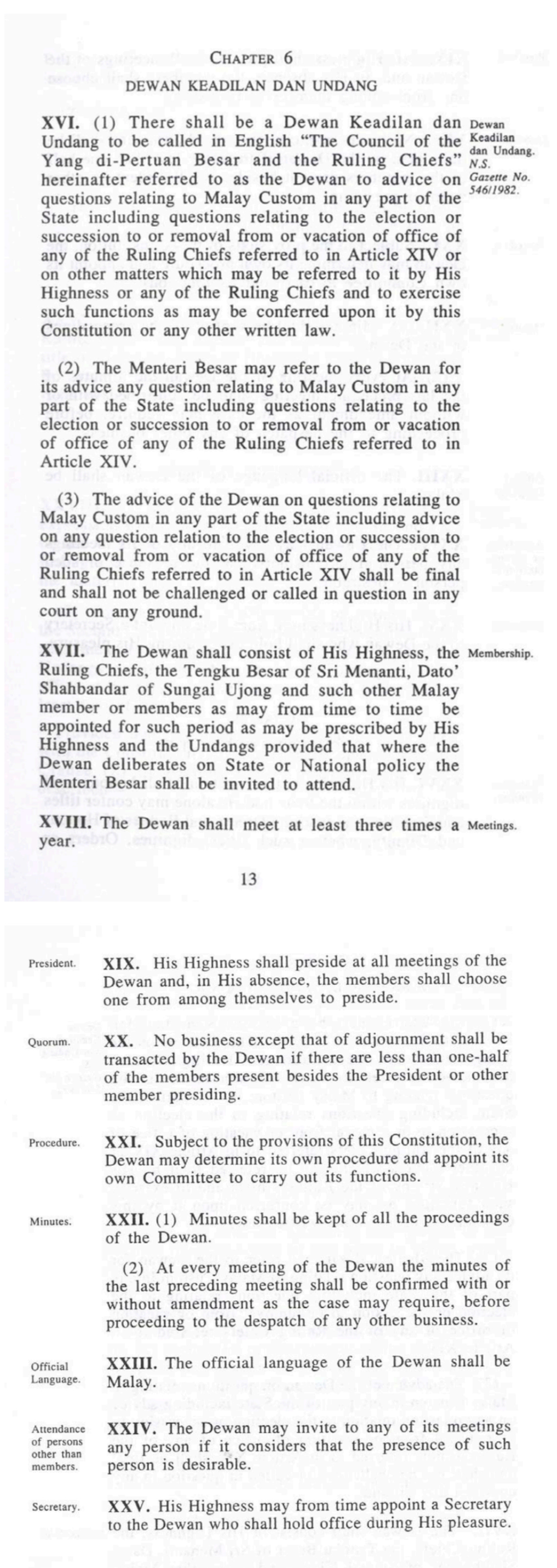
The DKU is established under Chapter 6 (Articles 16 to 25) of the Negeri Sembilan Constitution 1959. Its primary constitutional role is to advise on matters of Malay custom and tradition, including on any question relating to the election, succession, removal or vacation of office of any of the Ruling Chiefs.
(See the appendix for a full extract of Chapter 6 of the Negeri Sembilan Constitution 1959.)
Who are members of the DKU?
The membership of the DKU is set by Article 17. The current DKU consists of:
Yang di-Pertuan Besar Tuanku Muhriz (President). Article 19 provides that His Highness shall preside at all meetings of the Dewan.
The Ruling Chiefs. "Ruling Chiefs" is a defined term for the purposes of Article 17, covering the four Undangs of Sungei Ujong, Jelebu, Johol and Rembau, and the Tunku Besar of Tampin.
The Tunku Besar of Seri Menanti, named in Article 17 in his own right. The office is currently held by Tunku Ali Redhauddin ibni Tuanku Muhriz.
The Dato’ Shahbandar of Sungai Ujong, named in Article 17 in his own right.
Other Malay members may be appointed from time to time, for such period as His Highness and the Undang may prescribe.
What are the functions of the DKU?
The principal function sits in Article 16. The council advises the Yang di-Pertuan Besar on any question relating to Malay custom and tradition. In practice that advisory role concentrates on the Ruling Chiefs, covering the election, succession, removal, or vacation of office of any Undang or the Tunku Besar Tampin. The substantive customary act stays within the Luak that performs it, and the DKU is where the question is brought to be advised as a matter of adat. Under Article 16(3), the advice the council gives on such questions is final and cannot be questioned in any court on any ground.
Who sets the order of precedence among the Ruling Chiefs?
The DKU does, under Article 30. The Article sits in Chapter 8 of the First Part, among the general provisions, rather than in Chapter 6 with the rest of the DKU machinery:
The order expresses official rank. An order of precedence records constitutional seniority: where each office stands in the hierarchy of the state. That rank then governs the visible forms of state life, including processions, installations, royal audiences, and official lists. Ceremony is one of the things rank governs, so describing precedence as ceremonial gets the relationship backwards. The pattern is familiar from other systems: the British order of precedence reflects constitutional rank rather than dinner arrangements, and diplomatic precedence under the Vienna Convention recognises official status while deliberately withholding any implication of substantive authority.
Rank confers standing without command. A senior chief does not hold authority over a junior one by virtue of the order. Article 7 fixes His Highness at the head of the order in all circumstances, and every position below that is a statement of seniority rather than a grant of authority.
The power to determine the order is a genuine legal power, and it belongs to the DKU alone. The determination binds, requires confirmation from no other body, and is the single place in the Constitution where the Dewan determines a question itself rather than advising on one. That drafting choice carries weight in the current dispute. Under Article 16 the Dewan “advises”, and the substantive act happens elsewhere, in the Luak. Under Article 30 the order shall be as “determined” by the Dewan. The drafters plainly knew how to confer a determining power, and readings that treat the DKU’s role as a determining one under Article 16 have to explain why the word appears here and nowhere else.
A further implication follows from the nature of the power. An order of precedence is also a register of office-holders, since a chief must hold his office before he can be ranked in it. Any determination of precedence therefore presupposes an answer to who holds each office, and that answer would be the DKU’s own.
Who else may attend DKU meetings?
The Menteri Besar may be invited to attend under the proviso to Article 17, where the Dewan deliberates on State or National policy.
A DKU Secretary may be appointed by His Highness under Article 25. The office is currently held by Raja Norazli Raja Nordin.
Under Article 24, the Dewan may invite any other person to a meeting where it considers that person’s presence desirable.
How often does DKU meet?
Article 18 specifies that the DKU must meet at least three times a year.
Is there a quorum for DKU meetings?
Article 20 states that there needs to be at least one-half of the members present besides the President or other member presiding.
Are there minutes for DKU meetings?
Article 22(1) specifies that minutes of meetings shall be kept and Article 22(2) specifies that minutes of the last meeting will be confirmed at the next meeting of the DKU.
Where does adat meet the written constitution?
The DKU is the single point in Negeri Sembilan’s constitutional architecture where adat and written law meet. Every other institution in the state sits on one side or the other. The Lembaga of each Luak, the Telaga Undang, the Buapak, the Ibu Soko, and the Waris are pure adat institutions. The Dewan Undangan Negeri, the Executive Council, and the High Court are of the written Constitution.
The DKU is the only body that sits on both sides at once. That hybridity is by design. The Negeri Sembilan Constitution 1959 is structured in two parts.
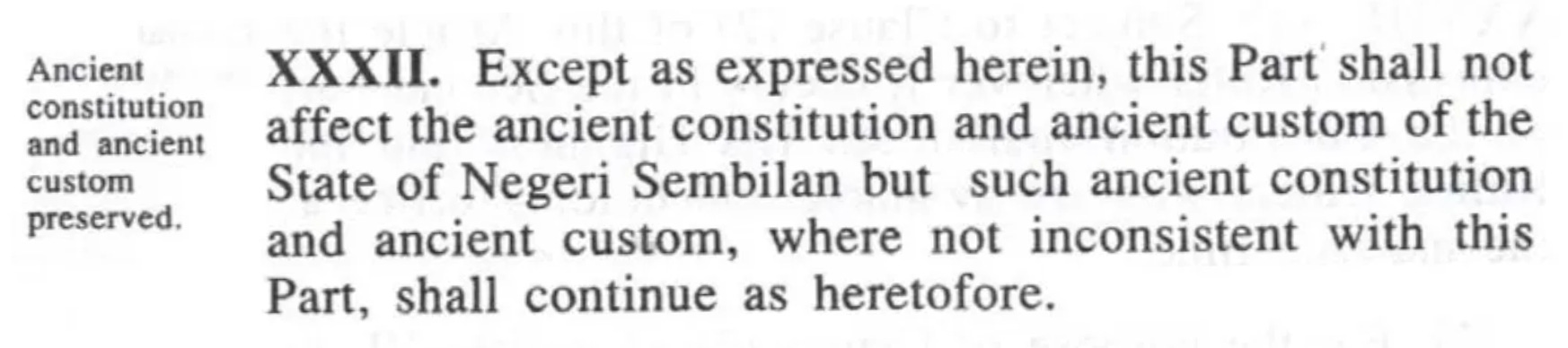
The First Part is titled “Ancient constitution and ancient custom preserved” and covers the Yang di-Pertuan Besar, the Ruling Chiefs, the DKU, and the rules of succession.
The Second Part is “The Machinery of Government” and covers the Executive, the Legislature, and the modern apparatus of state. The DKU lives in the First Part, alongside the adat institutions it gives constitutional effect to, and it ends with Article 32.
Article 32 is the provision that protects adat legally, preserving the ancient constitution and ancient custom of the state. This, however, is subject to one qualifier: when adat and the written First Part disagree, the written First Part takes precedence in a court of law.
What is the DKU’s role in the removal of an Undang?
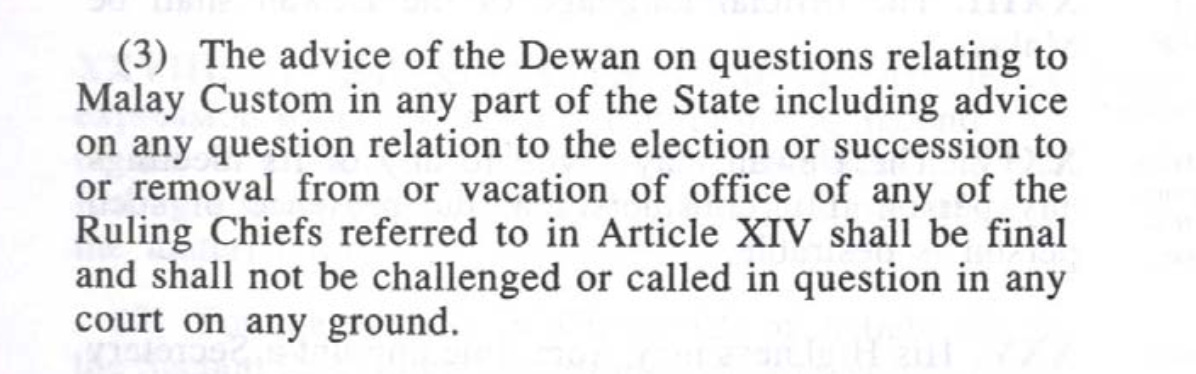
The DKU’s role is set by Article 16, which empowers the Dewan to advise on any question of Malay custom, including the election, succession, removal or vacation of office of any Ruling Chief (including the Undangs). That role is purely advisory. The Dewan advises; it does not decide.
The removal of a Ruling Chief is a customary act of the Luak. An Undang is elected under the custom of his Luak, and he is removed the same way, by the adat institutions of that Luak, the Ibu Soko and the Lembaga, acting according to Luak custom. The matter then reaches the DKU, which advises on the customary question. The Luak is where a Ruling Chief is removed, and the Dewan is where that removal is acknowledged.
Article 16(3) sets out what follows. The advice of the Dewan on such questions is final, and cannot be challenged or called in question in any court on any ground. Once the customary process within the Luak has run and the DKU has given its advice, that advice stands beyond the reach of any court. Article 71 of the Federal Constitution reinforces this position, directing that disputes concerning a state's constitution be resolved according to that state's own constitution, which makes the Negeri Sembilan Constitution 1959 the operative document.
What happened at the 17 April DKU meeting?
The DKU held a special sitting on 17 April 2026, chaired by the Yang di-Pertuan Besar. The sitting was presented with 33 grounds relating to pesaka and adat for Mubarak’s removal as Undang of Sungei Ujong. Following the sitting, the DKU acknowledged the removal of Mubarak as holder of the Dato’ Klana Petra title, carried out under the custom of the Luak (Sinar Harian, 17 April 2026).
The Yang di-Pertuan Besar invoked Article 24 to invite the Ibu Soko Klana Hulu and the Waris Klana Hulu of Luak Sungei Ujong to take part. Some online commentators have suggested the Ibu Soko Klana Hulu and Waris Klana Hulu were invited to make up the quorum, a reading that does not hold, because Article 20 fixes the quorum by reference to members, and an Article 24 invitee is not a member, so their presence has no bearing on the quorum count.
Does the DKU need to make a unanimous decision?
Some online commentators have demanded the release of the 17 April minutes to see if the DKU “decision” was unanimous. This framing is inaccurate, because the DKU does not vote on this. Under adat, the removal is decided within the Luak by the Ibu Soko and the Lembaga, and brought to the DKU for acknowledgement under Article 16. Unanimity is not a constitutional condition because there is no decision or vote in the DKU to be unanimous about.
Has the DKU ever lost a challenge in court?
In an opinion piece, Edy Noor Reduan, Deputy Head of Information for PKR Negeri Sembilan, writing in Free Malaysia Today, argued that the DKU has been challenged in court five times between 1984 and 2018, at every level of the Malaysian judiciary. According to that piece, the cases span the Federal Court (1984), the Court of Appeal (1998), and the High Court (2005, 2012, and 2018) (Free Malaysia Today, 2 May 2026).
Two of those five cases were themselves disputes over the legitimacy of the Undang of Sungei Ujong, and both were resolved in Mubarak Dohak’s favour on the basis of DKU confirmation. In Syed Abu Bakar Syed Hassan v Zainal Ariffin Ibrahim [2005] 7 CLJ 457, and again in YTM Datuk Othman Ismail v Dato’ Mubarak Dohak [2012] 1 LNS 1378, Mubarak’s own position as Undang was challenged, and in both the courts declined to override the DKU’s authority (Malay Mail, 18 May 2026).
A sixth challenge followed in 2024. On 20 September 2024, the Seremban High Court struck out a writ of summons filed by the Buapak of Kampung Tanjong against the chair of the selection committee for the 22nd Undang Luak Rembau, over the contested selection of the new Undang. The Judicial Commissioner found that the court did not have jurisdiction over adat and customary ceremonies in Negeri Sembilan, and the defendant’s counsel said the matter should be returned to the DKU.
The DKU’s authority has been challenged in court before. Every challenge failed.
Will Mubarak and the Undangs succeed in challenging the DKU?
Mubarak has continued to act as Undang of Sungei Ujong, issuing statements through the Undang's office and disputing the validity of his removal (Malaysiakini, 22 April 2026).
On 5 May, Mubarak and the three Undangs filed the latest in a long line of attempts to challenge DKU authority in court. They filed an originating summons at the Seremban High Court seeking an interim stay of the 17 April DKU acknowledgement and an order compelling release of the sitting’s minutes. On 13 May, Justice Roz Mawar Rozain declined the application for an interim stay, citing insufficient evidence, with liberty to refile.
There is an irony to this dispute. Twice before, challengers tried to use the courts to unseat Mubarak as Undang, and twice the courts held that the DKU's authority over the question was final and declined to intervene. He now asks a court to treat that same authority differently, this time to undo his own removal. The shield he raised in 2005 and 2012 has become the sword.
Read Next: What Happened at the Seremban High Court Sitting on 13 May
Appendix
The following is reproduced from Chapter 6 of the Negeri Sembilan Constitution 1959, as published by the Negeri Sembilan state government.

If you are new to this Substack, and are not sure where to begin, visit our Start Here page, where we list all our articles organised by theme.
Related Posts:


Sources:
Mahkamah batal writ saman terhadap Datuk Perba (Sinar Harian), 20 September 2024
Luak Sungei Ujong dinasihat terima pemberhentian Mubarak (Sinar Harian), 17 April 2026
Can Negeri Sembilan’s Ruler Actually Be ‘Fired’? (The Rakyat Post, 20 April 2026)
Why Negeri Sembilan is not in a constitutional crisis (Free Malaysia Today, 23 April 2026)
Mengapa N Sembilan tak berada dalam krisis perlembagaan (Free Malaysia Today, 26 April 2026)
‘Bincang anak beranak’, pembesar N Sembilan bertemu petang tadi (Free Malaysia Today, 29 April 2026)
What games afoot regarding Negeri Sembilan? Christopher Leong (Malay Mail, 18 May 2026)
Anak Nogori is independent commentary on the unfolding constitutional crisis in Negeri Sembilan, where centuries-old Adat Perpatih, royal succession law, and modern political manoeuvring are colliding in ways Malaysia has never seen before. If you find this useful, share it with someone who should be following this, or subscribe to receive the latest articles in your inbox.
