


What was the 13 May sitting about?
On 17 April 2026, the Dewan Keadilan dan Undang (DKU) sat and acknowledged the removal of Mubarak Dohak as Undang of Luak Sungei Ujong.
On 5 May, Mubarak, the three sitting Undangs, the Tunku Besar Tampin and the Syahbandar of Sungei Ujong filed an originating summons at the Seremban High Court for an interim stay (a temporary halt) of that DKU decision (Free Malaysia Today, 5 May 2026).
What is Article 16?
Article 16 of the Negeri Sembilan Constitution 1959 governs the constitutional role of the DKU in matters concerning the Undang.
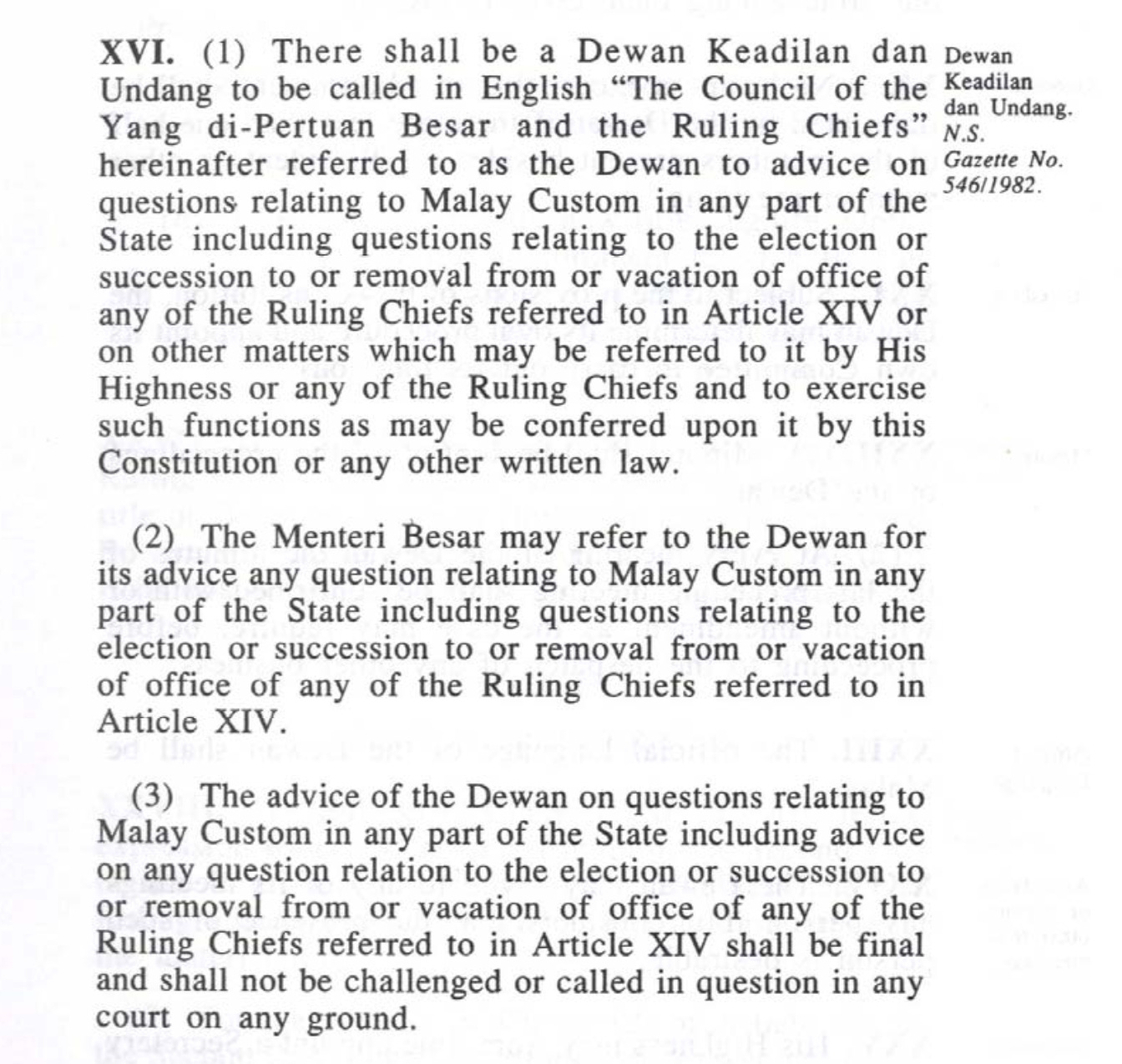
Article 16(3) is the provision at the heart of this case. It states that the acknowledgement of the DKU on the election, succession, removal or vacation of any Undang is final and cannot be challenged in any court on any ground.
What happened yesterday
Yesterday’s session was a return date on the originating summons (a procedural first appearance, not a full trial). The case came before Justice Roz Mawar Rozain.
The Plaintiffs
Mubarak Dohak (the previous Undang of Sungei Ujong)
Maarof Mat Rashad (Undang of Jelebu)
Muhammed Abdullah (Undang of Johol)
Abdul Rahim Yasin (Undang of Rembau)
Tunku Syed Razman Syed Idrus Al Qadri (Tunku Besar Tampin)
Badarudin Abdul Khalid (Dato’ Shahbandar of Sungei Ujong)
The Defendants
The Dewan Keadilan dan Undang
Raja Norazli Raja Nordin (DKU Secretary)
The Negeri Sembilan state government
The Plaintiffs asked the court to do two things: order the DKU to release the minutes of the 17 April sitting, and grant an interim stay of the 17 April DKU decision to remove Mubarak. A court-ordered pause would mean that the removal, and everything flowing from it (staff reassignment, eviction from the official residence and announcement of a new Undang), would be suspended while the case proceeds.
Three things happened yesterday, and all three favoured the Defendants.
First, the interim stay was refused. The judge declined to pause the 17 April DKU decision, on the basis that there was insufficient evidence supporting the application, with liberty to refile. The practical effect is clean: the 17 April decision continues to operate with full legal force and nothing about Mubarak’s removal is suspended.
Second, the Defendants signalled they will challenge the court’s authority to hear the case at all. Senior counsel Steven Thiru, appearing for the DKU and its Secretary, invoked Article 16(3) and submitted that the court has no jurisdiction over DKU acknowledgements on the removal of any Undang, effectively, an ouster clause (Free Malaysia Today, 13 May 2026).
The judge directed the Defendants to file that objection formally (with supporting affidavits) within seven days, with a hearing scheduled for 28 July 2026.
Third, the state government took a separate procedural objection. The state government argued that only DKU members are entitled to copies of DKU minutes, and that the preparation and release of those minutes is not within the state government’s jurisdiction in any event. That is a different argument from the constitutional ouster, and it means the Plaintiffs now have to win on two fronts to keep the case alive.
Who is Steven Thiru, and why does it matter
Steven Thiru is one of Malaysia’s most senior constitutional litigators. A former President of the Malaysian Bar (2015 to 2017), he has argued some of the most significant constitutional cases of the last decade, including landmark matters at the Federal Court on judicial independence and fundamental liberties.
His instruction by the DKU signals two things. The Defendants are taking the 28 July hearing seriously enough to instruct counsel of his calibre. And they are positioning the case to be decided on the strongest possible reading of Article 16(3), with the aim of establishing a precedent that DKU decisions are not reviewable by the courts at all.
What 28 July actually decides
The 28 July hearing will not decide if the 17 April DKU acknowledgement was valid, that is, whether Mubarak was constitutionally removed.
It will decide one prior question: does the court have the power to hear this case at all?
What this means
A judge who thought the Plaintiffs had a strong case on Article 16(3) would likely have left some room for at least a narrow stay. Refusing all interim relief, and putting the question of whether it can hear the case at all first in line, signals a court taking the ouster clause seriously.
And the longer the case proceeds without a stay, the more time the state government has to complete the removal of Mubarak from his official residence and complete the transition of staff and assets, and the more time the adat structure of Luak Sungei Ujong has to resolve its internal succession dispute and consolidate the recognition of the new Undang.
Every week that passes without a stay strengthens the practical and constitutional argument that Mubarak’s removal has already taken effect and should not be judicially unwound.
At the 13 May Seremban Court sitting, on every contested point, the hearing went overwhelmingly in favour of the Defendants.
Read next: The DKU Secretary Has Not Been Suspended. So Why Is the Press Reporting That He Has?
If you are new to this Substack and are not sure where to begin, visit our Start Here page, where we list all our articles organised by theme.
Related Posts:


Sources:
Anak Nogori is independent commentary on the unfolding constitutional crisis in Negeri Sembilan, where centuries-old Adat Perpatih, royal succession law and modern political manoeuvring are colliding in ways Malaysia has never seen before. If you find this useful, share it with someone who should be following this, or subscribe to receive the latest articles in your inbox.
