


What each clause means
Article 26: The Ruler as sole source of titles, dignities, Orders and Badges
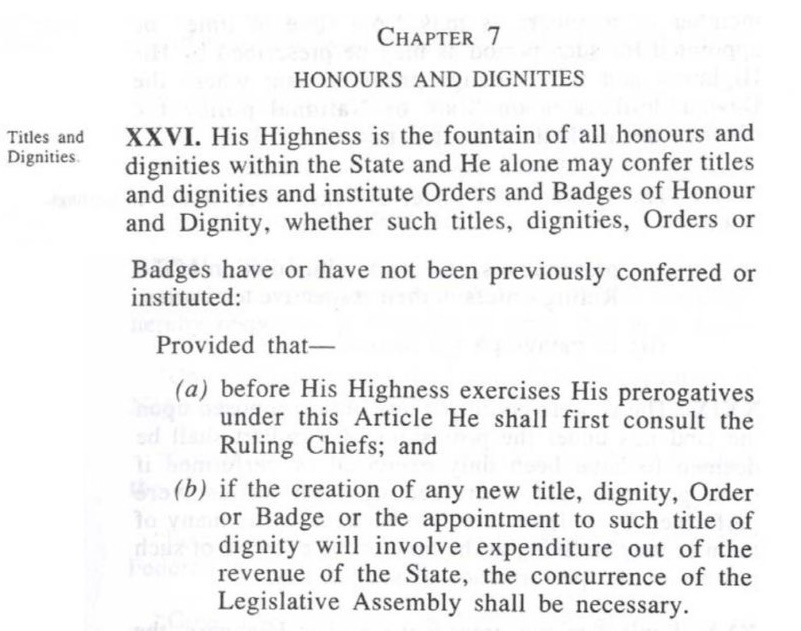
His Highness is the fountain of all honours and dignities within the State and He alone may confer titles and dignities and institute Orders and Badges of Honour and Dignity, whether such titles, dignities, Orders or Badges have or have not been previously conferred or instituted:
Article 26 sits in Chapter 7 of the First Part of the Constitution, under the heading Honours and Dignities. The clause names the Yang di-Pertuan Besar as the fountain of all honours within the State. In practice this means He alone may confer a title or dignity, and He alone may institute an Order or Badge of Honour, whether the title, Order or Badge already exists or is being created for the first time. No other body, and no other office-holder, shares this power.
Article 26(a): The requirement to consult the Ruling Chiefs first
Provided that:
(a) before His Highness exercises His prerogatives under this Article He shall first consult the Ruling Chiefs; and
Before exercising this power, the Yang di-Pertuan Besar must first consult the Ruling Chiefs. The clause requires consultation, but it does not require the agreement or consent of the Ruling Chiefs. It does not give the Ruling Chiefs a veto over the conferral of a title, and it does not specify what form the consultation must take, how long it must last, or what happens if a Ruling Chief disagrees with the outcome.
Article 26(b): Legislative Assembly concurrence where a new honour incurs expenditure
(b) if the creation of any new title, dignity, Order or Badge or the appointment to such title of dignity will involve expenditure out of the revenue of the State, the concurrence of the Legislative Assembly shall be necessary.
A second condition applies only where the creation of a new title, dignity, Order or Badge, or an appointment to one, will involve spending State revenue. In that situation, the concurrence of the Legislative Assembly is required. Titles or appointments that involve no expenditure fall outside this requirement.
What Article 26 does not say
Article 26 therefore performs two distinct functions. First, it identifies the Yang di-Pertuan Besar as the sole constitutional source of State honours. Secondly, it imposes procedural conditions before that power is exercised: consultation with the Ruling Chiefs, and Legislative Assembly concurrence only where the creation of a new honour or appointment to it would involve State expenditure.
Article 26 does not define what counts as a "title" or a "dignity": and it does not distinguish between titles created afresh and hereditary titles that already exist within a royal household.
This gap has surfaced disagreement in recent events. In June 2026, lawyers disagreed publicly on whether the conferral of the Tunku Panglima Besar title on Tunku Zain Al-'Abidin required prior consultation with the Ruling Chiefs under Article 26. Lawyer Khairul Azam, acting for the Undang of Jelebu, argued that it did. Khairul further argued that the alleged failure to consult could be challenged in court, or referred to the Dewan Keadilan dan Undang (DKU) (Malaysiakini, 12 June 2026).
Whether a consultation dispute under Article 26 falls within the DKU's jurisdiction is less clear when Article 16 is read on its own terms.
Article 16(1) defines the council as the relevant body to advise on questions relating to Malay Custom, including the election, succession, removal or vacation of office of a Ruling Chief. Other titles are not expressly mentioned in this clause, and reach the DKU only if the Yang di-Pertuan Besar or a Ruling Chief chooses to refer them.
Article 26 likewise does not identify any court or tribunal to determine disputes concerning a conferral, nor does it prescribe any procedure for challenging one.
Constitutional law academic Professor Emeritus Datuk Noor Aziah Mohd Awal took the opposing view, that a hereditary royal household appointment sits outside Article 26's scope altogether (Astro Awani, 13 June 2026).
This publication is of the view that the Putera Yang Empat (Four Princes) are hereditary palace titles associated with the royal household rather than constitutional honours created under Article 26. Historically they have been conferred by the Yang di-Pertuan Besar during a customary istiadat at the Balairong Seri, without any publicly documented practice of consultation under Article 26(a). On that reading, appointments within the Putera Yang Empat fall outside Article 26 altogether.
The Article is also silent on what follows if consultation under paragraph (a) does not happen, or happens imperfectly. The Article does not name any process or forum for resolving the question. This stands in stark contrast to Article 16(3), which makes the Dewan Keadilan dan Undang (DKU)’s advice on questions of Malay custom, including the removal of a Ruling Chief, final and immune from challenge in any court. Article 26 carries no equivalent provision.
Paragraph (b) does not define “expenditure out of the revenue of the State”, leaving open whether specific expenditures, such as ceremonial costs, stipends or pensions associated with a new honour, would require the concurrence of the Legislative Assembly.
Article 26 does not specify how a title is removed. It is confined to the conferral and creation of honours. The power to remove a title appears in Article 27 which deals with forfeiture where the holder has committed a grave offence.
The Adat saying goes: malu tak boleh diagih, suku tak boleh dianjak; dianjak layu, dicabut mati (honour cannot be parcelled out, lineage cannot be uprooted; uprooted, it withers, pulled out, it dies).
Article 26 identifies the constitutional source of honours in Negeri Sembilan. It answers who may confer titles, dignities, Orders and Badges of Honour. It does not attempt to resolve every question about what falls within those categories, leaving room for disputes about the boundary between constitutional honours and customary hereditary titles.
Footnote: The Constitution numbers its Articles in Roman numerals. This publication uses Arabic numerals for readability.
Our posts referencing Article 26:
Anak Nogori Weekly Round-Up (8–14 June 2026) — Reports the legal disagreement between Khairul Azam and Professor Emeritus Datuk Noor Aziah Mohd Awal over whether Article 26 consultation applied to the Tunku Panglima Besar conferral.
Sources:
Anak Nogori is independent commentary on the unfolding constitutional crisis in Negeri Sembilan, where centuries-old Adat Perpatih, royal succession law, and modern political manoeuvring are colliding in ways Malaysia has never seen before. If you find this useful, share it with someone who should be following this, or subscribe to receive the latest articles in your inbox.
