


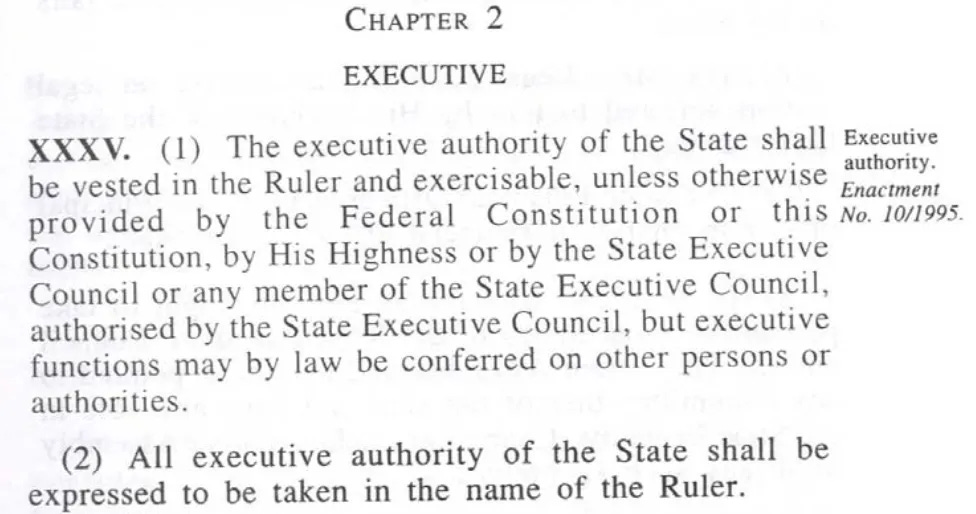
Article 35 opens Chapter 2 of the Second Part of the Negeri Sembilan Constitution 1959, the chapter dealing with the Executive.
Article 28 gives “Ruler” a special meaning for the Second Part of the Constitution. Subject to the exception in Article 28(2), it means His Highness together with the Ruling Chiefs who are available and holding office at the material time. Under Article 34, “His Highness” means the person lawfully holding office as Yang di-Pertuan Besar. Ruling Chiefs are defined as the four Undangs of Sungai Ujong, Jelebu, Johol and Rembau together with the Tunku Besar Tampin.
What each clause means
Article 35(1): The executive authority of the state, and the persons and bodies that may exercise it
(1) The executive authority of the State shall be vested in the Ruler and exercisable, unless otherwise provided by the Federal Constitution or this Constitution, by His Highness or by the State Executive Council or any member of the State Executive Council, authorised by the State Executive Council, but executive functions may by law be conferred on other persons or authorities.
Article 35(1) does two separate jobs:
“Vested in the Ruler” tells you where the State’s executive authority legally resides. Under Article 28, “Ruler” means the Yang di-Pertuan Besar together with the relevant Ruling Chiefs.
“Exercisable by…” tells you who can actually carry out that executive authority. Article 35 says it can be exercised by the Yang di-Pertuan Besar, the State Executive Council, or an authorised member of the Council.
In practical terms, this means that while executive authority belongs constitutionally to the “Ruler”, it may be exercised by the Yang di-Pertuan Besar and the State Executive Council.
The Ruling Chiefs do not have to participate every time the State government makes an executive decision.
Article 35(2): The name in which all executive authority is expressed
(2) All executive authority of the State shall be expressed to be taken in the name of the Ruler.
Article 35(2) deals with the formal source of executive acts. Even where executive authority is exercised by the State Executive Council under Article 35(1), the resulting act is expressed as being taken “in the name of the Ruler”.
The distinction is therefore straightforward: Article 35(1) says who holds executive authority and who may exercise it. Article 35(2) says in whose name that authority is formally expressed.
The Constitution numbers its Articles in Roman numerals. This publication uses Arabic numerals for readability.
Sources:
Anak Nogori is independent commentary on the unfolding constitutional crisis in Negeri Sembilan, where centuries-old Adat Perpatih, royal succession law, and modern political manoeuvring are colliding in ways Malaysia has never seen before. If you find this useful, share it with someone who should be following this, or subscribe to receive the latest articles in your inbox.
