


(Updated 2 August 2026)
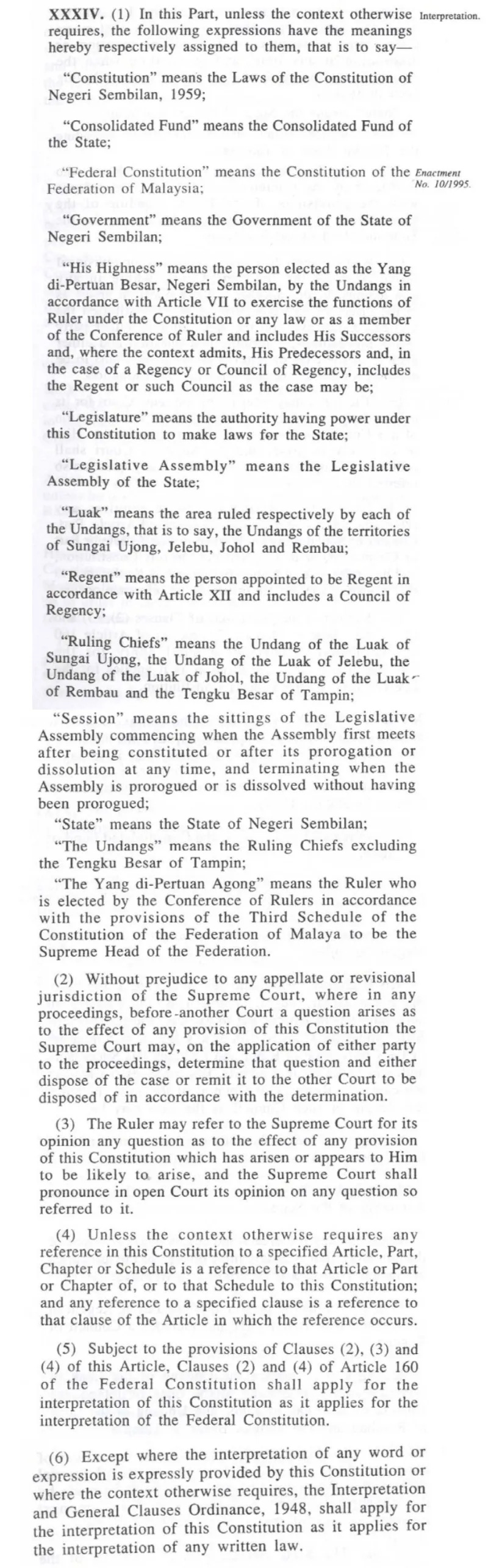
Article 34 is the interpretation clause of the Negeri Sembilan Constitution 1959.
In practical terms, an interpretation clause is the Constitution’s dictionary: it tells the reader what particular words mean when they appear in this Part.
That sounds technical, but some of the definitions are important to establish. In particular, Article 34 draws precise distinctions between the Yang di-Pertuan Besar, the Ruling Chiefs, and the Undangs. The Constitution deliberately assigns each of them a different meaning.
Clause 34(1) is definitional, and clauses 34(2) to 34(6) deal with interpretation mechanics.
What each clause means
Article 34(1): The defined expressions, including His Highness, the Undangs, the Ruling Chiefs and the Luak
Article 34(1) begins:
In this Part, unless the context otherwise requires, the following expressions have the meanings hereby respectively assigned to them...
It then defines a series of terms used throughout the Second Part of the Constitution. Most are straightforward. Three definitions are particularly useful in understanding the constitutional structure.
The Yang di-Pertuan Besar
“His Highness” means the person elected as the Yang di-Pertuan Besar, Negeri Sembilan, by the Undangs in accordance with Article 7 to exercise the functions of Ruler under the Constitution or any law or as a member of the Conference of Ruler and includes His Successors and, where the context admits, His Predecessors and, in the case of a Regency or Council of Regency, includes the Regent or such Council as the case may be;”
There are two important points here.
First, “His Highness” means the Yang di-Pertuan Besar only. It does not include the Undangs or the Ruling Chiefs.
Second, the definition expressly describes him as the person “elected ... by the Undangs in accordance with Article 7”, which governs election to the office. Whether someone has validly become Yang di-Pertuan Besar must be determined under the operative provisions of Article 7 governing election, eligibility and death.
The Ruling Chiefs
“Ruling Chiefs” means the Undang of the Luak of Sungai Ujong, the Undang of the Luak of Jelebu, the Undang of the Luak of Johol, the Undang of the Luak of Rembau and the Tengku Besar of Tampin;”
There are therefore five Ruling Chiefs for the purposes of this definition:
Undang of Sungai Ujong
Undang of Jelebu
Undang of Johol
Undang of Rembau
Tengku Besar of Tampin
The definition is applied in the Constitution in Article 17 which lists the membership of the Dewan Keadilan dan Undang (DKU), where it names the Ruling Chiefs as a bloc comprising of these five. The Tunku Besar Seri Menanti and the Dato’ Shahbandar of Sungei Ujong sit in the DKU under their own names in Article 17, standing outside the defined category of Ruling Chiefs.
The Undangs
“The Undangs” means the Ruling Chiefs excluding the Tengku Besar of Tampin;”
“The Undangs” are the four territorial chiefs: the Undang of the Luak of Sungei Ujong, Jelebu, Johol and Rembau. These four have the power to elect the Yang di-Pertuan Besar under Article 7.
Although every Undang is a Ruling Chief, not every Ruling Chief is an Undang.
One drafting feature is worth marking for the debate over the Undangs’ status. Clause 34(1) treats “His Highness” and “Ruling Chiefs” as separate defined terms. The compendium term “Ruler”, which gathers them for certain purposes, is defined in Article 28 rather than here, and for federal purposes in Article 160(2) of the Federal Constitution.
Within Article 34, the Yang di-Pertuan Besar and the Ruling Chiefs remain distinct categories.
What are Articles 34(2) to 34(6)?
The remaining clauses are principally rules about how constitutional questions are interpreted and referred to the courts. Clauses 34(2) and 34(3) provide two ways for a constitutional question to reach the apex court, named in the 1959 text as the Supreme Court and exercised today by the Federal Court.
Article 34(2)
(2) Without prejudice to any appellate or revisional jurisdiction of the Supreme Court, where in any proceedings, before another Court a question arises as to the effect of any provision of this Constitution the Supreme Court may, on the application of either party to the proceedings, determine that question and either dispose of the case or remit it to the other Court to be disposed of in accordance with the determination.
This clause provides that where a question arises in court about the effect of a provision of the Negeri Sembilan Constitution, the apex court may, on the application of either party, determine the constitutional question itself or send the case back to the original court to be decided consistently with that determination.
The printed text uses the historical expression “Supreme Court”. Malaysia’s apex court is now the Federal Court.
Article 34(3)
(3) The Ruler may refer to the Supreme Court for its opinion any question as to the effect of any provision of this Constitution which has arisen or appears to Him to be likely to arise, and the Supreme Court shall pronounce in open Court its opinion on any question so referred to it.
This clause provides a separate mechanism under which the Ruler may refer a question concerning the effect of a constitutional provision to the Federal court for its opinion. This is different from ordinary litigation between parties. It creates a constitutional reference procedure initiated by the Ruler.
“Ruler” in this case takes its definition from Article 28(1) that is His Highness and the Ruling Chiefs, not His Highness on his own.
Article 34(4)
(4) Unless the context otherwise requires any reference in this Constitution to a specified Article, Part, Chapter or Schedule is a reference to that Article or Part or Chapter of, or to that Schedule to this Constitution; and any reference to a specified clause is a reference to that clause of the Article in which the reference occurs.
This is essentially a drafting rule. It says that when the Constitution mentions an Article, Part, Chapter, or Schedule, it is talking about the Negeri Sembilan Constitution itself, unless it clearly says otherwise.
Article 34(5)
(5) Subject to the provisions of Clauses (2), (3) and (4) of this Article, Clauses (2) and (4) of Article 160 of the Federal Constitution shall apply for the interpretation of this Constitution as it applies for the interpretation of the Federal Constitution.
This clause imports parts of Article 160 of the Federal Constitution into the interpretation of the Negeri Sembilan Constitution, subject to the preceding clauses.
Article 34(6)
(6) Except where the interpretation of any word or expression is expressly provided by this Constitution or where the context otherwise requires, the Interpretation and General Clauses Ordinance, 1948, shall apply for the interpretation of this Constitution as it applies for the interpretation of any written law.
This clause then provides a general fallback rule: where the Negeri Sembilan Constitution has not itself defined a word or expression and the context does not require a different meaning, the Interpretation and General Clauses Ordinance 1948 applies.
Taken together, these provisions establish the interpretive machinery for the Second Part.
What Article 34 does not say
Article 34 defines constitutional terminology. It does not confer all the powers associated with those terms.
In particular, Article 34 does not determine:
whether an Undang has been lawfully elected or removed (Article 14 and Article 16, read with the custom of the relevant Luak);
whether someone claiming to act as an Undang was validly holding that office at a particular date (Article 14, read with Article 16 where the DKU has advised on the question);
whether the Yang di-Pertuan Besar has been lawfully suspended or removed (Article 10);
whether a vacancy in the office of Yang di-Pertuan Besar existed (Articles 9, 10(1)(b) and 10A(2));
whether a subsequent election of a Yang di-Pertuan Besar was valid (Article 7 and Article 11);
what procedure the Undangs must follow when exercising their Article 10 powers;
whether a question concerning Adat is justiciable in court (Article 16(3) and Article 32);
whether the finality provision in Article 16(3) prevents judicial review of a particular question.
Those questions have to be answered under the specific Articles dealing with those powers and processes. Article 34 supplies the vocabulary. It does not confer the power.
Why this matters in 2026
Article 34 matters because much of the current dispute turns on who was constitutionally entitled to act, and in what capacity.
To exercise a power reserved to “the Undangs”, the persons acting must first fall within the constitutional meaning of that term. Who the lawful Undangs are must be taken into account when calculating whether the Undangs validly exercise a constitutional power.
Likewise, Article 34 defines “His Highness” by reference to a person elected Yang di-Pertuan Besar “in accordance with Article 7”. Merely proclaiming or describing someone as the 12th Yang di-Pertuan Besar does not answer the prior constitutional questions: was the existing Yang di-Pertuan Besar lawfully removed or had the office otherwise become vacant, and was his successor then elected according to the Constitution?
That is why Article 34, despite looking like one of the driest provisions in the Constitution, is useful in 2026. Before asking whether a constitutional power was properly exercised, one has to identify which constitutional office held that power and who lawfully occupied that office at the relevant time.
Our posts referencing Article 34:
Sources:
If you are new to this Substack, and are not sure where to begin, visit our Start Here page, where we list all our articles organised by theme.
Anak Nogori is independent commentary on the unfolding constitutional crisis in Negeri Sembilan, where centuries-old Adat Perpatih, royal succession law, and modern political manoeuvring are colliding in ways Malaysia has never seen before. If you find this useful, share it with someone who should be following this, or subscribe to receive the latest articles in your inbox.
