


(Updated 14 June 2026)
An annotated law review paper of the Negeri Sembilan Constitution 1959 has been circulating, built around a single proposition: that His Highness deliberately disregarded the Constitution, and that the Undangs were therefore entitled to remove him.
The central weakness in the paper is that it assumes the most important point in the entire dispute: that former Undang Mubarak Dohak remained a lawful Undang, and that Tuanku Muhriz was validly removed on 19 April 2026. Everything that follows depends on both being true.
The question worth asking is whether the Constitution, the facts and the procedures support them.
Were the requirements of Article 10 for removing the Yang di-Pertuan Besar shown to be met?
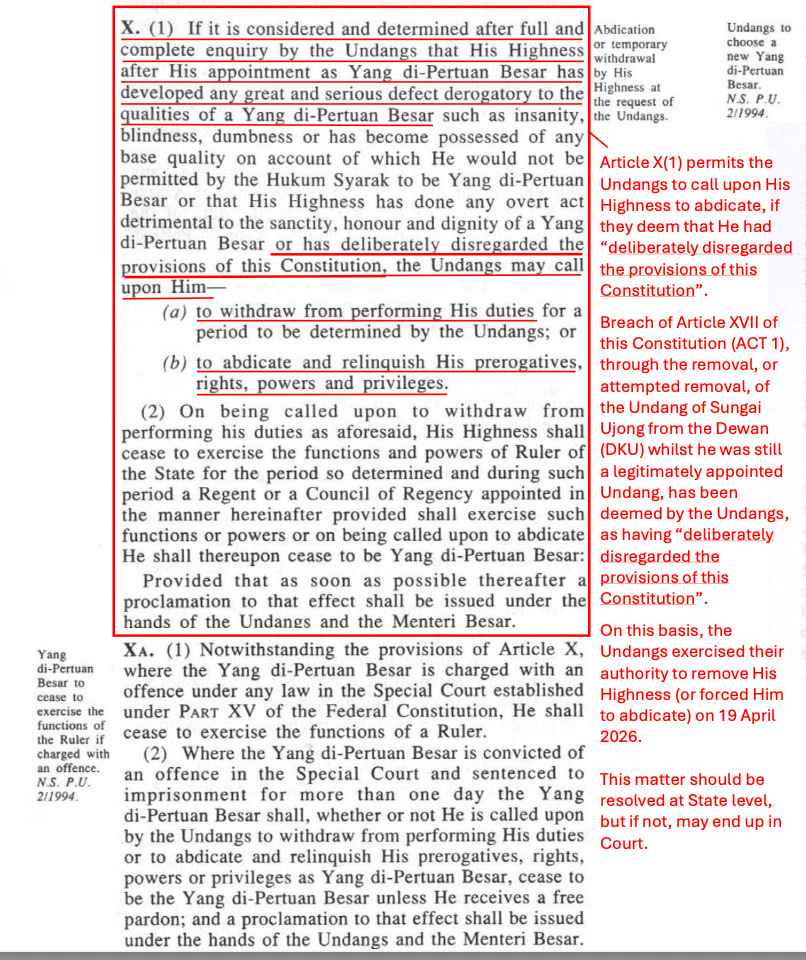
The red text states:
“On this basis, the Undangs exercised their authority to remove His Highness (or forced Him to abdicate) on 19 April 2026.”
Article 10 allows the Undangs to call upon the Yang di-Pertuan Besar to withdraw from his duties or to abdicate, and it allows this only after a “full and complete enquiry” has considered and determined that one of the grounds the Article specifies exists, among them a deliberate disregard of the Constitution. It is a power to call upon him, and it arises only once an established finding has been reached within a defined process.
The red commentary quietly skips several crucial questions:
Was there a full and complete enquiry?
Who conducted it?
What procedure was followed?
Was the finding formally made?
Was a proclamation issued in accordance with Article 10?
The paper treats an allegation as a constitutional fact. Article 10 permits removal only where the specified process has been followed and a defined ground established, so a belief among the Undangs that a breach has occurred falls short of the test on its own. On the material presented, the paper leaves those requirements unestablished, and its later arguments therefore rest on a proposition that remains contested.
A former Court of Appeal judge, Datuk Seri Mohd Hishamudin Mohd Yunus, has likewise observed that the absence of a full and complete enquiry and of a valid proclamation would each be sufficient to render the 19 April declaration invalid, independent of Mubarak’s status (Malay Mail, 5 May 2026).
Subsequent events point the same way. In the period that followed, the office continued to be treated as occupied, Tuanku Muhriz remained recognised as the Yang di-Pertuan Besar by the state government and by Putrajaya, and the machinery of Article 11, which governs a vacancy, was left untouched.
When a rival proclamation was later staged at a hotel in Alor Gajah, the federal government reaffirmed its recognition of Tuanku Muhriz (Malay Mail, 5 June 2026), and the palace described that proclamation as carrying no constitutional effect (FMT, 9 June 2026).
Did Mubarak remain the lawful Undang of Sungei Ujong?
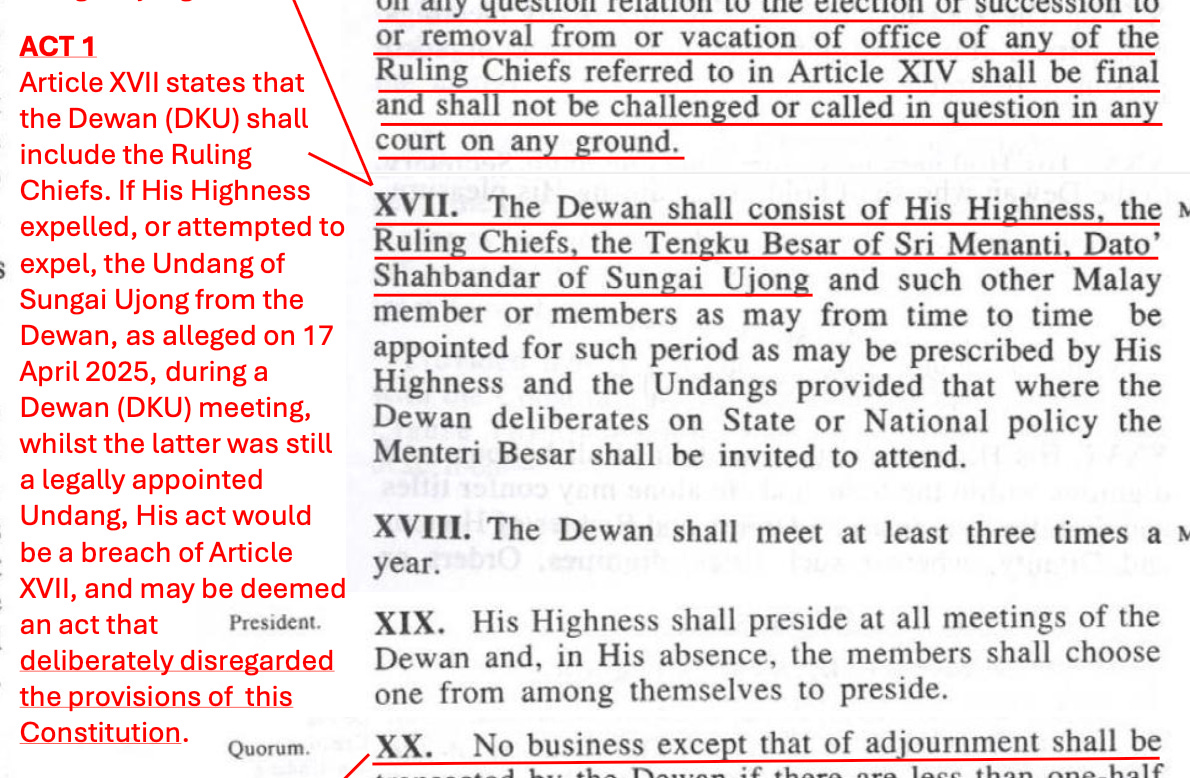
The paper’s argument under Article 17 begins here:
“ACT 1: Article 17 states that the Dewan (DKU) shall include the Ruling Chiefs. If His Highness expelled, or attempted to expel, the Undang of Sungai Ujong from the Dewan, as alleged on 17 April 2025 [sic], during a Dewan (DKU) meeting, whilst the latter was still a legally appointed Undang, His act would be a breach of Article 17, and may be deemed an act that deliberately disregarded the provisions of this Constitution.”
The extract describes an allegation, which it acknowledges in its own wording, and the commentary then proceeds as though the alleged expulsion had occurred and moves to the consequences that would follow.
A court would begin with a more fundamental question:
Did His Highness in fact expel or attempt to expel the Undang?
By what act?
Under what authority?
What evidence establishes that the alleged exclusion occurred?
The paper supplies the conclusion ahead of the factual foundation.
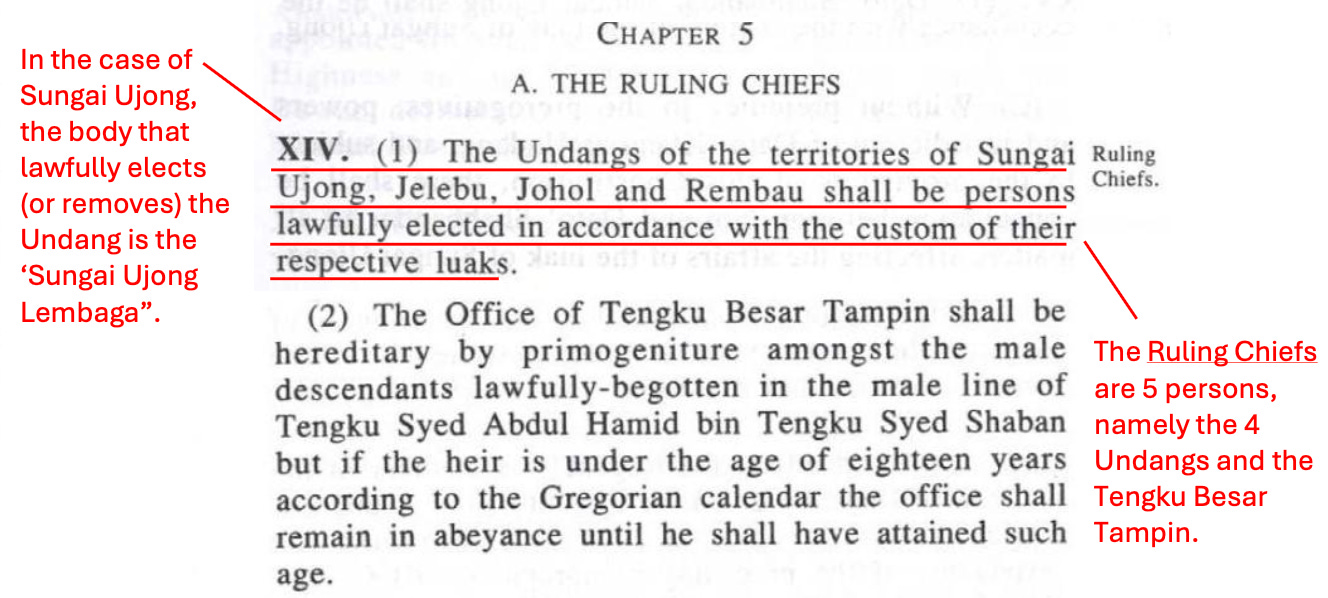
The paper accepts that:
“In the case of Sungai Ujong, the body that lawfully elects (or removes) the Undang is the Sungai Ujong Lembaga.”
The question then becomes how that adat determination interacts with the constitutional role assigned to the DKU by Article 16.
Under Adat Perpatih, the authority to elect and remove the Undang of Sungei Ujong rests with the adat institutions of the Luak, which determined that Mubarak no longer held the adat authority of the office. The DKU does not itself remove an Undang; rather, it performs the constitutional role assigned to it when questions concerning Malay custom arise.
The distinction matters because two different functions are involved:
• The Luak’s adat authority to elect and remove an Undang.
• The DKU’s constitutional function to advise in relation to questions arising from that removal.

The DKU’s advice of 17 April 2026 acknowledged Mubarak’s removal, and Article 16(3) provides that the advice of the DKU on such questions shall be final and shall not be challenged or called in question in any court on any ground.
The paper proceeds on the basis that Mubarak nevertheless remained a lawful Undang. It does not explain how that conclusion is reconciled with the constitutional finality attached to the DKU’s advice.
It may be argued that defects in the underlying adat process could be challenged independently of the DKU’s advice. Whether such a challenge would be available is itself a more complicated question than the paper acknowledges. If the validity of the Luak’s determination is a question of Malay custom, Article 16 appears to assign such questions to the DKU, whose advice the Constitution declares final.
Does Article 26 govern the appointment of the Tunku Panglima Besar?
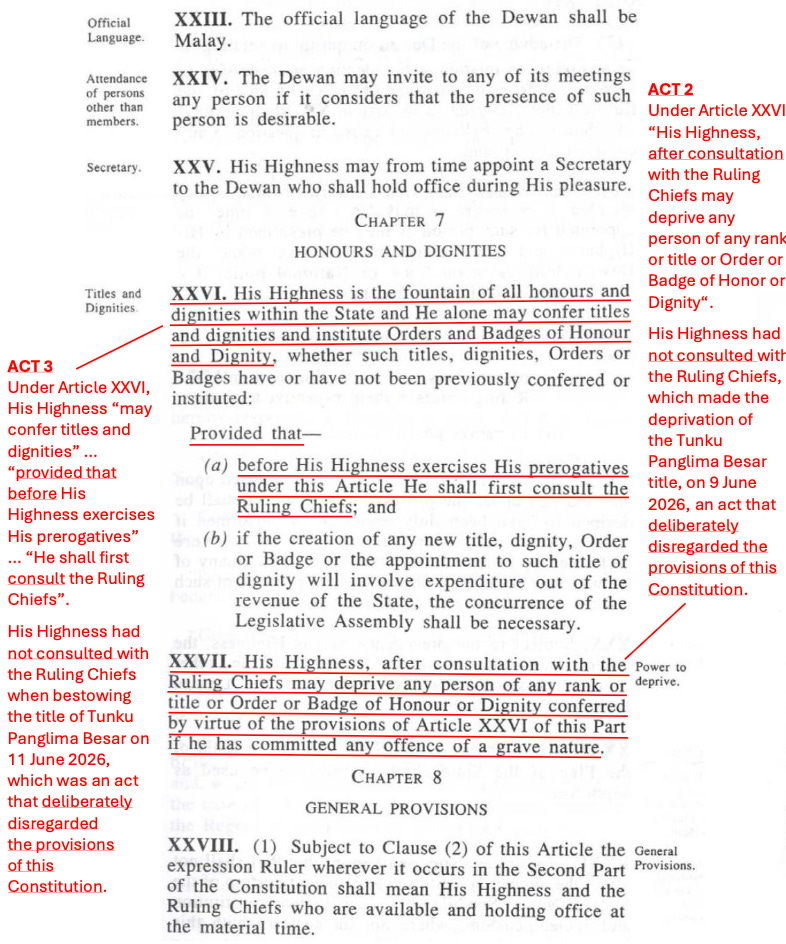
The red text claims:
“His Highness had not consulted with the Ruling Chiefs” regarding both removal and conferment of the Tunku Panglima Besar title.
Article 26 concerns the conferment of titles, dignities, Orders and badges of honour by His Highness as the fountain of honours within the State. The provision is directed principally at the creation and conferment of state honours and dignities.
The office of the Tunku Panglima Besar is different in character. It is not created by the Constitution, its qualifications and succession are not prescribed by the Constitution, and it forms part of the internal structure of the Negeri Sembilan royal household rather than the constitutional machinery of the State.
Unlike the Undangs, the Tunku Besar Tampin or members of the Dewan Keadilan dan Undang, the Tunku Panglima Besar is not mentioned anywhere in the Constitution. The title exists through royal custom and palace practice, not constitutional text.
The appointment of a Tunku Panglima Besar is an internal royal appointment made pursuant to custom and the prerogatives of the Yang di-Pertuan Besar, rather than an exercise of the Article 26 honours power.
The red notes say:
“His Highness had not consulted with the Ruling Chiefs when bestowing the title of Tunku Panglima Besar on 11 June 2026, which was an act that deliberately disregarded the provisions of this Constitution.”
A court would ask:
Was consultation required?
Did consultation occur?
If not, was the defect procedural or jurisdictional?
Does non-compliance invalidate the act?
The paper assumes that Article 26 governs the appointment. It does not explain why a palace title, unmentioned in the Constitution and rooted in royal custom, should be treated as falling within Article 26 at all.

Article 79 reserves to His Highness and the Ruling Chiefs the prerogatives, powers and jurisdiction they held, except in so far as the Constitution expressly provides otherwise. Where the text speaks, it governs, and where it stays silent, the customary prerogative survives intact. Since the office of Tunku Panglima Besar appears nowhere in the Constitution, Article 79 leaves the Yang di-Pertuan Besar’s customary power to fill it undisturbed.
Lastly, the paper proceeds as though Tunku Nadzaruddin was deprived of the title. In reality, he relinquished it himself. By accepting an invalid proclamation as Yang di-Pertuan Besar, he vacated the position he previously occupied and brought about the consequence that followed.
The document repeatedly substitutes allegation for proof

Notice the wording:
“as alleged on 17 April 2025 [sic]”
The constitutional extract itself acknowledges an allegation. The red commentary then proceeds as though that allegation has already been proven. Treating an open question as a closed one is the mark of advocacy rather than constitutional interpretation.

The document is a legal argument by an unidentified author. There is nothing improper about that. This publication is also written pseudonymously.
The comments in red depend upon a number of assumptions that have not been demonstrated, and several of the paper’s conclusions proceed by treating disputed propositions as established facts.
Whether the article is credited or anonymous is ultimately beside the point. The argument should be judged on the soundness of its premises, the coherence of its reasoning and whether its conclusions follow from facts that have first been established rather than assumed.
The central weakness
The red commentary depends on two propositions: that Tuanku Muhriz was validly removed on 19 April 2026, and that Mubarak remained the lawful Undang of Sungei Ujong.
Neither proposition is established by the paper. Yet much of its constitutional analysis depends upon both already being true. Once those assumptions are removed, the paper’s case largely collapses.
Footnote:
A note on numbering: the Negeri Sembilan Constitution 1959 sets out its Articles in Roman numerals, while this publication renders them in Arabic for ease of reading.
If you are new to this Substack, and are not sure where to begin, visit our Start Here page, where we list all our articles organised by theme.
Related Posts


Sources:

What Happened at the Seremban High Court Sitting on 13 May (Anak Nogori), 14 May 2026
‘Proclamation’ of new ruler invalid, says Negeri Sembilan palace (FMT), 9 June 2026
Tunku Zain named new Tunku Panglima Besar of Negeri Sembilan (Malay Mail), 11 June 2026
Tunku Zain proclaimed as Tunku Panglima Besar of Negri Sembilan (The Star), 11 June 2026
Anak Nogori is independent commentary on the unfolding constitutional crisis in Negeri Sembilan, where centuries-old Adat Perpatih, royal succession law and modern political manoeuvring are colliding in ways Malaysia has never seen before. If you find this useful, share it with someone who should be following this, or subscribe to receive the latest articles in your inbox.

