


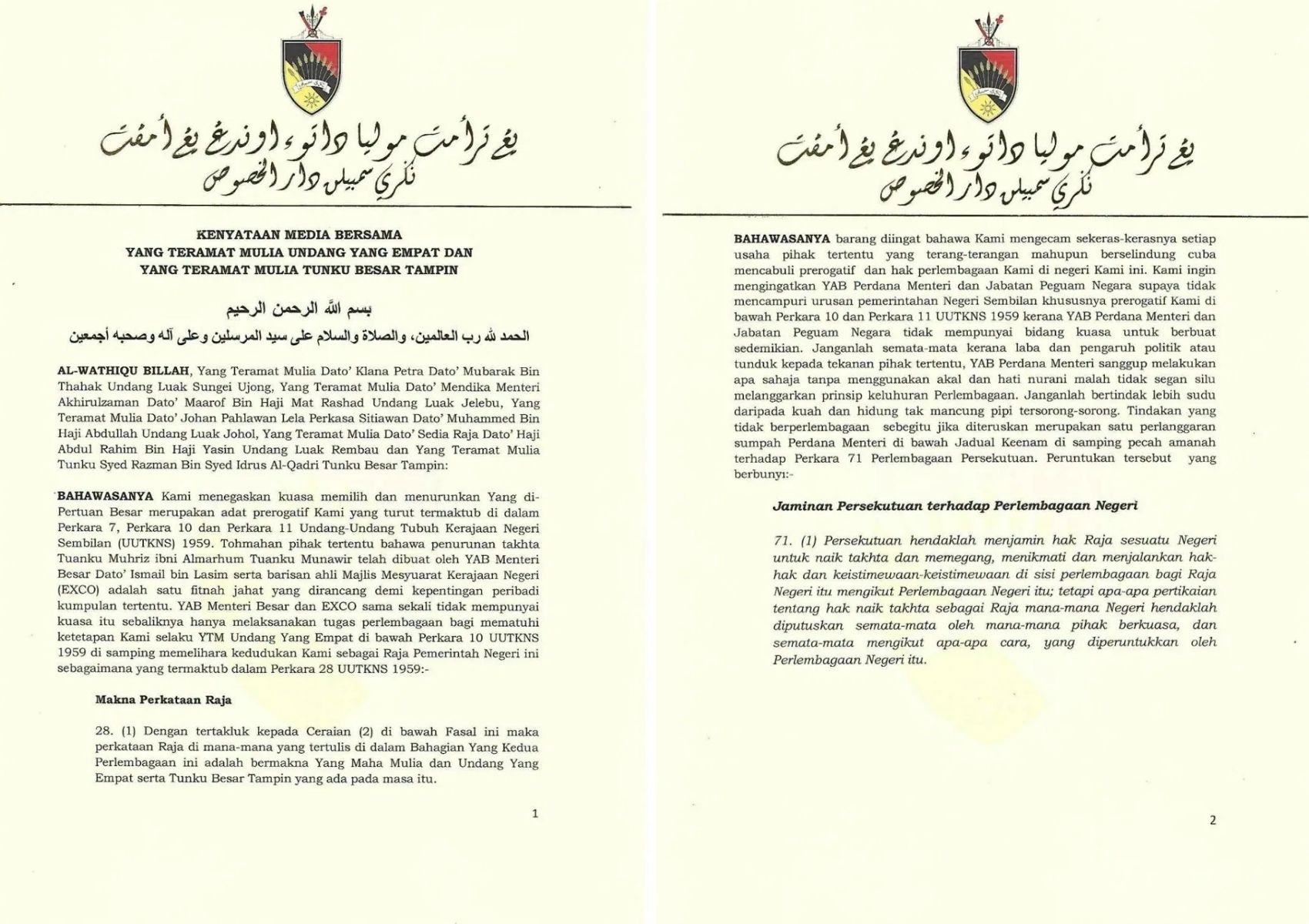
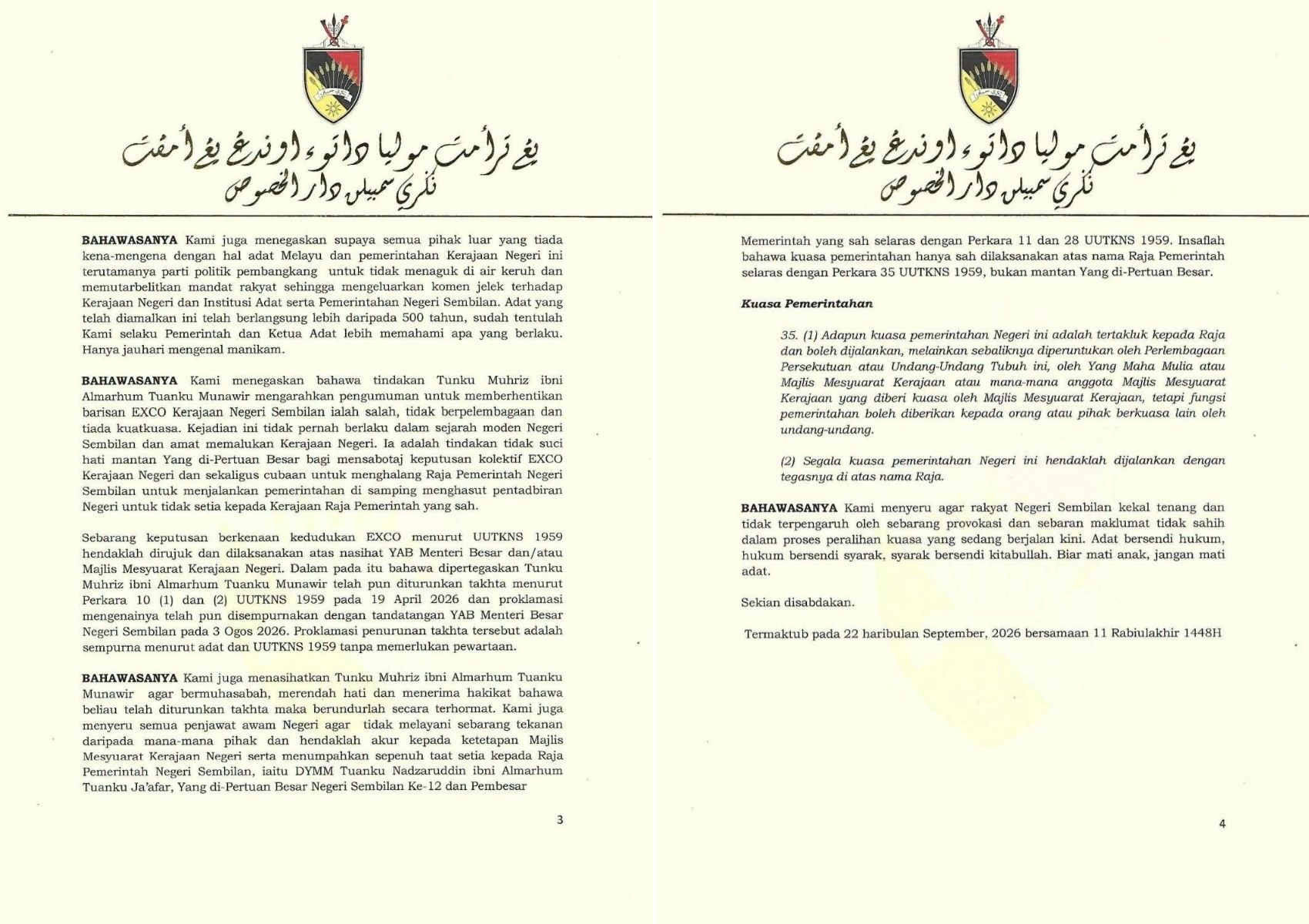
On 22 September 2026, five signatories issued a four-page joint media statement on the position of the Yang di-Pertuan Besar of Negeri Sembilan. They were the removed Undangs Mubarak Dohak of Luak Sungei Ujong and Maarof Mat Rashad of Luak Jelebu; Abdul Rahim Yasin, whose appointment as Undang of Luak Rembau the Dewan Keadilan dan Undang (DKU) maintains was never completed; Muhammed Abdullah, Undang of Luak Johol; and Tunku Syed Razman Syed Idrus Al-Qadri, the Tunku Besar Tampin.
What the statement says
The signatories claimed the power to elect and depose the Yang di-Pertuan Besar as their customary prerogative under Articles 7, 10 and 11.
They described as malicious slander the view that the Menteri Besar and the State Executive Council (EXCO) deposed Tuanku Muhriz, and said the state government merely complied with their decision.
They asserted that the 19 April proclamation was completed by the signature of Menteri Besar Ismail Lasim on 3 August and needed no publication in the Gazette.
They called Tuanku Muhriz the “former” Yang di-Pertuan Besar, and accused him of acting in bad faith (literally, “not pure of heart”), of sabotage and of obstruction.
They exhorted the Prime Minister not to act for gain and political influence, and warned him and the Attorney General’s Chambers (AGC) to keep out of Negeri Sembilan’s affairs.
They closed by calling on civil servants to swear full loyalty to Tunku Nadzaruddin, and on the public to remain calm during “the transfer of power that is currently under way”.
(Read a full English translation here.)
Where things stand
Two institutions have already set out the legal position the statement has to contend with.
On 14 September, the DKU issued a statement which said that no enquiry under Article 10(1) of the Negeri Sembilan Constitution 1959 had ever been held, that Tuanku Muhriz was given no notice or opportunity to be heard, and that four of the six people who signed the signatories’ 5 September document did not hold the offices they claimed.
The AGC’s statement on 17 September said that the 19 April proclamation was invalid for failing to meet the mandatory requirements of Article 10,
Read against those findings, the statement does the signatories more harm than good.
Eight constitutional and legal problems raised by the statement
1. It puts their responsibility on the record
The five signatories insist that the decision to remove Tuanku Muhriz was theirs, exercising what they describe as their customary and constitutional prerogative under Articles 7, 10 and 11, and that the Menteri Besar and the State Executive Council (EXCO) merely complied.
On the DKU and AGC’s finding that no “full and complete enquiry” took place, the five have signed a document claiming sole ownership of a defective act.
2. They still do not explain what their claimed Article 10 enquiry examined or found
Article 10(1) permits the Undangs to call on the Yang di-Pertuan Besar to abdicate only “after full and complete enquiry”, and only on the grounds the Article lists: serious incapacity, a quality disqualifying him under Hukum Syarak (Islamic law), an overt act detrimental to the dignity of the office, or deliberate disregard of the Constitution.
The 22 September statement does not identify which of those grounds was relied upon. Nor does it describe when an enquiry was held, what it examined, whether Tuanku Muhriz was notified, or whether he was given an opportunity to respond.
Those omissions are particularly significant because they concern precisely the defects identified by the DKU on 14 September and subsequently by the AGC.
3. Article 28 works against them
The statement claims that their position as Ruler of the state is enshrined in Article 28. The Article defines “Ruler” for the purposes of the Second Part of the Constitution as:
“His Highness and the Ruling Chiefs who are available and holding office at the material time”.
That wording makes the status of the signatories important: the DKU and AGC both stated that three of the four people who signed the earlier document as Undangs did not hold those offices.
There is also a structural point. Article 28 appears in the Second Part of the Constitution, dealing with the machinery of government. The provisions governing the election and removal of the Yang di-Pertuan Besar sit in the First Part.
4. Their own Article 71 argument points back to the DKU
The statement invokes Article 71(1) of the Federal Constitution in support of its warning to the Prime Minister and the AGC not to interfere in the governance of Negeri Sembilan.
Article 71(1) provides that any dispute over the title to succession as Ruler is to be determined:
“solely by such authorities and in such manner as may be provided by the Constitution of that State.”
For the removal of a Yang di-Pertuan Besar in Negeri Sembilan, the relevant machinery is Article 10, which only the Undangs can set in motion. That makes the identity of the Undangs critical.
Who holds office as Undang is a question on which Article 16 empowers the DKU to advise, and Article 16(3) provides that its advice on questions of Malay custom, including the removal of a Ruling Chief, is final and cannot be challenged in any court.
Article 71, the provision the statement invokes against federal involvement, is the provision that directs the dispute right back to the DKU.
5. Three signatories claim constitutional powers attached to offices the DKU says they do not hold
On the DKU’s advice, three of the four people who purported to act as Undangs were not holding those offices.
A federal government that respects the DKU’s determinations on who lawfully holds office as Undang is therefore deferring to Negeri Sembilan’s own constitutional machinery.
6. It raises questions of sedition and treason
The closing paragraphs go further than defending the 19 April proclamation. They call upon state civil servants to follow the EXCO and give their full loyalty to Tunku Nadzaruddin, while describing a transfer of power as already under way.
That instruction comes after the DKU directed state officers to continue recognising Tuanku Muhriz and said that no government officer was required to act upon instructions founded on the signatories’ 5 September document (DKU Statement, 14 September 2026).
It also comes while litigation over the conduct of several of the signatories remains pending. The High Court injunction of 5 June and the subsequent committal proceedings form part of that background (FMT, 8 July 2026, FMT, 7 September 2026, Malay Mail, 7 September 2026).
The DKU’s solicitors have separately argued that the EXCO’s announcement accepting the proclamation breached the same orders, and have said their clients intend to begin contempt proceedings against its members (DKU Statement, 14 September 2026, Halim & Ismail Letter, 16 September 2026).
The wording may therefore attract scrutiny under laws extending beyond the Negeri Sembilan Constitution. Section 3(1)(a) of the Sedition Act 1948 concerns a tendency to excite disaffection against a Ruler. Section 121B of the Penal Code concerns an intention to depose a Ruler from the sovereignty of a State.
Whether either provision has been breached would require investigation and, ultimately, determination through the criminal justice system. The immediate point is narrower: by asking public officers to transfer their loyalty away from the Yang di-Pertuan Besar whom both the DKU and the AGC confirm in office, the statement moves beyond constitutional argument into conduct capable of legal scrutiny.
7. They warn the Prime Minister against acting for gain and political influence, and tell the AGC to stay out
The statement warns the Prime Minister against acting, in its words, merely for gain and political influence or under pressure from certain parties, without reason or conscience, and warns both the Prime Minister and the AGC against interfering in Negeri Sembilan’s affairs.
The exhortation framed as a warning is directed at a position the federal government has not taken. The Prime Minister said on 18 September that Putrajaya would not interfere beyond insisting that the proper procedures be followed in full (Bernama, 18 September 2026). Two days later, with the EXCO maintaining its position, he said the full weight of the government’s machinery would be deployed to defend constitutional monarchy (FMT, 20 September 2026). The two statements rest on the same premise. The federal government claims no power to decide who holds the throne, and commits itself to upholding the State Constitution’s procedures and the Ruler they have not removed. Article 71 guarantees exactly that.
8. Their case depends on an MB signature whose validity and circumstances are disputed
The signatories say the 19 April proclamation became complete when Menteri Besar Ismail Lasim added his signature. Article 10(2) does require the proclamation to be issued under the hands of the Undangs and the Menteri Besar. The dispute is over what happened before and after that requirement could be satisfied.
The DKU’s position is that the proclamation had already lapsed after the then Menteri Besar declined to sign it on 20 April, and that a signature added months later could not revive it (RTM, 14 September 2026). Ismail, meanwhile, has said that his 3 August signature was given under duress (Straits Times, 8 September 2026).
Summary
For all its forceful language, the statement does not resolve the issues that have defined the dispute since April.
There is still no account in the document of the “full and complete enquiry” required by Article 10(1). Three of the signatories continue to claim the powers of offices the DKU says they do not hold. The effect of the Menteri Besar’s later signature remains contested. And Article 71 ultimately directs attention back to the constitutional authorities and procedures of Negeri Sembilan.
What the statement adds is a record. By expressly claiming responsibility for the purported removal, repeating instructions to state officers and calling for their loyalty to be transferred to Tunku Nadzaruddin, it potentially exposes the signatories to further contempt proceedings and to criminal investigation. The questions include whether their conduct breaches the High Court’s 5 June injunction, whether the words have a seditious tendency under the Sedition Act 1948, and whether the call to transfer loyalty engages Section 121B of the Penal Code concerning the deposition of a Ruler.
The committal proceedings over the 5 June injunction are already before the courts. Whether any criminal offence has been committed is for the police, the Attorney General’s Chambers and the courts to decide, and the provisions in question are not minor ones. Contempt of court is punishable by imprisonment or a fine at the court’s discretion. A conviction under Section 3(1)(a) of the Sedition Act 1948 carries a fine, imprisonment or both. A conviction under Section 121B of the Penal Code carries imprisonment of 30 to 40 years.
Related Posts:


If you are new to this Substack and are not sure where to begin, visit our Start Here page, where we list all our articles organised by theme.
Sources:
Federal Constitution (Reprint 2020) (Attorney General’s Chambers of Malaysia)
Negeri Sembilan DKU granted leave to begin contempt proceedings against 6 (FMT, 8 July 2026)
Appeals court should decide jurisdiction over NS undangs, says lawyer (FMT, 7 September 2026)
DKU NS arah setiausaha lapor polis desakan turunkan Yang di-Pertuan Besar (FMT, 14 September 2026)
Tuanku Muhriz kekal Yang di-Pertuan Besar Negeri Sembilan - DKU (RTM, 14 September 2026)
Exco statement on Negeri Sembilan ruler has no legal effect, says AGC (FMT, 17 September 2026)
Lawyers accuse Negeri Sembilan govt of ‘coup’, threaten contempt action (FMT, 17 September 2026)
Don’t Bow To Political Pressure, Anwar Tells Negeri Sembilan Govt, MB (Bernama, 18 September 2026)
Mohd. Zafir enggan ulas isu pewartaan proklamasi (Utusan Malaysia, 18 September 2026)
Was deposing a ruler part of your manifesto, Anwar asks Umno (FMT, 20 September 2026)
Exco N Sembilan gantung tugas setiausaha kerajaan, penasihat undang-undang (FMT, 22 September 2026)
Anak Nogori is independent commentary on the unfolding constitutional crisis in Negeri Sembilan, where centuries-old Adat Perpatih, royal succession law, and modern political manoeuvring are colliding in ways Malaysia has never seen before. If you find this useful, share it with someone who should be following this, or subscribe to receive the latest articles in your inbox.
