


What each clause means
Article 10(1): The conditions, the grounds, and the call
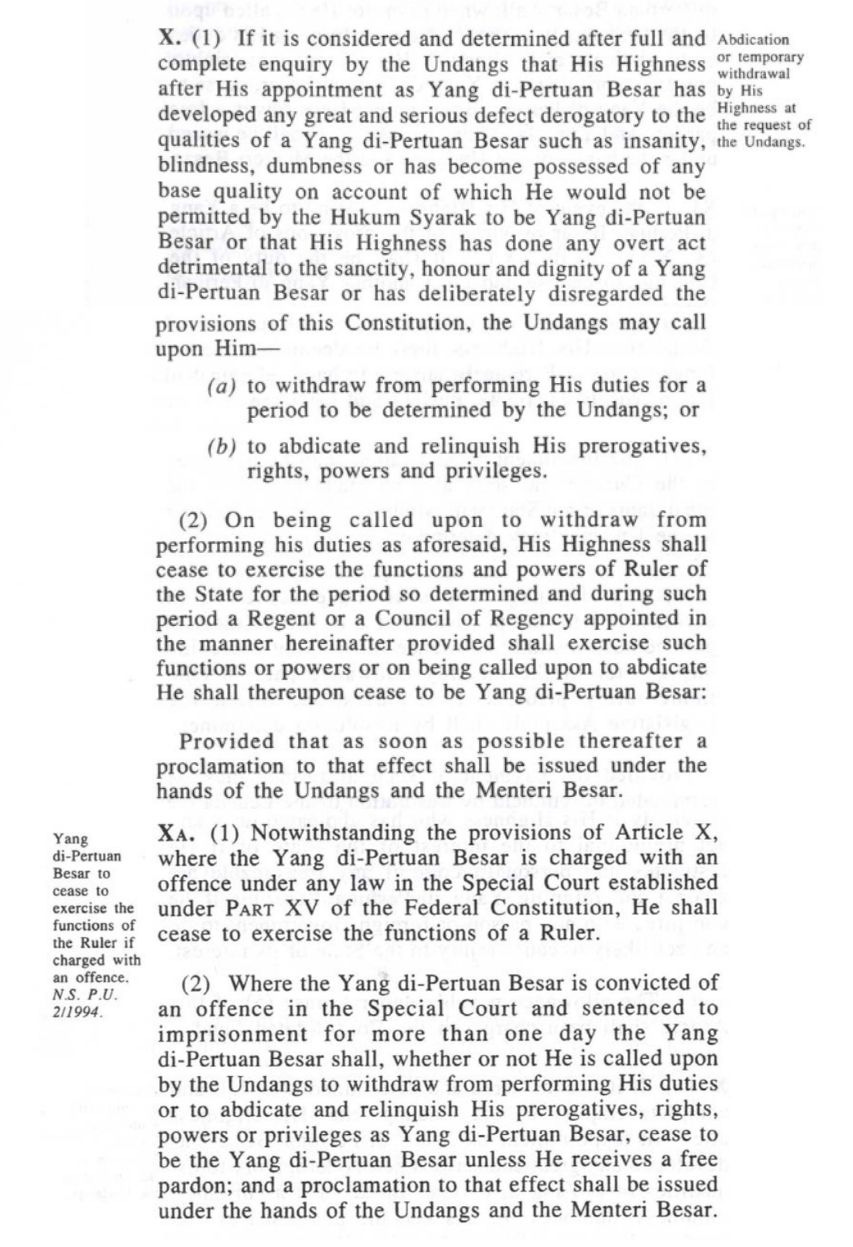
If it is considered and determined after full and complete enquiry by the Undangs that His Highness after His appointment as Yang di-Pertuan Besar has developed any great and serious defect derogatory to the qualities of a Yang di-Pertuan Besar such as insanity, blindness, dumbness or has become possessed of any base quality on account of which He would not be permitted by the Hukum Syarak (Islamic law) to be Yang di-Pertuan Besar or that His Highness has done any overt act detrimental to the sanctity, honour and dignity of a Yang di-Pertuan Besar or has deliberately disregarded the provisions of this Constitution, the Undangs may call upon Him —
(a) to withdraw from performing His duties for a period to be determined by the Undangs; or
(b) to abdicate and relinquish His prerogatives, rights, powers and privileges.
This is one very long sentence in the printed text, and it does three separate things. Taken apart, it reads more easily.
First, a condition that must be satisfied before anything else happens. The matter must be “considered and determined after full and complete enquiry by the Undangs”. An enquiry comes first. Whatever follows depends on it having taken place.
Second, the grounds. The enquiry must find one of the following. The grounds are specific and limited:
that His Highness, after his appointment, has developed a great and serious defect derogatory to the qualities of a Yang di-Pertuan Besar, such as insanity, blindness or dumbness
that he has become possessed of a base quality on account of which the Hukum Syarak (Islamic law) would not permit him to be Yang di-Pertuan Besar
that he has done an overt act detrimental to the sanctity, honour and dignity of a Yang di-Pertuan Besar
that he has deliberately disregarded the provisions of the Constitution
The words “after His appointment” is worth pausing on, and worth reading carefully. Article 10 addresses what has happened since he took the throne. A grievance predating the appointment is not what this Article is for.
Third, what the Undangs may then do. They may call upon him either to withdraw from performing his duties for a period they determine, under 10(1)(a), or to abdicate and relinquish his prerogatives, rights, powers and privileges, under 10(1)(b). The choice between the two belongs to the Undangs. The question of whether the requirements of Article 10(1) were in fact satisfied in any particular case is a separate issue.
Article 10(2): What follows the call
On being called upon to withdraw from performing his duties as aforesaid, His Highness shall cease to exercise the functions and powers of Ruler of the State for the period so determined and during such period a Regent or a Council of Regency appointed in the manner hereinafter provided shall exercise such functions or powers or on being called upon to abdicate He shall thereupon cease to be Yang di-Pertuan Besar:
Provided that as soon as possible thereafter a proclamation to that effect shall be issued under the hands of the Undangs and the Menteri Besar.
If the call is to withdraw, His Highness ceases to exercise the functions and powers of Ruler for the period determined, and a Regent or Council of Regency exercises them in the meantime. If the call is to abdicate, he “shall thereupon cease to be Yang di-Pertuan Besar”.
The cessation follows from the call itself, with nothing further required to make it effective, which is why every word of 10(1) carries so much weight. If a valid call ends a reign, then validity is the whole question, and validity rests on two things: that a full and complete enquiry was held on one of the four grounds, and that the persons making the call were the Undangs.
The proviso: the proclamation
A proclamation “shall be issued under the hands of the Undangs and the Menteri Besar” as soon as possible thereafter. “Under the hands of” means signed by. The proclamation must therefore carry the signatures of the Undangs and of the Menteri Besar, and this is the only point in Article 10 at which the Menteri Besar appears.
Because the proclamation comes afterwards, it records a cessation that has already occurred rather than bringing one about. The Constitution is silent on what happens where a Menteri Besar declines to sign.
Article 10A: The 1994 insertion that operates outside Article 10, where the Special Court replaces the enquiry and the call
Article 10A was inserted in 1994 (N.S. P.U. 2/1994) and opens with the words “Notwithstanding the provisions of Article X”. It operates outside the machinery described above, and the enquiry, the grounds and the call have no part in it.
Article 10A(1): What a charge in the Special Court does to the exercise of the office
Notwithstanding the provisions of Article 10, where the Yang di-Pertuan Besar is charged with an offence under any law in the Special Court established under Part 15 of the Federal Constitution, He shall cease to exercise the functions of a Ruler.
Under 10A(1), where the Yang di-Pertuan Besar is charged with an offence in the Special Court established under Part XV of the Federal Constitution, he ceases to exercise the functions of a Ruler. The office stays with him while the exercise of it stops. A Regent or Council of Regency is then appointed by the Undangs under Article 12(1)(e) and 12(6A), and that appointment ends when the circumstances producing it cease.
Article 10A(2): What a conviction does to the office itself, and the only exit from it
Where the Yang di-Pertuan Besar is convicted of an offence in the Special Court and sentenced to imprisonment for more than one day the Yang di-Pertuan Besar shall, whether or not He is called upon by the Undangs to withdraw from performing His duties or to abdicate and relinquish His prerogatives, rights, powers or privileges as Yang di-Pertuan Besar, cease to be the Yang di-Pertuan Besar unless He receives a free pardon; and a proclamation to that effect shall be issued under the hands of the Undangs and the Menteri Besar.
Under 10A(2), where he is convicted in the Special Court and sentenced to imprisonment for more than one day, he ceases to be Yang di-Pertuan Besar unless he receives a free pardon. The text says this follows “whether or not He is called upon by the Undangs” to withdraw or to abdicate, so the four chieftainships stand aside from it entirely. A proclamation signed by the Undangs and the Menteri Besar follows, and as under Article 10 it records a cessation that has already occurred.
Two routes therefore exist by which a reign may end against the wish of the holder. One runs through an enquiry conducted by four men. The other runs through a charge and a conviction in a court established under the Federal Constitution, with a pardon as the only exit.
What Article 10 does not say
It says nothing about the Dewan Keadilan dan Undang (DKU). The DKU is nowhere in Article 10. Its advisory function under Article 16 runs to questions of Malay custom, including the election, succession, removal and vacation of office of the Ruling Chiefs.
The Yang di-Pertuan Besar is a separate constitutional office and is not included within the Constitution's definition of "Ruling Chiefs". Article 34 defines “Ruling Chiefs” as the four Undangs together with the Tunku Besar Tampin. The DKU therefore has no stated role in the removal of a Ruler, and the Undangs have no stated role in the removal of one of their own.
It says nothing about the Tunku Besar Tampin. The power under Article 10 belongs to “the Undangs”, which Article 34 defines as the Ruling Chiefs excluding the Tunku Besar Tampin. Four men hold this power, and the fifth Ruling Chief does not.
It gives the Dato' Shahbandar of Sungai Ujong no role. The Dato' Shahbandar is a member of the DKU under Article 17 and, under Article 15, must be consulted by the Undang of Sungei Ujong on matters affecting the affairs of the Luak. Article 10 confers nothing on him.
It does not define “full and complete enquiry”. The Constitution prescribes no procedure, no form of notice, and no right of the Yang di-Pertuan Besar to be heard. The requirement has stood undefined since 1959, and events since April 2026 have raised the question of what it demands in practice for the first time.
It does not answer the prior question of who is an Undang. Article 10 assumes the answer and proceeds. Who lawfully holds each of the four chieftainships is settled elsewhere, under the custom of each Luak, with the DKU advising under Article 16. Article 10 cannot be reached until that question is closed.
It provides no power to install a successor. Article 10 ends the reign, in the circumstances it describes. The election of a new Yang di-Pertuan Besar is governed by Article 11, and the persons eligible are those set out in Article 7.
Footnote: The Constitution numbers its Articles in Roman numerals. This publication uses Arabic numerals for readability.
Our posts referencing Article 10:
What Is the Negeri Sembilan Royal Crisis and Why Does It Matter?
How Social Media has Influenced the Negeri Sembilan Royal Crisis
What the Constitution Actually Says About Removing a Yang di-Pertuan Besar: Liyana Marzuki
Proper Processes Exist to Remove a MB and YDPB, They Were Not Followed: Anthony Loke
Can Negeri Sembilan’s Ruling Chiefs Suspend the DKU Secretary and Convene Their Own Sitting?
An Anonymous Law Review’s Case Against Tuanku Muhriz Examined
Court Document: Exhibit DMA-1, 19 April 2026
Court Document: Judicial Review Leave Application, filed 17 July 2026
Court Document: Supporting Affidavit of Muhammed Abdullah, 17 July 2026
Sources:
Anak Nogori is independent commentary on the unfolding constitutional crisis in Negeri Sembilan, where centuries-old Adat Perpatih, royal succession law, and modern political manoeuvring are colliding in ways Malaysia has never seen before. If you find this useful, share it with someone who should be following this, or subscribe to receive the latest articles in your inbox.
