


No provision of the Negeri Sembilan Constitution has featured more prominently in the state's constitutional crisis since April 2026 than Article 16.
Article 16 of the Negeri Sembilan Constitution 1959 creates the Dewan Keadilan dan Undang (DKU), defines the matters on which it gives advice, and provides that such advice shall be final and shall not be challenged in court.
What each clause means
Article 16(1): The council, the subject matter, and the persons who may refer a question to it
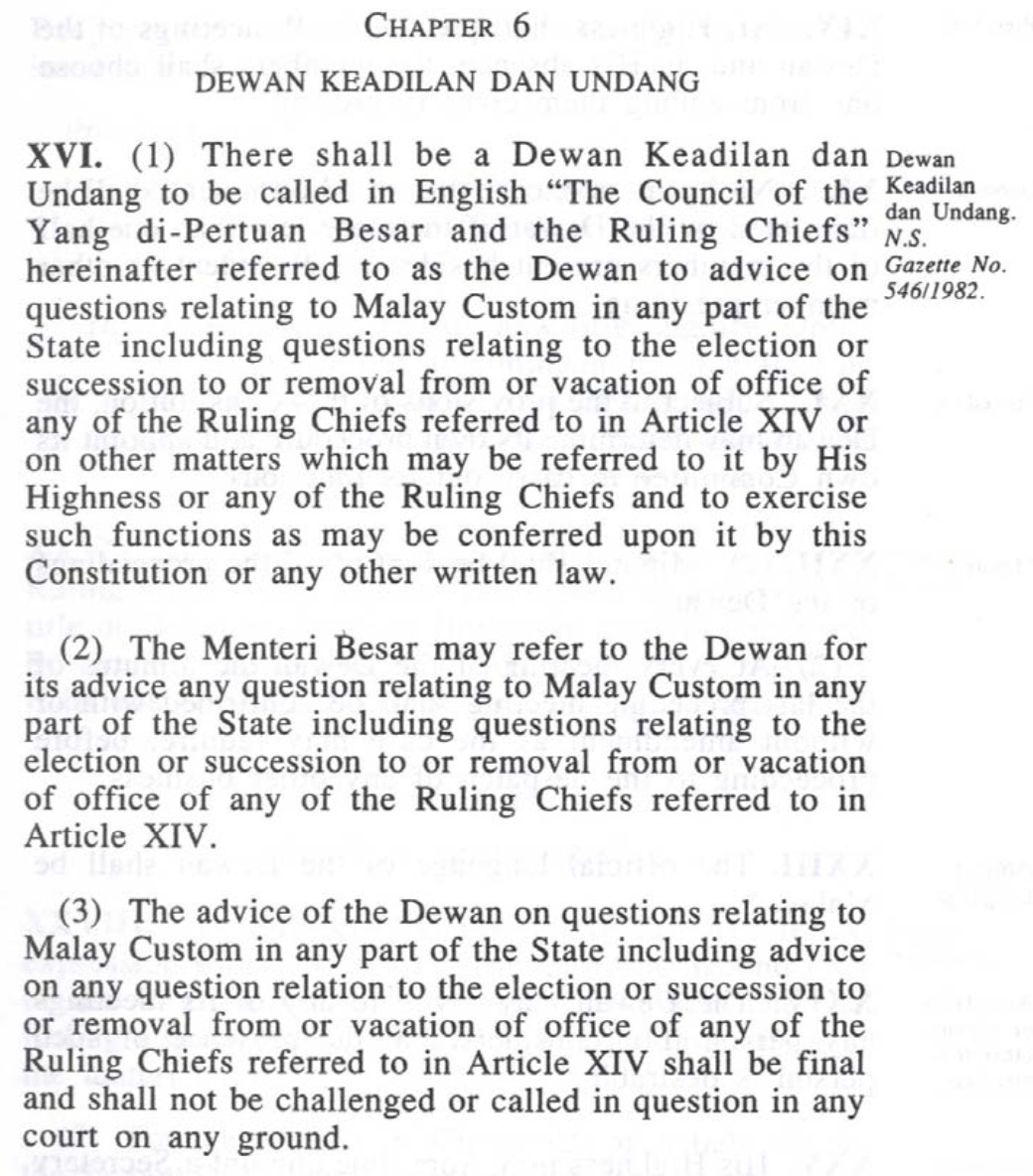
(1) There shall be a Dewan Keadilan dan Undang to be called in English “The Council of the Yang di-Pertuan Besar and the Ruling Chiefs” hereinafter referred to as the Dewan to advice [sic] on questions relating to Malay Custom in any part of the State including questions relating to the election or succession to or removal from or vacation of office of any of the Ruling Chiefs referred to in Article XIV or on other matters which may be referred to it by His Highness or any of the Ruling Chiefs and to exercise such functions as may be conferred upon it by this Constitution or any other written law.
The clause does four things at once.
It establishes the Dewan Keadilan dan Undang and gives it an English name, “The Council of the Yang di-Pertuan Besar and the Ruling Chiefs”.
It fixes the subject matter: questions relating to Malay Custom in any part of the State.
It then spells out one category of such questions, being the election of, succession to, removal from, or vacation of office of any of the Ruling Chiefs referred to in Article 14. Article 14 covers the four Undangs of Sungai Ujong, Jelebu, Johol and Rembau, and the Tunku Besar Tampin.
Finally it adds two further heads of work: other matters referred to the Dewan by the Yang di-Pertuan Besar or by any of the Ruling Chiefs, and functions conferred on the Dewan by the Constitution or by any other written law. Article 30 is an example of the last of these, giving the DKU the determination of precedence among the Ruling Chiefs and other dignitaries.
Article 16 is concerned with the advice given by the Dewan on questions of Malay Custom and the legal consequences that attach to that advice. The customary act of choosing or removing an Undang belongs to the Luak institutions.
Article 16(2): The Menteri Besar’s power of referral
(2) The Menteri Besar may refer to the Dewan for its advice any question relating to Malay Custom in any part of the State including questions relating to the election or succession to or removal from or vacation of office of any of the Ruling Chiefs referred to in Article XIV.
The Menteri Besar may refer a question of Malay Custom to the Dewan for its advice, including any of the four events listed in Article 16(1) concerning a Ruling Chief.
The word is “may”. The clause confers a discretion rather than imposing a duty, and it does not set a timetable nor an obligation on the Dewan to answer.
It is worth reading Article 16(2) alongside Article 17. The Menteri Besar is not a member of the Dewan. Article 17 provides only that he shall be invited to attend where the Dewan deliberates on State or National policy. Article 16(2) therefore gives the elected government a way to put a question, without a seat and without a vote.
Article 16(3): The finality of the advice, and the bar on challenge in court
(3) The advice of the Dewan on questions relating to Malay Custom in any part of the State including advice on any question relation [sic] to the election or succession to or removal from or vacation of office of any of the Ruling Chiefs referred to in Article XIV shall be final and shall not be challenged or called in question in any court on any ground.
The clause does two separate things. It makes the advice final. It then bars a court from entertaining a challenge, and the words “on any ground” are the widest formulation available to a drafter.
The clause is not original to 1959. The Article has been amended once, by the notification gazetted as W.K.N.S. 546/1982 and in force from 29 July 1982, which gave Article 16 its present three-clause shape and inserted the bar in clause (3). The year before, the Federal Court had declined jurisdiction in a Negeri Sembilan dispute over the election of an Undang, and Salleh Abas FJ observed in the course of that judgment that Article 16 as it then stood contained no words stating that its validity could not be questioned in any court (GK Legal, 6 June 2026).
Article 16(3) is the provision counsel for the DKU relied on at the Seremban High Court on 13 May 2026, arguing that the court had no jurisdiction to hear a suit over the events of 17 April (Free Malaysia Today, 13 May 2026).
What Article 16 does not say
It says nothing about the election or removal of the Yang di-Pertuan Besar. Article 16(3) is confined to the Ruling Chiefs referred to in Article 14. The office of Yang di-Pertuan Besar is dealt with in Articles 7 to 12, and the power to call upon him to withdraw or abdicate sits with the Undangs under Article 10, following a full and complete enquiry. The DKU has no stated role in that process, which means the finality in Article 16(3) has nothing to attach to on that question.
It gives the Luak institutions no express right of referral. Article 16(1) names the Yang di-Pertuan Besar and the Ruling Chiefs as the persons who may refer a matter, and Article 16(2) adds the Menteri Besar. The Lembaga Adat, the Buapak, the Ibu Soko, the waris, and the office-holder whose position is the question itself appear nowhere on that list. The customary structures that perform the act have no textual right to bring the resulting question forward, and no express procedural role.
It requires no reasons and no publication. Article 16 sets no obligation to state grounds, to hear the person affected, or to make the advice public. Article 22 requires that minutes be kept of all proceedings of the Dewan, and it stops there. Article 16 does not require the Dewan to publish reasons for its advice. Combined with Article 16(3), this places considerable weight on the institution's own internal discipline.
It does not define Malay Custom. The DKU advises only on questions of Malay Custom and the finality in Article 16(3) attaches only to advice on Malay Custom, yet neither Article 16 nor the interpretation provisions of Article 34 say what the phrase “Malay Custom” covers. Article 32 preserves the ancient constitution and ancient custom of the State so far as they are not inconsistent with the First Part, which is the nearest the Constitution comes to marking out the boundary.
The bar in Article 16(3) attaches to advice. Article 16(3) is drafted to protect advice on Malay Custom. On the election, succession, removal or vacation of office of an Undang, the Dewan's function is advisory, and that advice is what the finality clause covers.
Has the DKU’s authority been tested in court?
The finality in Article 16(3) has come before the courts more than once, and the pattern of those cases shapes how the clause is read today.
In an opinion piece for Free Malaysia Today, Edy Noor Reduan, Deputy Head of Information for PKR Negeri Sembilan, counted five occasions between 1984 and 2018 on which the DKU’s authority was litigated, across the Federal Court, the Court of Appeal and the High Court (Free Malaysia Today, 2 May 2026). A sixth matter reached the Seremban High Court in 2024.
Federal Court, 1980 (reported 1981 and 1984). Dato’ Menteri Othman bin Baginda & Anor v Dato’ Ombi Syed Alwi bin Syed Idrus [1981] 1 MLJ 29, also reported at [1984] 1 CLJ 28, arose from the succession to the 14th Undang of Jelebu after the office fell vacant in November 1979. The Federal Court, with Suffian LP presiding, declined jurisdiction, reading Articles 14 and 16 of the State Constitution together with Articles 71 and 181 of the Federal Constitution and treating the DKU as the proper forum for a question of custom (Malay Mail, 11 May 2026). The finality now in Article 16(3) was inserted only in 1982, so this decision rested on the court being the wrong forum, a ground lawyers call forum non conveniens (an inappropriate court for the matter), rather than on the later bar
High Court, 1998. Dato’ Laxamana Dato' Mokhtar bin Dato’ Kelana Maamor & Ors v Lembaga Adat Istiadat Luak Sg Ujong [1998] concerned a Sungei Ujong succession. Following the 1981 decision, Justice Suriyadi told the four plaintiffs that the civil court was not the appropriate body for a customary succession matter and would not usurp the DKU's function where an appointment carried its blessing (Malay Mail, 11 May 2026). The Free Malaysia Today list records this as a Court of Appeal matter, while the account by counsel in Malay Mail describes a High Court decision, and the discrepancy is unresolved on the available sources
High Court, 2005. Syed Abu Bakar Syed Hassan & Ors v Zainal Ariffin bin Ibrahim & Ors [2005] 7 CLJ 457 contested the position of Mubarak Dohak, who then held the office of Undang of Sungei Ujong. The court declined to override the DKU, and his position stood (Malay Mail, 18 May 2026)
High Court, 2012. YTM Datuk Othman Ismail v Dato’ Mubarak Dohak & Ors [2012] 1 LNS 1378, also reported at [2012] CLJU 1378, brought a further challenge to Mubarak’s standing, and the court again declined to substitute its judgment for the DKU’s (Malay Mail, 18 May 2026)
High Court, 2018. The fifth case in the Free Malaysia Today list carries no name, citation or independent report, resting on that opinion column alone (Free Malaysia Today, 2 May 2026). It is recorded here as attributed to that source
Seremban High Court, 20 September 2024. Judicial Commissioner Wan Fadhilah Nor Wan Idris struck out a writ of summons filed by the Buapak (lineage head) of Kampung Tanjong, Datuk Kaya Maharaja Hassan Ab Hamid, against Datuk Perba Abdul Razak Mohd Yassin, chair of the selection committee for the 22nd Undang of Luak Rembau, finding that the court had no jurisdiction over adat (custom) and istiadat (ceremony) in Negeri Sembilan (Sinar Harian, 20 September 2024)
A single thread runs through these cases: on questions of Luak custom the courts have left the customary institutions to their own judgment rather than imposing the court's. Since 1982, Article 16(3) has reinforced that by making the DKU's advice final and closing it to challenge in court.
Footnote: The Constitution numbers its Articles in Roman numerals. This publication uses Arabic numerals for readability.
Our posts referencing Article 16:
What Does the Negeri Sembilan Constitution Actually Say About Removing a Ruler
The DKU Secretary Has Not Been Suspended. So Why Is the Press Reporting That He Has?
Can Negeri Sembilan’s Ruling Chiefs Suspend the DKU Secretary and Convene Their Own Sitting?
Does Article 79 Let the Ruling Chiefs Convene a DKU Sitting on 5 June?
An Anonymous Law Review’s Case Against Tuanku Muhriz Examined
Sources:
Mahkamah batal writ saman terhadap Datuk Perba (Sinar Harian, 20 September 2024)
DKU is the appropriate body to decide on the appointment of an Undang (Malay Mail, 11 May 2026)
What games afoot regarding Negeri Sembilan? (Malay Mail, 18 May 2026)
The NS Constitution and the clause built to silence the courts: can it? (GK Legal, 6 June 2026)
Anak Nogori is independent commentary on the unfolding constitutional crisis in Negeri Sembilan, where centuries-old Adat Perpatih, royal succession law, and modern political manoeuvring are colliding in ways Malaysia has never seen before. If you find this useful, share it with someone who should be following this, or subscribe to receive the latest articles in your inbox.
