

Mubarak No Longer Has State Authority As Undang: The Menteri Besar’s Three Statements
Three media statements from the Menteri Besar set out the State Government's position on Mubarak's removal as Undang and on the declaration of 19 April 2026.

This is a reference document, part of this publication's archive of primary sources. It collects and translates the three media statements issued by the Menteri Besar of Negeri Sembilan between 17 and 27 April 2026.
Between 17 and 27 April 2026, the Menteri Besar of Negeri Sembilan, Datuk Seri Aminuddin Harun, issued three media statements on the removal of the removed Undang of Luak Sungei Ujong, Mubarak bin Dohak, and on the declaration he and three serving Undangs read on 19 April 2026. Read in sequence, the three documents form the State Government’s record of the crisis as it broke. This page reproduces each statement with an English translation and sets out what each one establishes.
The first statement: 17 April 2026
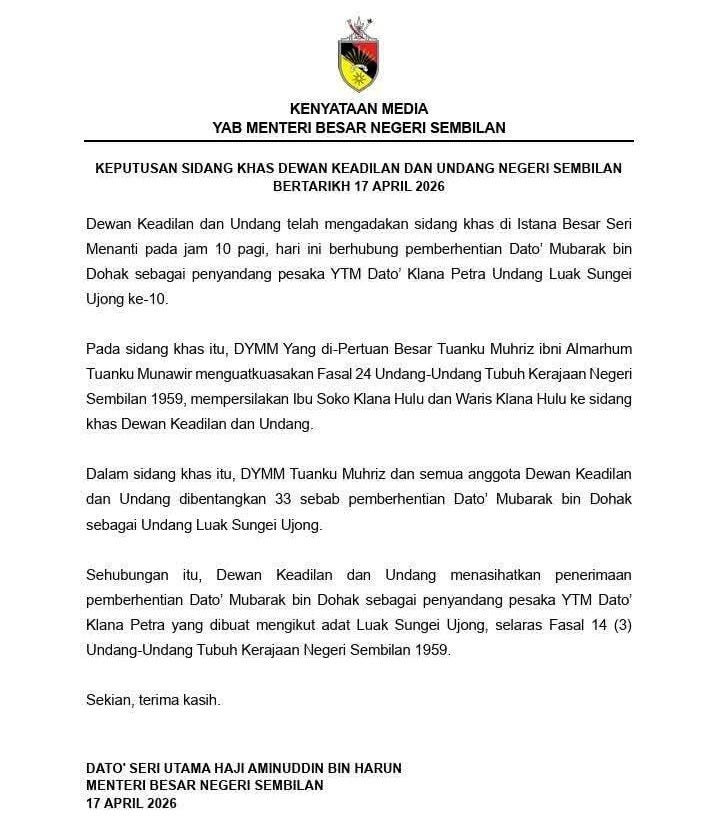
The earliest of the three records the outcome of the special sitting of the Dewan Keadilan dan Undang (DKU) held at Istana Besar Seri Menanti that morning.
English Translation:
MEDIA STATEMENT YAB MENTERI BESAR OF NEGERI SEMBILAN
OUTCOME OF THE SPECIAL SITTING OF THE DEWAN KEADILAN DAN UNDANG OF NEGERI SEMBILAN, DATED 17 APRIL 2026
The Dewan Keadilan dan Undang held a special sitting at Istana Besar Seri Menanti at 10 o’clock this morning concerning the removal of Dato’ Mubarak bin Dohak as holder of the heritage title YTM Dato’ Klana Petra, the 10th Undang of Luak Sungei Ujong.
At that special sitting, DYMM Yang di-Pertuan Besar Tuanku Muhriz ibni Almarhum Tuanku Munawir, giving effect to Article 24 of the Negeri Sembilan Constitution 1959, invited the Ibu Soko Klana Hulu and the Waris Klana Hulu into the special sitting of the Dewan Keadilan dan Undang.
At that special sitting, DYMM Tuanku Muhriz and all members of the Dewan Keadilan dan Undang were presented with the 33 grounds for the removal of Dato’ Mubarak bin Dohak as Undang of Luak Sungei Ujong.
In this connection, the Dewan Keadilan dan Undang advised acceptance of the removal of Dato’ Mubarak bin Dohak as holder of the heritage title YTM Dato’ Klana Petra, carried out according to the custom of Luak Sungei Ujong, in line with Article 14(3) of the Negeri Sembilan Constitution 1959.
That is all, thank you.
DATO’ SERI UTAMA HAJI AMINUDDIN BIN HARUN MENTERI BESAR OF NEGERI SEMBILAN 17 APRIL 2026
What the 17 April statement establishes
The statement places three things on the public record. The sitting was convened and chaired by the Ruler: Tuanku Muhriz gave effect to Article 24 of the Negeri Sembilan Constitution 1959 and brought the Ibu Soko Klana Hulu and the Waris Klana Hulu, the customary heirs of the Klana title, into the chamber. The full DKU then considered the case, with every member presented with the 33 grounds for the removal. The DKU advised acceptance of a removal that the statement describes as having been carried out according to the custom of Luak Sungei Ujong.
Read closely, the statement keeps the two acts distinct: the Luak removes, while the DKU advises acceptance.
The second statement: 20 April 2026
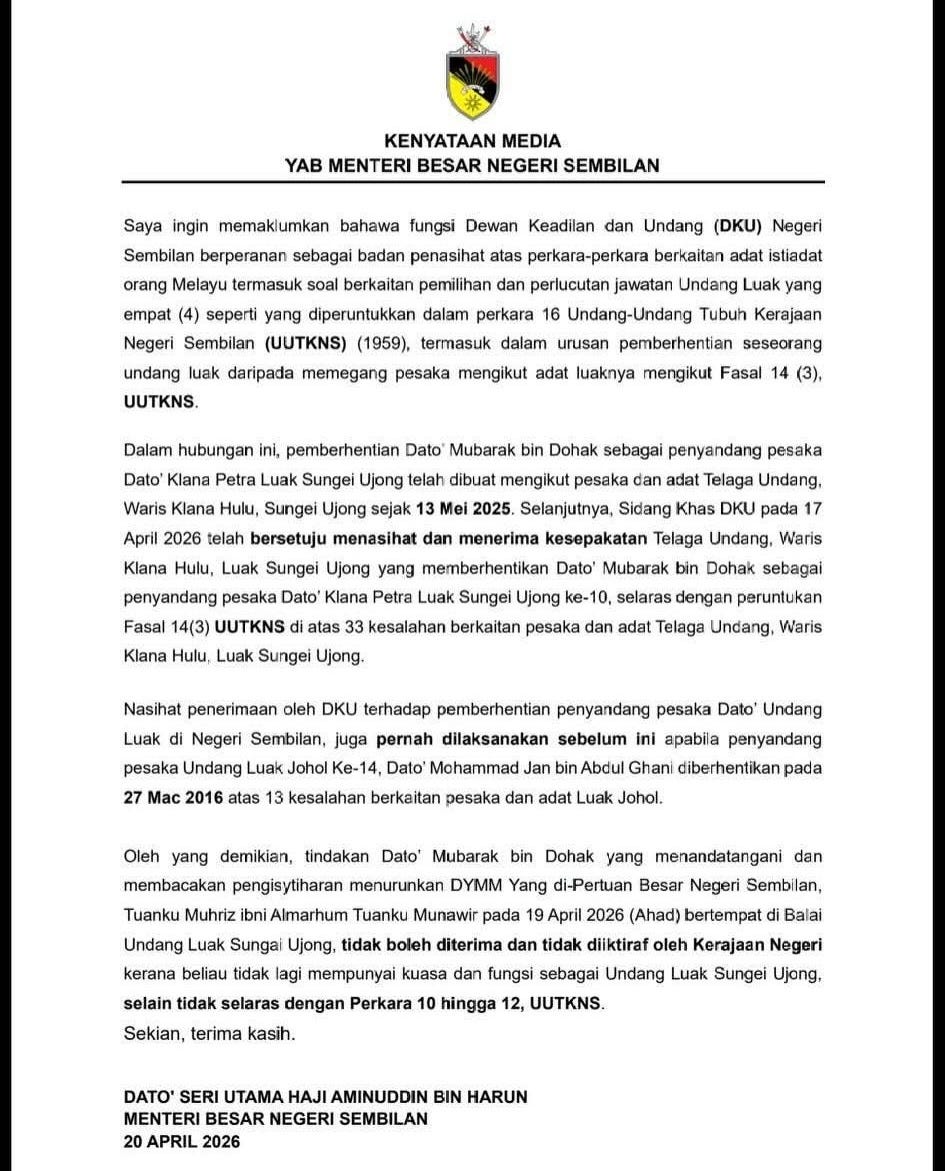
Three days later, after Mubarak and the three Undangs read their declaration at the Balai Undang Luak Sungei Ujong, the Menteri Besar issued a second statement withholding the State Government’s recognition.
English Translation:
MEDIA STATEMENT YAB MENTERI BESAR OF NEGERI SEMBILAN
I wish to inform that the function of the Dewan Keadilan dan Undang of Negeri Sembilan is to serve as an advisory body on matters relating to the customs and ceremonies of the Malay people, including questions concerning the election and removal of the four Undang Luak as provided under Article 16 of the Negeri Sembilan Constitution 1959, including the matter of removing an Undang Luak from holding the heritage title according to the custom of his Luak under Article 14(3).
In this connection, the removal of Dato’ Mubarak bin Dohak as holder of the heritage title Dato’ Klana Petra Luak Sungei Ujong, Waris Klana Hulu, Sungei Ujong, was made according to the heritage and custom of Telaga Undang, Waris Klana Hulu, Sungei Ujong, since 13 May 2025. Subsequently, the Special Sitting of the Dewan Keadilan dan Undang on 17 April 2026 agreed to advise and accept the consensus of the Telaga Undang, Waris Klana Hulu, Luak Sungei Ujong, which removed Dato’ Mubarak bin Dohak as holder of the heritage title of the 10th Klana Petra Luak Sungei Ujong, in line with the provision of Article 14(3), over 33 offences relating to the heritage and custom of Telaga Undang, Waris Klana Hulu, Luak Sungei Ujong.
The acceptance advised by the Dewan Keadilan dan Undang regarding the removal of a holder of the heritage title Dato’ Undang Luak in Negeri Sembilan was also carried out previously, when the holder of the heritage title of the 14th Undang Luak Johol, Dato’ Mohammad Jan bin Abdul Ghani, was removed on 27 March 2016, over 13 offences relating to the heritage and custom of Luak Johol.
Therefore, the action of Dato’ Mubarak bin Dohak in signing and reading the declaration to depose DYMM the Yang di-Pertuan Besar of Negeri Sembilan, Tuanku Muhriz ibni Almarhum Tuanku Munawir, on 19 April 2026 (Sunday) at the Balai Undang Luak Sungei Ujong, cannot be accepted and is not recognised by the State Government, as he no longer holds the power and function of Undang of Luak Sungei Ujong, and is moreover inconsistent with Articles 10 to 12 of the Negeri Sembilan Constitution 1959.
That is all, thank you.
DATO’ SERI UTAMA HAJI AMINUDDIN BIN HARUN MENTERI BESAR OF NEGERI SEMBILAN 20 APRIL 2026
What the 20 April statement establishes
The second statement dates the removal, cites a precedent, and withholds recognition. The State Government asserts that Mubarak ceased to hold the Klana Petra title on 13 May 2025, almost a year before the public crisis. Whether that removal was valid is the point Mubarak contests.
It then records that the State Government cannot accept the 19 April declaration, on the ground that Mubarak no longer held the power or function of Undang, and that the declaration was inconsistent with Articles 10 to 12, the provisions governing the removal and replacement of a Yang di-Pertuan Besar.
The third statement: 27 April 2026
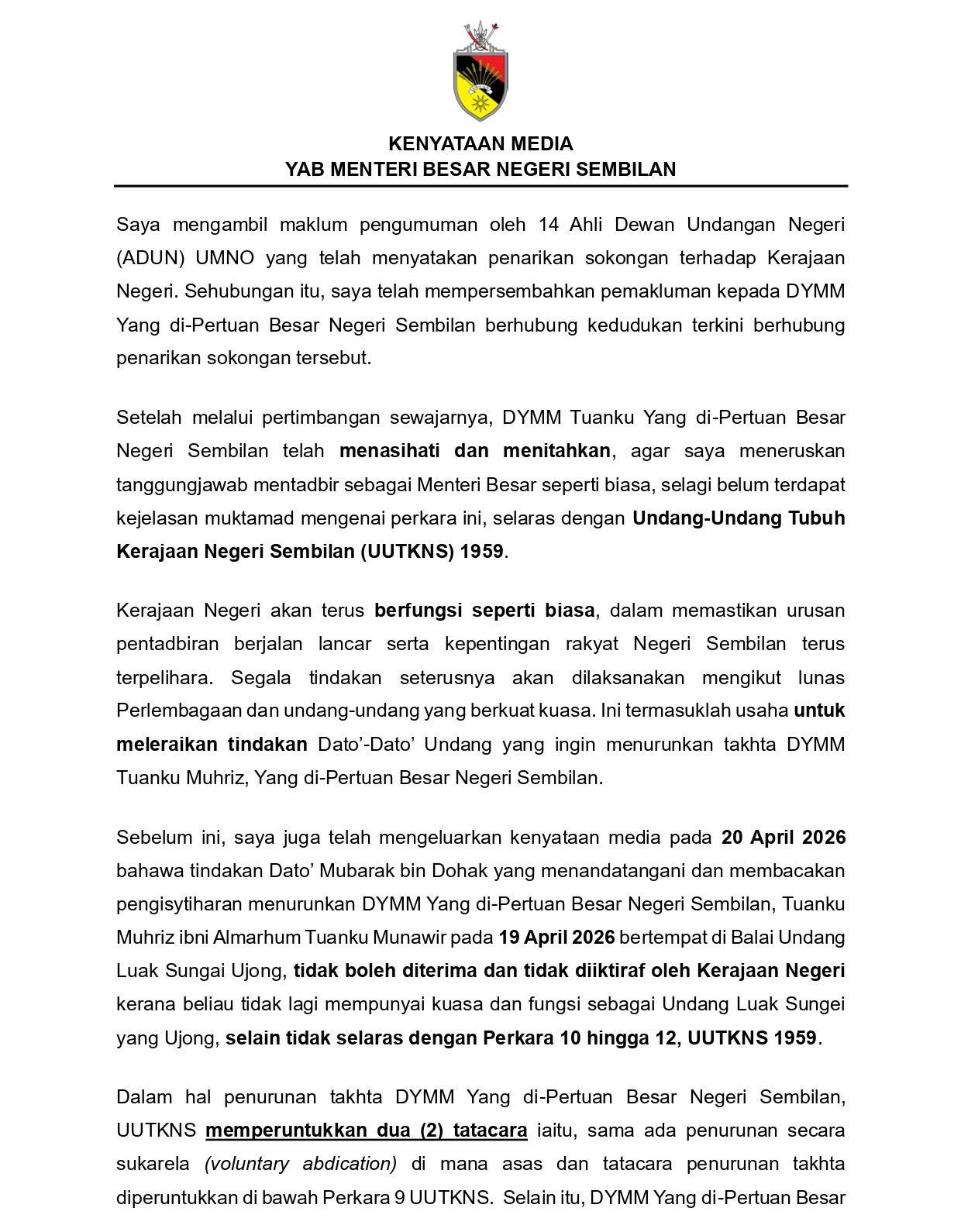
The third statement is the longest and the most argued. The Menteri Besar issued it after fourteen UMNO assemblymen announced the withdrawal of their support from the State Government, and it sets out the State Government’s constitutional reasoning for treating the 19 April declaration as ineffective.
English Translation:
MEDIA STATEMENT YAB MENTERI BESAR OF NEGERI SEMBILAN
I take note of the announcement by 14 UMNO State Assemblymen (ADUN) declaring the withdrawal of their support from the State Government. In this connection, I have submitted a briefing to DYMM the Yang di-Pertuan Besar of Negeri Sembilan on the current position regarding that withdrawal of support.
After due consideration, DYMM Tuanku the Yang di-Pertuan Besar of Negeri Sembilan has advised and decreed that I continue my responsibility of administering as Menteri Besar as usual, so long as there is no conclusive clarity on this matter, in line with the Negeri Sembilan Constitution 1959 (UUTKNS).
The State Government will continue to function as usual, ensuring that administration runs smoothly and that the interests of the people of Negeri Sembilan remain protected. All further actions will be carried out according to the principles of the Constitution and the laws in force. This includes efforts to undo the action of the Dato’-Dato’ Undang who wish to depose DYMM Tuanku Muhriz, the Yang di-Pertuan Besar of Negeri Sembilan.
Previously, I also issued a media statement on 20 April 2026 stating that the action of Dato’ Mubarak bin Dohak in signing and reading the declaration to depose DYMM the Yang di-Pertuan Besar of Negeri Sembilan, Tuanku Muhriz ibni Almarhum Tuanku Munawir, on 19 April 2026 at the Balai Undang Luak Sungei Ujong, cannot be accepted and is not recognised by the State Government, because he no longer holds the power and function of Undang of Luak Sungei Ujong, and is moreover inconsistent with Articles 10 to 12 of the Negeri Sembilan Constitution 1959.
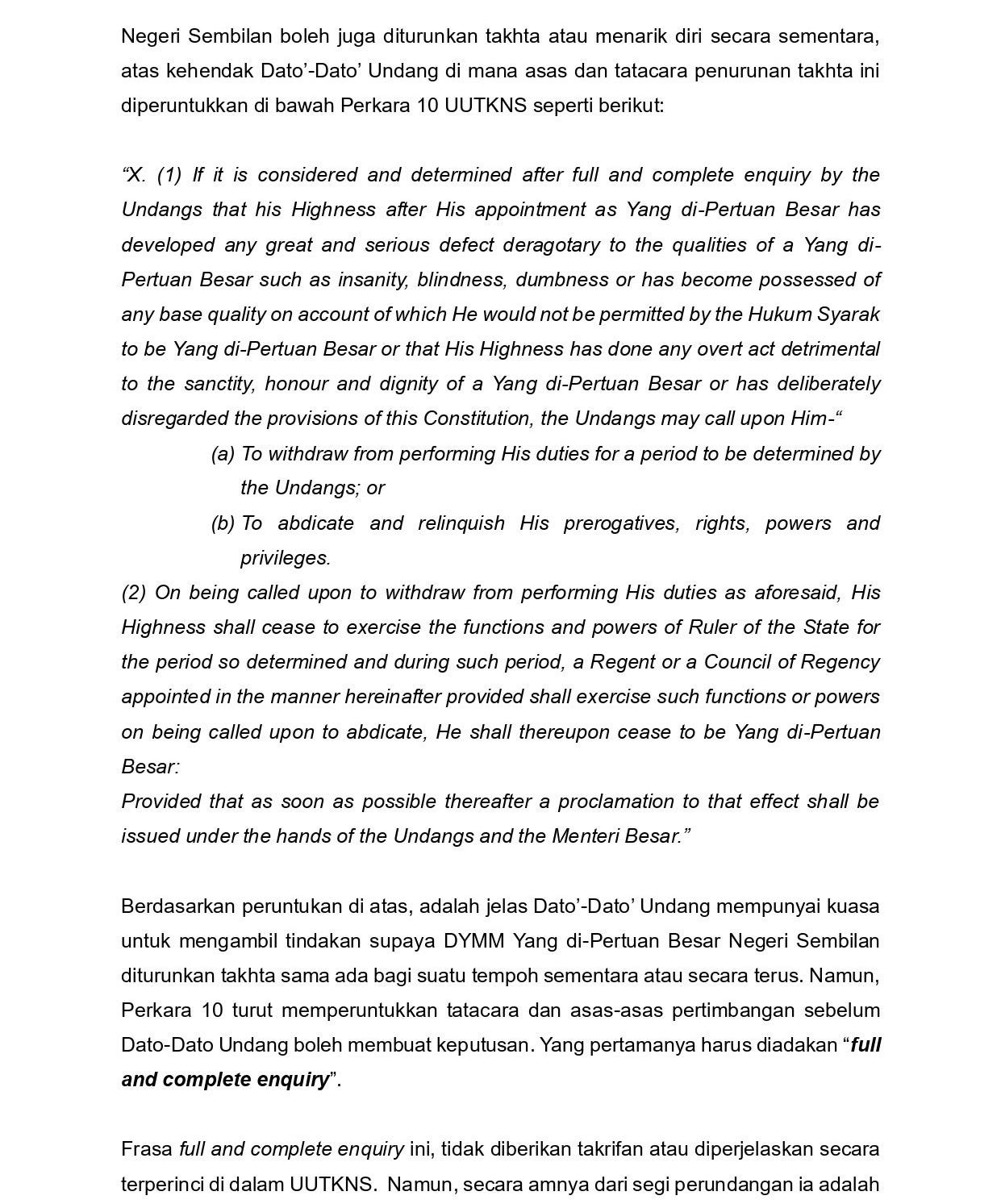
On the matter of deposing DYMM the Yang di-Pertuan Besar of Negeri Sembilan, the UUTKNS provides two procedures, namely either voluntary abdication, the basis and procedure for which are provided under Article 9, or the deposition of the Yang di-Pertuan Besar, or His temporary withdrawal, at the will of the Dato’-Dato’ Undang, the basis and procedure for which are provided under Article 10 of the UUTKNS as follows:
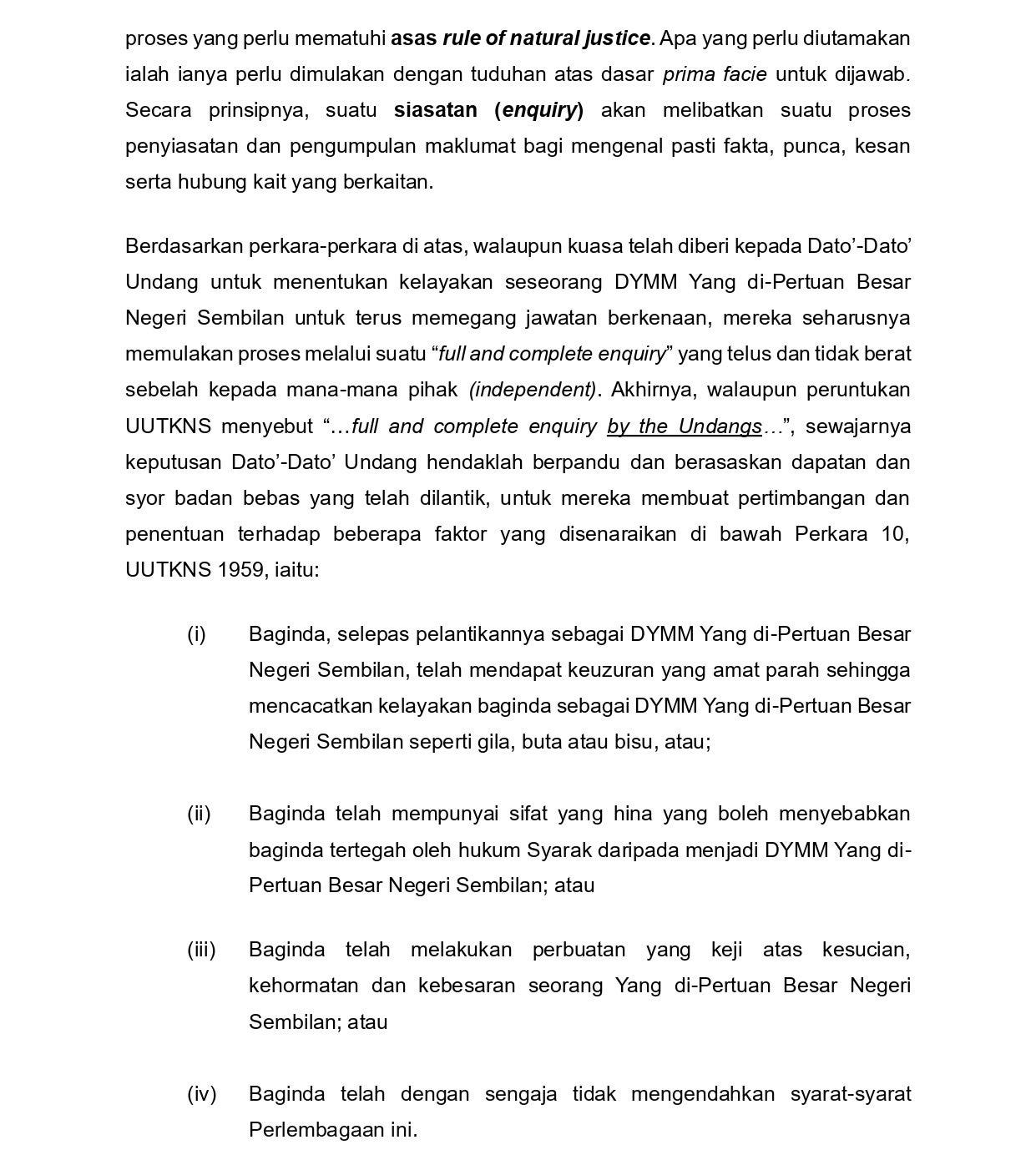
“X. (1) If it is considered and determined after full and complete enquiry by the Undangs that his Highness after His appointment as Yang di-Pertuan Besar has developed any great and serious defect derogatory to the qualities of a Yang di-Pertuan Besar such as insanity, blindness, dumbness or has become possessed of any base quality on account of which He would not be permitted by the Hukum Syarak to be Yang di-Pertuan Besar or that His Highness has done any overt act detrimental to the sanctity, honour and dignity of a Yang di-Pertuan Besar or has deliberately disregarded the provisions of this Constitution, the Undangs may call upon Him— (a) To withdraw from performing His duties for a period to be determined by the Undangs; or (b) To abdicate and relinquish His prerogatives, rights, powers and privileges. (2) On being called upon to withdraw from performing His duties as aforesaid, His Highness shall cease to exercise the functions and powers of Ruler of the State for the period so determined and during such period, a Regent or a Council of Regency appointed in the manner hereinafter provided shall exercise such functions or powers on being called upon to abdicate, He shall thereupon cease to be Yang di-Pertuan Besar: Provided that as soon as possible thereafter a proclamation to that effect shall be issued under the hands of the Undangs and the Menteri Besar.”
Based on the above provision, it is clear that the Dato’-Dato’ Undang have the power to take action to depose DYMM the Yang di-Pertuan Besar of Negeri Sembilan, whether for a temporary period or permanently. However, Article 10 also provides the procedures and the bases for consideration that must precede any decision by the Dato’-Dato’ Undang. The first is that a “full and complete enquiry” must be held.
The phrase “full and complete enquiry” is not defined or explained in detail in the UUTKNS. However, generally and from a legal standpoint, it is a process that must comply with the principle of the rule of natural justice. What must be prioritised is that it begin with an accusation, on a prima facie basis, to be answered. In principle, an enquiry will involve a process of investigation and the gathering of information to identify the facts, the causes, the effects, and the relevant connections.
Based on the matters above, although power has been given to the Dato’-Dato’ Undang to determine the fitness of a DYMM Yang di-Pertuan Besar of Negeri Sembilan to continue holding the office, they ought to begin the process through a “full and complete enquiry” that is transparent and not biased toward any party (independent). Ultimately, although the UUTKNS provision states “...full and complete enquiry by the Undangs...”, the decision of the Dato’-Dato’ Undang ought properly to be guided by and based on the findings and recommendations of an independent body duly appointed, in order for them to consider and determine several factors listed under Article 10, UUTKNS 1959, namely:
(i) His Highness, after His appointment as DYMM Yang di-Pertuan Besar of Negeri Sembilan, has developed a defect so severe as to impair His fitness, such as insanity, blindness or dumbness; or (ii) His Highness has acquired a base quality that may cause Him to be barred by Hukum Syarak from being DYMM Yang di-Pertuan Besar of Negeri Sembilan; or (iii) His Highness has committed a vile act against the sanctity, honour and dignity of a Yang di-Pertuan Besar of Negeri Sembilan; or (iv) His Highness has deliberately disregarded the conditions of this Constitution.
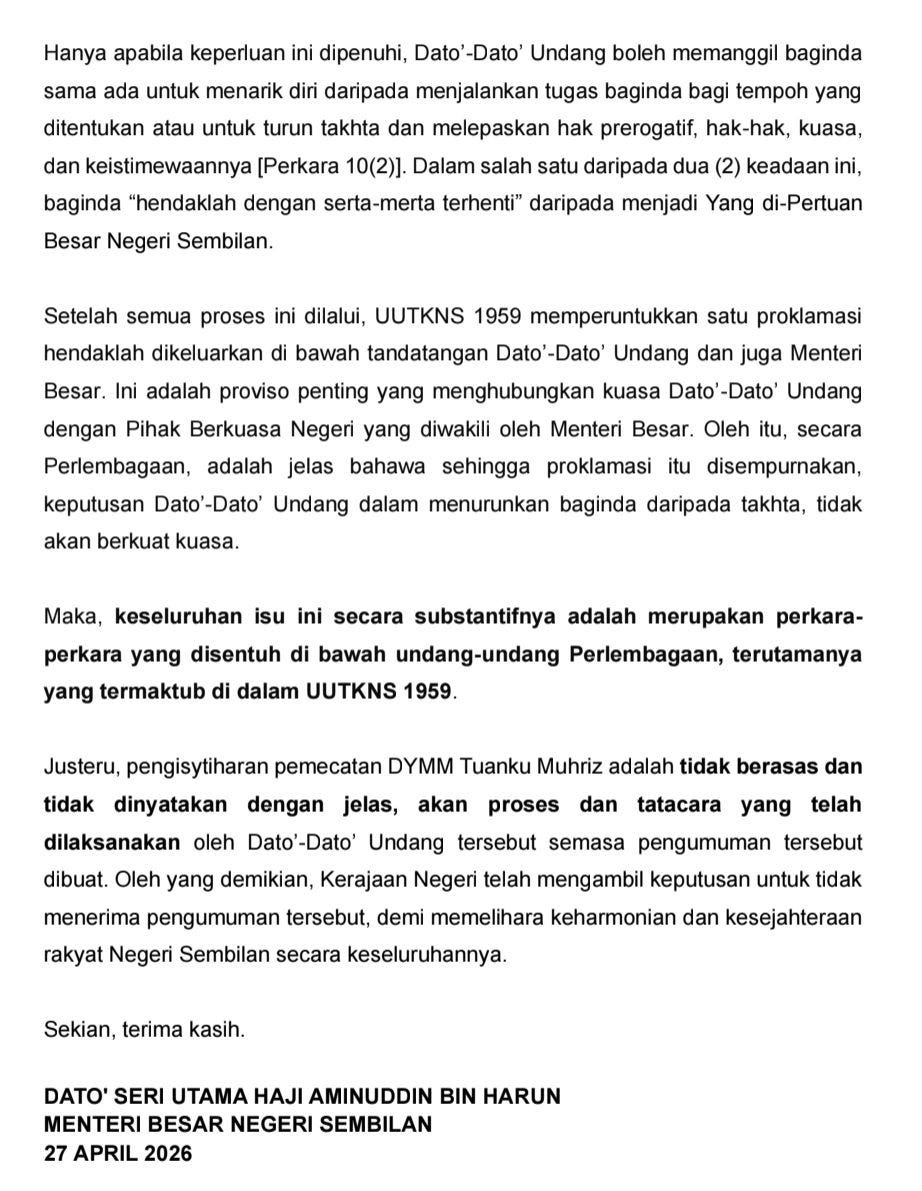
Only when these requirements are met may the Dato’-Dato’ Undang call upon His Highness, whether to withdraw from performing His duties for a determined period, or to abdicate and relinquish His prerogatives, rights, powers, and privileges [Article 10(2)]. In either of these two situations, His Highness “shall thereupon immediately cease” to be the Yang di-Pertuan Besar of Negeri Sembilan.
After all of this process has been completed, the UUTKNS 1959 provides that a proclamation must be issued under the signatures of the Dato’-Dato’ Undang and also the Menteri Besar. This is an important proviso linking the power of the Dato’-Dato’ Undang with the State Authority represented by the Menteri Besar. Therefore, constitutionally, it is clear that until that proclamation is completed, the decision of the Dato’-Dato’ Undang to depose His Highness from the throne will not take effect.
Accordingly, the entire issue is substantively a matter touched upon under constitutional law, particularly that enshrined in the UUTKNS 1959.
Therefore, the declaration deposing DYMM Tuanku Muhriz is without basis and does not clearly state the process and procedure carried out by those Dato’-Dato’ Undang at the time the announcement was made. For that reason, the State Government has decided not to accept the announcement, in order to preserve the harmony and wellbeing of the people of Negeri Sembilan as a whole.
That is all, thank you.
DATO’ SERI UTAMA HAJI AMINUDDIN BIN HARUN MENTERI BESAR OF NEGERI SEMBILAN 27 APRIL 2026
What the 27 April statement establishes
The third statement carries the State Government’s fullest constitutional argument. It opens with continuity: after fourteen UMNO assemblymen withdrew their support, the Menteri Besar reported that the Yang di-Pertuan Besar had advised and decreed that he continue administering as usual. It then turns to procedure. The deposition of a Yang di-Pertuan Besar runs through Article 9 for voluntary abdication or Article 10 for removal at the will of the Undangs. Article 10 carries two conditions. The Undangs must first hold a full and complete enquiry, which the statement reads as a process bound by natural justice and ideally guided by an independent body. The deposition then takes effect only once a proclamation is issued under the signatures of the Undangs and the Menteri Besar together.
On the State Government’s reading, the declaration of 19 April fell short at both conditions. The statement treats the enquiry requirement as unmet and the proclamation as incomplete, the Menteri Besar’s signature being absent.
A note on Article 14 and Article 16(3)
Both the 17 and 20 April statements cite Article 14(3) as the basis for removal. But Article 14(3) is about allowances, not removal. Article 14(1) provides that an Undang is elected according to the custom of his Luak, and removal follows the same custom. Article 14(3) simply provides a lifetime allowance for a former Undang and allows that allowance to be withheld in certain circumstances.
The DKU’s role appears in Article 16. Under Article 16(1), it advises on questions of Malay custom, including the removal of a Ruling Chief. Article 16(3) makes that advice final and not subject to challenge in court. In short, Article 14 provides the customary basis for removal, while Article 16(3) provides the finality.
There is some irony in the citation. The proviso to Article 14(3) allows the Legislative Assembly to withhold a former chief’s allowance for conduct prejudicial to the State. The provision cited as the basis for removal is actually concerned with the financial consequences that may follow it.
The proviso the Menteri Besar relies upon
The strongest point in the 27 April statement is structural. Article 10 ends with a proviso: a proclamation deposing a Yang di-Pertuan Besar must issue under the hands of the Undangs and the Menteri Besar. The signature of the Menteri Besar is, on this reading, a constitutional gate. The declaration of 19 April carried the signatures of Mubarak and three Undangs and lacked the signature of the Menteri Besar, who instead issued a statement rejecting it.
The Menteri Besar is a party, not a referee
These three statements are the State Government’s official position, but they are not the words of a neutral observer. By 27 April, fourteen UMNO assemblymen had withdrawn confidence in the Menteri Besar, leaving his own position under challenge (UMNO Media Statement, 29 April 2026).
The statements carry weight, since they record the Government's position on recognition, administration, and constitutional procedure. They make the executive's case for why the declaration of 19 April was ineffective. They should therefore be read as the position of a participant in the dispute, rather than as a ruling that stands above the controversy.
The sequence, in order
On 13 May 2025, the removal of Mubarak as holder of the Dato’ Klana Petra title took effect under the custom of Luak Sungei Ujong, almost a year before the public crisis.
On 17 April 2026, the DKU sat at Istana Besar Seri Menanti under Tuanku Muhriz, who gave effect to Article 24. The 33 grounds were presented, and the DKU advised acceptance of the removal.
On 19 April 2026, Mubarak and the three Undangs signed and read a declaration at the Balai Undang Luak Sungei Ujong purporting to depose Tuanku Muhriz and to name a successor.
On 20 April 2026, the Menteri Besar issued the first rejection, recording that the declaration was not recognised and that Mubarak no longer held the office that would have given it force.
On 27 April 2026, after fourteen UMNO assemblymen withdrew support, the Menteri Besar issued the detailed statement setting the declaration against the Article 10 procedure and reporting the Ruler’s decree that he continue in office.
What this means
Across three statements in eleven days, the State Government set out a single position from two directions. Mubarak’s office had been vacated under the custom of the Luak, the DKU had advised acceptance of that removal under its Article 16 role, and the declaration of 19 April had failed the procedure that Article 10 lays down for deposing a Yang di-Pertuan Besar. The case the Menteri Besar advances is a constitutional one.
Article 10 makes the deposition of a Yang di-Pertuan Besar depend on a proclamation signed by the Undangs and the Menteri Besar together. The declaration of 19 April carried the signatures of Mubarak and the three Undangs but not that of the Menteri Besar. On the State Government's reading, the declaration was therefore an announcement without legal effect.
Read Next: Mubarak Ordered to Vacate Official Residence and the Balai Immediately
If you are new to this Substack, and are not sure where to begin, visit our Start Here page, where we list all our articles organised by theme.
Related Posts:


Sources:
Declaration to Depose Negeri Sembilan Ruler Not Recognised (Bernama, 20 April 2026)
Pengisytiharan Mubarak tidak sah, bukan lagi Undang Luak Sungei Ujong (Buletin TV3, 20 April 2026)
The Laws of the Constitution of Negeri Sembilan 1959 (Negeri Sembilan State Government)
Anak Nogori is independent commentary on the unfolding constitutional crisis in Negeri Sembilan, where centuries-old Adat Perpatih, royal succession law, and modern political manoeuvring are colliding in ways Malaysia has never seen before. If you find this useful, share it with someone who should be following this, or subscribe to receive the latest articles in your inbox.

