


Two new Undangs were installed at Istana Besar Seri Menanti on 27 June 2026, one for Luak Sungei Ujong and one for Luak Rembau, and within a week each installation had drawn an objection from inside its own Luak.
That has revived an old question in a new form: when the lineages of a single Luak cannot agree on who should hold the title, who actually decides?
The answer turns on separating two acts that are often confused, the selection of an Undang, which belongs to the Luak, and the installation, which belongs to the Yang di-Pertuan Besar, both acts of Adat Perpatih.
What are the Sungei Ujong and Rembau objections about?
Both quarrels sit inside a single Luak rather than between Luaks, and both turn on process.
In Sungei Ujong, the waris of Klana Perut Hulu and Klana Perut Hilir objected that the installation of Muhammad Faris Johari as the 11th Undang departed from the order set in the Teromba and proceeded without the unanimous agreement of the Dato-Dato Lembaga Adat and the consent of the Ibu-Ibu Soko that custom requires (Sinar Harian, 27 June 2026).
In Rembau, the Ibu Soko Nan Tua of the Waris Perut Biduanda Sedia Raja Kampung Pulau, YM Rashimah Abu Bakar, argued that the 22nd turn belonged to Kampung Pulau rather than Kampung Tanjong and petitioned the Yang di-Pertuan Besar to set the installation of Hassan Ab Hamid aside.
However, the Rembau customary council held that its choice had been a proper act of the Luak taken free of palace influence (KiniTV Youtube video, 28 June 2026, Negeri Kita, 3 July 2026).
The Rembau quarrel reaches back to 2024. The title rotates between the two Biduanda lineages, the Waris Lela Maharaja and the Waris Sedia Raja, and the source kampung within the lineage on turn, the Lubuk Benih, is chosen through a Kerapatan of the Buapak Delapan.
In two kerapatan in June 2024, the Buapak favoured Kampung Tanjong, the kampung of Hassan Ab Hamid, while the Lembaga, Datuk Perba Abdul Razak Mohd Yassin, set those outcomes aside and proclaimed Kampung Pulau in their place (Malaysiakini, 30 July 2024,Sinar Harian, 30 July 2024). The two sides disagree over whether the Buapak’s vote governs or Kampung Pulau was owed a turn.
Where does Adat locate the choice of an Undang?
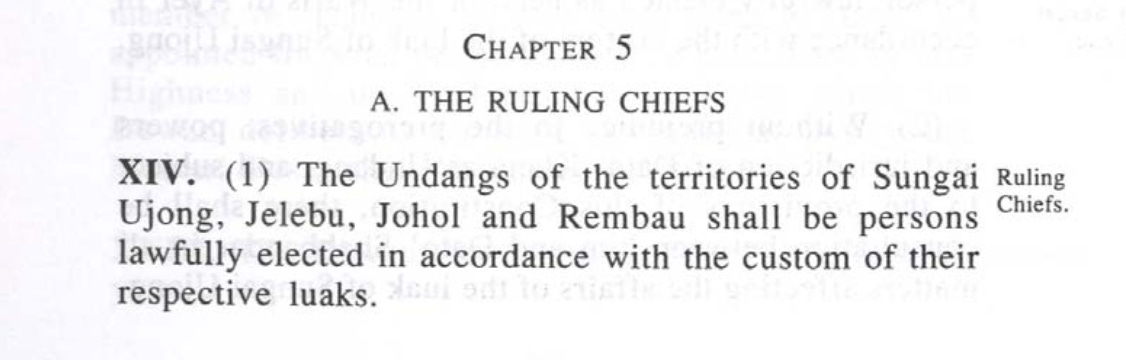
Article 14 of the Constitution provides that an Undang is a person lawfully elected according to the custom of his Luak.
That election belongs to the Luak's own customary institutions. The precise process differs from one Luak to another, reflecting each Luak's own Adat, but authority rises through its recognised customary bodies, including the Buapak, the Lembaga, the waris houses, and the Ibu Soko whose sanction the custom requires. Each Luak also follows its own established rotation between eligible waris branches.
The shape of that process is the point. The Adat saying goes, “Berjenjang naik, bertangga turun”, one climbs the steps to go up and takes the same rungs to come down, so authority moves through the structure by degrees rather than by leap.
What does the Yang di-Pertuan Besar actually do at the ceremony?
The throne only enters once the Luak presents what it regards as its settled choice, and the approach to it runs through two audiences at Seri Menanti.
Both Luak first present themselves before the Tunku Besar Seri Menanti, Tunku Ali Redhauddin, in the audience known as the mengadap, the formal act of appearing before royalty, to seek consent for the date of the ceremony (Malaysiakini, 25 June 2026).
They then go before the Yang di-Pertuan Besar himself, who receives the delegation, grants his perkenan, and by his titah recognises the completed customary act at the Istiadat Menzahirkan Kejadian Undang, as both Luak marked on 27 June 2026 (Free Malaysia Today, 1 July 2026).
How does the palace decide which selection to confirm?
Because the throne confirms rather than chooses, its practical check is narrow. It receives one selection from the Luak’s recognised bodies, and what it can reasonably weigh runs along a few lines:
Provenance: which body presents the name, and whether Adat recognises that body as competent to present in the Luak.
Form: whether the customary steps that precede presentation appear to have been observed.
Standing: whether the office-holders vouching for the selection hold the positions they claim.
Reconstructing disputed genealogies, weighing rival family claims, and settling which reading of a Teromba is correct, all belong within the Luak’s own customary institutions, which are the machinery built to resolve them. A losing branch that insists the turn was its own is raising a customary question for those bodies to answer, not for the palace.
Can a completed installation be set aside, and by whom?
Article 14 keeps both the making and the unmaking of an Undang within Luak custom, so a selection that is questioned returns to the same Lembaga, waris, and Ibu Soko that constituted it.
Where such a customary outcome reaches the Dewan Keadilan dan Undang (DKU), the DKU’s role under Article 16 is to advise and to acknowledge, and under Article 16(3) that advice is final and cannot be called into question in any court.
The crisis has already produced one completed instance of that sequence, since Mubarak Dohak, the removed Undang of Luak Sungei Ujong, lost office under the custom of the Luak through the Telaga Undang and the Waris Klana Hulu with effect from 13 May 2025, and the DKU acknowledged that customary removal at its special sitting on 17 April 2026 (Free Malaysia Today, 5 May 2026).
Where does responsibility for a contested selection sit?
The work of resolving who rightfully holds the turn sits with the Luak’s own bodies, the Lembaga, the waris, and the Ibu Soko, which are the machinery Adat builds for exactly this.
The throne, by comparison, is involved only in the timing of the ceremony, since the Luak delegation attends on a date the Yang di-Pertuan Besar has consented to at the Luak's own request, and the act at Seri Menanti is recognition of a choice already made.
The objectors' claims represent one reading of the customary process, while the Rembau customary council has advanced another. Those competing accounts leave the dispute where Adat places it, inside the Luak.
A ceremony at Seri Menanti can install a choice, though it was never built to referee one, and a Luak that cannot yet agree on its Undang will find the answer in the balai that makes him rather than the palace that receives him.
Read next: How Is an Undang of Negeri Sembilan Appointed and Removed?
If you are new to this Substack, and are not sure where to begin, visit our Start Here page, where we list all our articles organised by theme.
Related Posts:


Sources:
The Laws of the Constitution of Negeri Sembilan 1959 (Negeri Sembilan State Government), 1959
4 Undang bawa krisis adat N Sembilan ke mahkamah (Free Malaysia Today), 5 May 2026
Anak Nogori is independent commentary on the unfolding constitutional crisis in Negeri Sembilan, where centuries-old Adat Perpatih, royal succession law, and modern political manoeuvring are colliding in ways Malaysia has never seen before. If you find this useful, share it with someone who should be following this, or subscribe to receive the latest articles in your inbox.
