


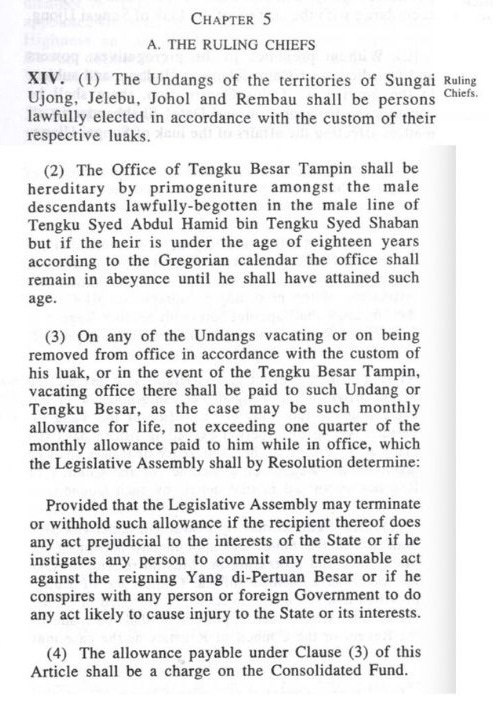
Article 14 opens Chapter 5 of the Negeri Sembilan Constitution 1959, headed “The Ruling Chiefs”.
It runs to four clauses and does two jobs. The first two say who holds the five chieftainships and by what method. The last two deal with money.
The Article is deliberately sparse. It identifies who holds each office and leaves almost every procedural question to the customary law of each Luak.
The Constitution supplies the framework and adat supplies the detail, and most misreadings of Article 14 come from different interpretations, a traditional reading of customary law set against a strict reading of the Constitution.
What each clause means
Article 14(1): Who the four Undangs are, and by what method they hold office
The Undangs of the territories of Sungai Ujong, Jelebu, Johol and Rembau shall be persons lawfully elected in accordance with the custom of their respective luaks.
This is the hinge of the chapter. The Constitution states that an Undang is elected, then hands over the whole question of how: who may take part, what qualifies a candidate, how a nomination is made, when the process must run, and how a disputed result is settled are all left to the custom of the Luak.
The broad structure is similar across the four Luak. Authority rises from the perut (matrilineal sub-lineage) through the Buapak (sub-clan elder) and the Lembaga (clan chief) to the kerapatan (customary council), and eligibility is confined to recognised Biduanda waris lines.
Each Luak then applies its own rules on eligibility, consultation and succession.
“Elected” in Article 14(1) therefore means selection by adat rather than by majority vote. Decisions are reached by muafakat (consensus), and a candidate who commands the larger number while a principal waris withholds agreement has not been elected in the sense the clause uses. This is why objections raised during 2026 have alleged the absence of full muafakat rather than disputed a count.
Where rival gatherings each claim to have reached muafakat, Article 14 does not supply a mechanism for choosing between them. That question falls to Article 16 and the jurisdiction of the Dewan Keadilan dan Undang (DKU).
Article 14(2): Tampin, the hereditary exception, and what happens when the heir is a minor
The Office of Tengku Besar Tampin shall be hereditary by primogeniture amongst the male descendants lawfully-begotten in the male line of Tengku Syed Abdul Hamid bin Tengku Syed Shaban but if the heir is under the age of eighteen years according to the Gregorian calendar the office shall remain in abeyance until he shall have attained such age.
Tampin is the exception in an otherwise elective chapter. The office passes by patrilineal primogeniture within a single named line, and the clause fixes the founder of that line by name.
Two theories of legitimacy therefore sit in adjacent clauses. The four Undangs hold office because a Luak chose them under matrilineal custom, which leaves their tenure answerable to the body that conferred it. The Tengku Besar of Tampin holds office by birth order within a male line, a reflection of Tampin’s separate history as a territory attached to Negeri Sembilan on different terms from the four core Luak.
The age proviso separates succession from the holding of office. A minor may be the heir, but he does not become Tengku Besar until he reaches eighteen. Until then, the office itself remains in abeyance. Article 14(2) does not make any provision for a regent, deputy or acting Tengku Besar to exercise its functions in the meantime.
Article 14(3): The pension on leaving office, and the grounds on which it can be withheld
On any of the Undangs vacating or on being removed from office in accordance with the custom of his luak, or in the event of the Tengku Besar Tampin, vacating office there shall be paid to such Undang or Tengku Besar, as the case may be such monthly allowance for life, not exceeding one quarter of the monthly allowance paid to him while in office, which the Legislative Assembly shall by Resolution determine:
Provided that the Legislative Assembly may terminate or withhold such allowance if the recipient thereof does any act prejudicial to the interests of the State or if he instigates any person to commit any treasonable act against the reigning Yang di-Pertuan Besar or if he conspires with any person or foreign Government to do any act likely to cause injury to the State or its interests.
This clause is about money. The opening words are a temporal condition describing when a payment obligation is triggered, namely an Undang vacating office or being removed in accordance with the custom of his Luak. The operative verb is “there shall be paid”.
Article 14(3) acknowledges that removal happens under Luak custom, and then sets a pension. Removal itself is a customary act of the Luak.
Where a question arises about whether that act occurred, the route runs through Article 16, under which the DKU advises on questions of Malay custom including the removal from or vacation of office of a Ruling Chief, and under Article 16(3) that advice is final and cannot be challenged in any court on any ground.
The terms of the pension are worth stating plainly:
The payment runs for life.
The ceiling is one quarter of the monthly allowance the holder received in office.
The figure is set by resolution of the Legislative Assembly, so a departed chief’s income is determined by elected politicians rather than by the palace, the DKU, or his own Luak.
The proviso then allows the same Assembly to terminate or withhold the allowance on three grounds: acts prejudicial to the interests of the State, instigating any person to commit a treasonable act against the reigning Yang di-Pertuan Besar, and conspiring with any person or foreign government to injure the State or its interests.
The wording tracks the proviso at Article 9(5), which governs the allowance payable to a Yang di-Pertuan Besar who has abdicated. The framers used one template for departed rulers and departed chiefs alike.
Article 14(4): Where the money comes from, and why that matters
The allowance payable under Clause (3) of this Article shall be a charge on the Consolidated Fund.
A charge on the Consolidated Fund is a payment authorised by the Constitution itself, which means it flows without needing to be voted through in the annual supply exercise. The effect is insulation. The sum cannot be quietly starved by omitting it from a budget line, and the Assembly can reach it only by acting openly under the Article 14(3) proviso, by resolution.
What Article 14 does not say
Four propositions are commonly attached to this Article that its text will not carry, and one limit is worth adding.
On removal powers. The Article records that removal occurs according to the custom of the Luak and attaches a pension to that event. The grounds, the deciding body, and the procedure all sit within customary law, and the DKU’s function of advising on questions of custom is conferred by Article 16 rather than by anything in Article 14.
On the role of the Yang di-Pertuan Besar. The Article assigns the choice to the Luak. The June 2026 installations followed the sequence it contemplates, with each Luak first settling on its candidate under adat and the candidate then presented before the Yang di-Pertuan Besar at an Istiadat Mengadap (audience of presentation) at Istana Besar Seri Menanti. What the throne supplies is recognition and effect, on a choice already made.
On a unified procedure. Article 14 does not prescribe a single method for electing the Undangs. Instead, it recognises the customary law of each Luak. Although the broad structure is similar, with authority exercised through the institutions of the perut, Buapak and Lembaga, and eligibility generally confined to designated Biduanda hereditary lineages, the detailed procedures differ from one Luak to another.
Rembau alternates between the Waris Jakun, whose chief bears the title Dato’ Lela Maharaja, and the Waris Jawa, whose chief bears the title Dato’ Sedia Raja. The Buapak Delapan first determines the lubuk benih, the village from which the candidate is to be chosen. The members of that village then select the candidate, after which the Lembaga Tiang Balai proclaims the result.
Sungai Ujong draws its Dato’ Klana from the Waris Klana, divided between the Perut Hulu and Perut Hilir. The election is conducted in practice by three electors, whose decision is expected to be unanimous in accordance with the principle of kebulatan. Where unanimity cannot be achieved, the Lembaga Tiang Balai may nominate a candidate of their own choosing.
Jelebu limits eligibility to three designated waris within the Biduanda clan, with succession rotating between them in a fixed order. Nomination begins within the relevant perut, passes through the Dato’ Ombi and Dato’ Mentri for verification of lineage and customary qualifications, and concludes with election by a council of eight Lembaga. The preference is for unanimity, although historical precedent exists for decisions by majority.
Johol is less fully documented in the published procedural literature than Rembau, Sungai Ujong and Jelebu.
Most of the principal English-language studies of Negeri Sembilan’s customary electoral systems were written between 1910 and 1946, and customary practice within each Luak has continued to evolve since. Article 14 recognises the custom of each Luak separately, so an objection valid under the custom of one Luak may not apply in another.
On disputed questions of custom. Article 14 assumes a Luak capable of producing one lawful answer. Where it cannot, the question passes to the DKU, which advises on questions of Malay custom under Article 16.
On enforcement. Article 14 says who the Undang is, and the state has to give effect to it. The 14th Undang Luak Johol was removed by his Luak in March 2016 and was still living in the Balai Undang more than a year later, until the state government cut off the water and electricity. The state's position was that the residence belongs to the office rather than to the man. Undangs have been removed before, and the state's power over an official residence has been tested and used.
Article 14 is often misunderstood as the Constitution choosing the Undangs. In reality, it leaves the choice where adat has always placed it: with each Luak acting according to its own custom.
Footnote: The Constitution numbers its Articles in Roman numerals. This publication uses Arabic numerals for readability.
Our posts referencing Article 14:
Sources:
Sungai Ujong (Journal of the Malayan Branch of the Royal Asiatic Society, 1921)
Sungei Ujong (Journal of the Malayan Branch of the Royal Asiatic Society, 1949)
Hassan dizahirkan sebagai Undang Luak Rembau ke-22 (Sinar Harian, 27 June 2026)
Anak Nogori is independent commentary on the unfolding constitutional crisis in Negeri Sembilan, where centuries-old Adat Perpatih, royal succession law, and modern political manoeuvring are colliding in ways Malaysia has never seen before. If you find this useful, share it with someone who should be following this, or subscribe to receive the latest articles in your inbox.
