

What is Article 7 of the Negeri Sembilan Constitution 1959?
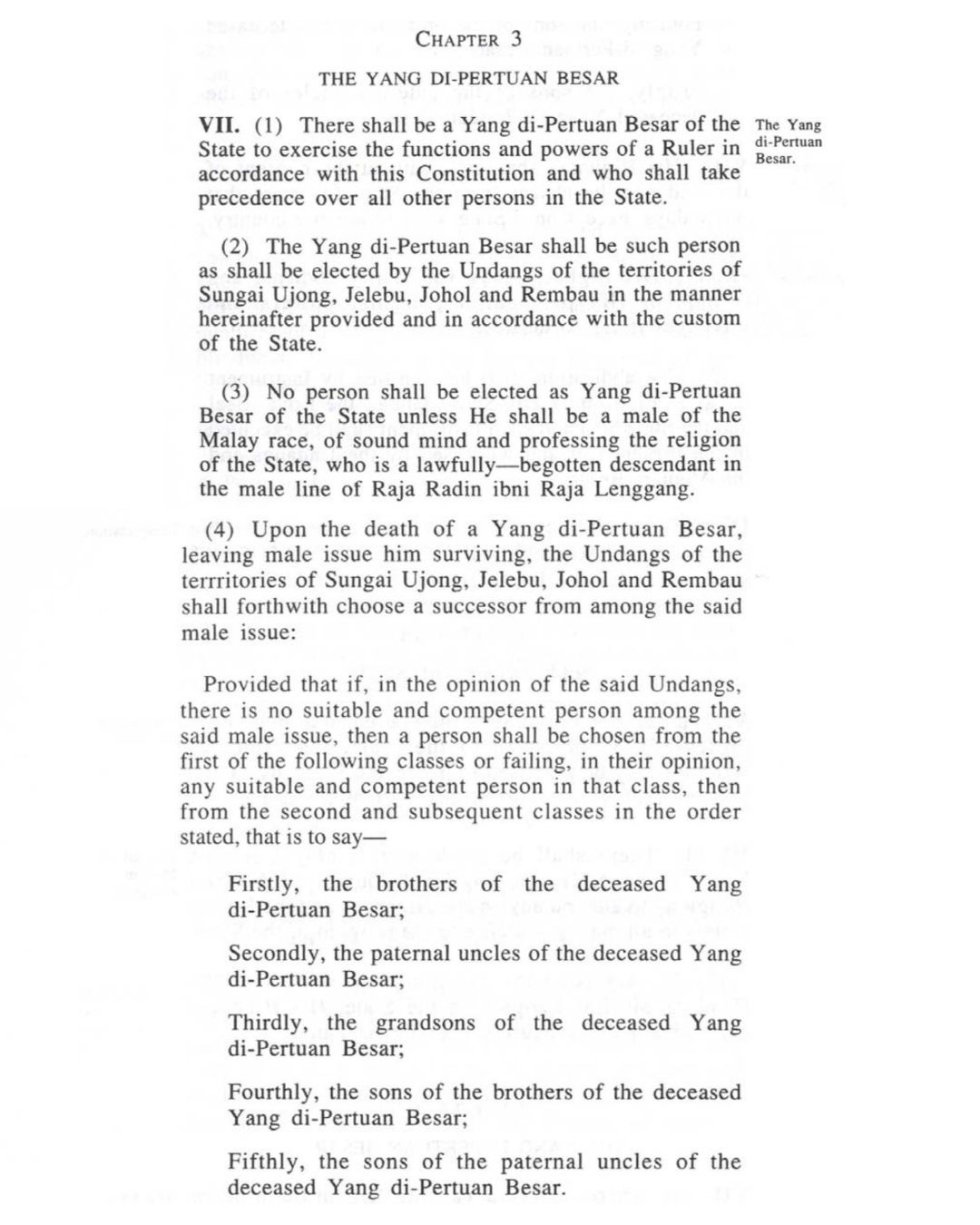
Article 7 creates the office of Yang di-Pertuan Besar, provides that he is elected by the four Undangs, sets out who is eligible, and sets out who may be chosen when a Yang di-Pertuan Besar dies.

What each clause means
Article 7(1): The office exists, and it outranks everyone.
There shall be a Yang di-Pertuan Besar of the State, who exercises the functions and powers of a Ruler in accordance with the Constitution and takes precedence over all other persons in the State. The office is the highest in Negeri Sembilan, and its powers are those conferred by the Constitution.
Article 7(2): The four Undangs choose him.
The Yang di-Pertuan Besar is elected by the Undangs of Sungai Ujong, Jelebu, Johol and Rembau, in the manner the Constitution goes on to provide and in accordance with the custom of the State. This is the sentence that makes Negeri Sembilan different from every other Malay state. Elsewhere the throne passes down a family line. Here it is filled by an election, and the electors are the four chiefs of the Luak.
Each Undang reaches office through the customary process of his own Luak. That is why disputes over who is lawfully an Undang can ultimately affect who may participate in electing the Yang di-Pertuan Besar.
Article 7(3): Who is eligible.
A person may be elected Yang di-Pertuan Besar only if he is male, of the Malay race, of sound mind, professing the religion of the State, and a lawfully-begotten descendant in the male line of Raja Radin ibni Raja Lenggang. The last requirement is the tightest. The office is filled by election, but the pool of eligible candidates is fixed by descent. The Undangs choose, and they choose from within a defined family.
Article 7(4): What happens when a Yang di-Pertuan Besar dies.
Upon the death of the Yang di-Pertuan Besar, leaving male issue surviving him, the four Undangs must choose his successor from among that male issue, and must do so forthwith, that is, without unnecessary delay.
The Constitution says “male issue”, which here means his sons. Grandsons appear separately, as the third class in the list below, and the list would make no sense if they were already included in the first pool.
Should the Undangs form the view that no suitable and competent person is to be found among the sons, they move to a list of five classes, taken strictly in order:
first, the brothers of the deceased Yang di-Pertuan Besar
second, his paternal uncles
third, his grandsons
fourth, the sons of his brothers
fifth, the sons of his paternal uncles
They may only move down the list once they have formed the view that the class above holds nobody suitable and competent. The judgement is theirs, and the order is the Constitution’s.
What Article 7 does not say
Article 7(4) provides for an election upon the death of a Yang di-Pertuan Besar. It provides for no other occasion. The circumstances in which the office may fall vacant during the lifetime of the incumbent are dealt with elsewhere in the Constitution, and they are narrow.
An election may also become necessary following a voluntary abdication under Article 9, an abdication called for by the Undangs after a full and complete enquiry under Article 10(1)(b), or a conviction and sentence in the Special Court under Article 10A(2).
Only in those three situations does Article 11 place a duty on the Undangs to choose and elect another Yang di-Pertuan Besar. Outside them, Article 7 provides no independent authority to elect another Yang di-Pertuan Besar.
Article 7(4) is also worth reading alongside Article 12(2), which provides that a Regent or Council of Regency shall be appointed from among the persons listed in Article 7(4). The succession classes therefore perform two constitutional functions. They identify the classes from which a Yang di-Pertuan Besar may be elected, and they identify the classes from which a Regent or Council of Regency may be appointed.
Articles Referencing Article 7:
What Is the Tunku Panglima Besar, and Why Did Tunku Nadzaruddin Lose It to Tunku Zain?
What the Federal Constitution Says About Negeri Sembilan: Articles 71, 160, 181
Why Do Several Wikipedia Pages Now Call the Undangs ‘Rajas’ of Negeri Sembilan?
Source:
Negeri Sembilan Constitution 1959
Anak Nogori is independent commentary on the unfolding constitutional crisis in Negeri Sembilan, where centuries-old Adat Perpatih, royal succession law, and modern political manoeuvring are colliding in ways Malaysia has never seen before. If you find this useful, share it with someone who should be following this, or subscribe to receive the latest articles in your inbox.
