


(Updated 1 October 2026)
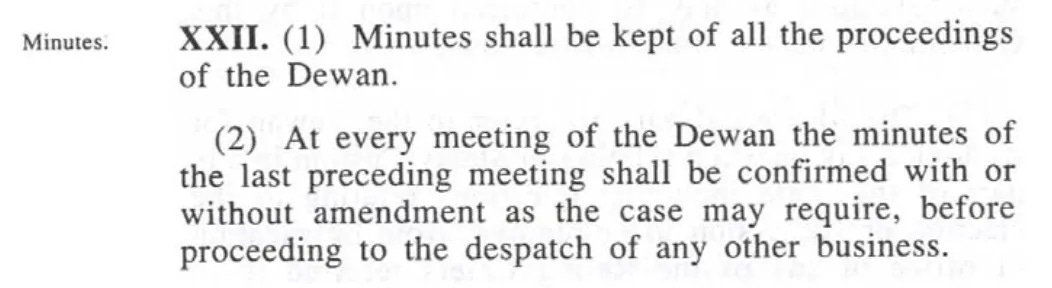
Article 22 sits in Chapter 6 of the Negeri Sembilan Constitution 1959, the chapter that establishes the Dewan Keadilan dan Undang (DKU).
What each clause means
Article 22(1): The requirement that minutes be kept of Dewan proceedings
(1) Minutes shall be kept of all the proceedings of the Dewan.
Every meeting of the Dewan must produce minutes, a written record of what took place. The Article does not say who prepares them, in what form, or on what timeline. That falls to Article 25, which allows His Highness to appoint a Secretary to the Dewan, and to Article 21, which lets the Dewan determine its own procedure.
Article 22(2): The confirmation of minutes at the next meeting, before other business
(2) At every meeting of the Dewan the minutes of the last preceding meeting shall be confirmed with or without amendment as the case may require, before proceeding to the despatch of any other business.
At the start of each meeting, the Dewan must first agree on the minutes of the meeting before it, confirming them as written or with amendment, before turning to any new item. It is a standard deliberative-body mechanism, designed to ensure the written record is checked against the collective memory of the members while that memory is still fresh, and before it is overtaken by the next round of business.
What Article 22 does not say
Article 22 is silent on several questions that have become live in 2026:
who, beyond the members of the Dewan, is entitled to see the minutes once they are confirmed;
the timeline for drafting and circulating minutes before the next meeting
These falls to the Dewan’s own procedure under Article 21 and to its Secretary under Article 25.
Why this matters in 2026
The court proceedings
At its 17 April 2026 sitting, the DKU acknowledged the removal of the previous Undang of Luak Sungei Ujong, Mubarak Dohak. On 5 May, Mubarak and five others filed an originating summons at the Seremban High Court. The other plaintiffs are Maarof Mat Rashad, the previous Undang of Luak Jelebu; Muhammed Abdullah, Undang of Luak Johol; Abdul Rahim Yasin, whose appointment as Undang of Luak Rembau the DKU maintains was never completed; the Tunku Besar Tampin; and the Dato’ Shahbandar of Sungei Ujong. They sought three things:
a declaration that, as DKU members, they are entitled to copies of the minutes;
an order that the minutes be produced within seven days; and
a suspension of any enforcement of the 17 April decisions until the minutes are handed over (Free Malaysia Today, 5 May 2026).
At the 13 May sitting, counsel for the state government argued that only Dewan members are entitled to the minutes, and that their preparation, drafting, safekeeping and release fall outside the state government’s jurisdiction. Counsel for the DKU raised a separate objection under Article 16(3), which places the Dewan’s advice on questions of Malay custom, including the removal of a Ruling Chief, beyond challenge in any court. The court made no order on the plaintiffs’ application for an interim stay (Free Malaysia Today, 13 May 2026).
Article 22(2) has since entered the case directly. GK Ganesan, writing from the court filings, reports that the DKU Secretary’s affidavit in reply, dated 26 May, relies on Article 22(2) to argue that minutes take legal form only once confirmed at the Dewan’s next meeting, so that no confirmed minutes yet exist to hand over (GK Legal, 27 September 2026).
The outcome of the 28 September case management had not appeared in public reporting at the time of writing, and Malaysiakini reported on 30 September that the minutes application remains pending before the Seremban High Court (Malaysiakini, 30 September 2026).
The UMNO statement of 30 September
On 30 September, UMNO Negeri Sembilan’s information chief, Muhammad Sufian Maradzi, issued a statement which described the question of the 17 April minutes as “fundamental” to the crisis, asked why the record underlying such a major decision was not produced when the dispute began, and said the previous PKR-led state government under Aminuddin Harun had failed to resolve the matter (Malaysiakini, 30 September 2026, The Star, 30 September 2026). The statement also described the Sungei Ujong position as having been “decided collectively” through the DKU.
Read against the Constitution and the court record, the statement raises four points:
Custody of the record. The UMNO statement attributes the non-release of the minutes to the previous state government. Article 22 places the duty to keep minutes on the Dewan, and Article 25 provides for a Secretary appointed by His Highness. In May, the state government’s counsel told the court that the preparation, safekeeping and release of the minutes fall outside the state government’s jurisdiction (Free Malaysia Today, 13 May 2026). The state government remains a defendant in the suit.
Confirmation of minutes. Aminuddin replied that he attended the sitting as a member and had no power to direct the DKU Secretary to release minutes the Dewan’s members had not yet confirmed (Harapan Daily, 30 September 2026). His account follows the same Article 22(2) reasoning that GK Ganesan attributes to the DKU Secretary’s affidavit. Only two DKU sittings have been reported since 17 April, both of them special meetings, not ordinary ones. Whether or not minutes can be confirmed at special sessions is not specified in the Constitution, but Article 21 allows the Dewan to determine its own procedure.
The DKU’s role. The UMNO statement says the position of the Undang of Luak Sungei Ujong was “said to have been decided collectively” through the DKU. This is inaccurate. The Constitution gives the DKU an advisory role on these questions. The removal of an Undang is a customary act of the Luak, which the DKU acknowledges, and under Article 16 the DKU advises on questions of Malay custom, including the removal of a Ruling Chief.
The effect of the minutes on advice already given. Article 16(3) makes that advice final and beyond challenge in any court. Releasing the minutes does not alter the DKU’s acknowledgement of Mubarak’s removal as Undang of Luak Sungei Ujong.
Footnote: The Constitution numbers its Articles in Roman numerals. This publication uses Arabic numerals for readability.
Our posts referencing Article 22 or the DKU minutes:
What Happened at the Seremban High Court Sitting on 13 May: covers the originating summons for the 17 April DKU minutes and the state government’s jurisdictional objection that Article 22 sits behind.
Sources
4 Undang bawa krisis adat N Sembilan ke mahkamah (Free Malaysia Today, 5 May 2026)
Fresh contempt bid filed against 6 in Negeri Sembilan dispute (Free Malaysia Today, 28 July 2026)
Anak Nogori is independent commentary on the unfolding constitutional crisis in Negeri Sembilan, where centuries-old Adat Perpatih, royal succession law, and modern political manoeuvring are colliding in ways Malaysia has never seen before. If you find this useful, share it with someone who should be following this, or subscribe to receive the latest articles in your inbox.
