


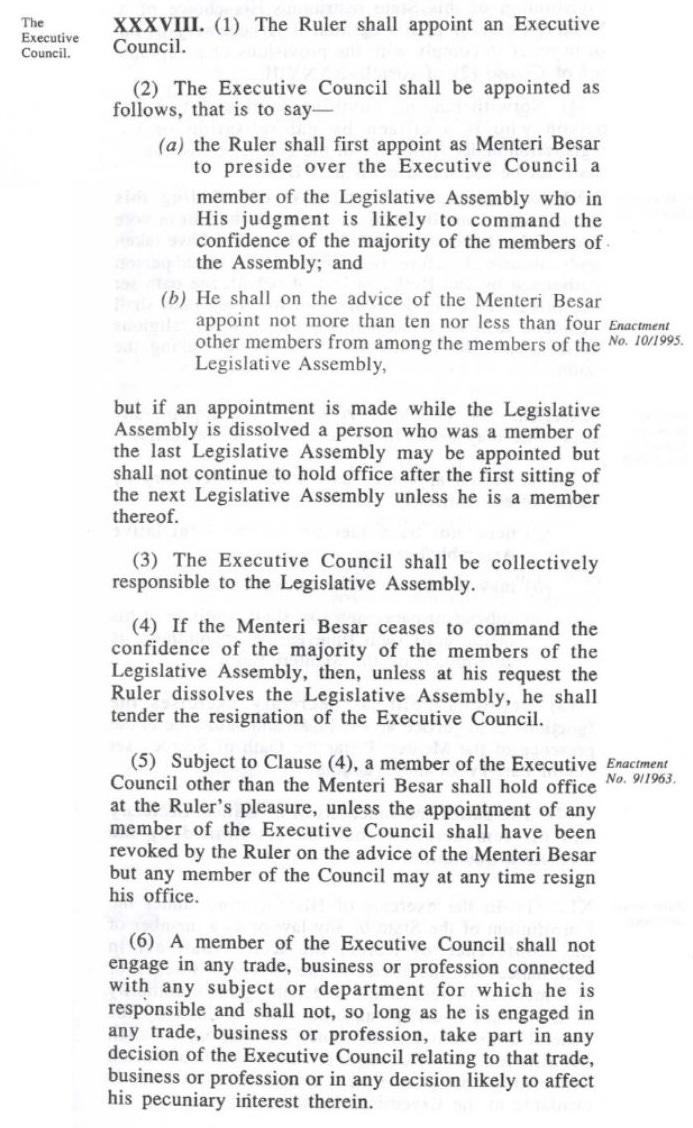
Article 38 sits in Chapter 2 of the Second Part of the Negeri Sembilan Constitution 1959, under the heading ‘Executive’.
(Note: Based on Article 28(2), “Ruler” here refers to His Highness and at least three of the four Undangs, or at least two if only three Undangs hold office.)
While Article 36 fixes the paperwork for appointing a Menteri Besar, Article 38 is the Article that builds the Council itself.
It sets the test for choosing the Menteri Besar, the process for appointing the remaining members, the principle of collective responsibility, the resignation trigger when confidence is lost, the tenure of ordinary members, and a conflict of interest bar.
What each clause means
Article 38(1): The Ruler’s duty to appoint an Executive Council
(1) The Ruler shall appoint an Executive Council.
This clause is a duty, not an option. The word “shall” leaves no room for the state to be run without a constituted Executive Council in place.
Article 38(2)(a): The confidence test for choosing the Menteri Besar
(2) The Executive Council shall be appointed as follows, that is to say:
(a) the Ruler shall first appoint as Menteri Besar to preside over the Executive Council a member of the Legislative Assembly who in His judgment is likely to command the confidence of the majority of the members of the Assembly; and
Three conditions sit inside this single sentence. The appointee must already be a member of the Legislative Assembly. The test is a test of confidence, meaning the support of a majority of the Assembly’s members, not popularity, seniority, or any other measure.
The judgment on who meets that test belongs to the Ruler, formed by looking at the composition of the Assembly rather than by conducting a floor vote before the appointment is made. Article 36(1) then requires this choice to be formalised through an Instrument executed under the Ruler’s Sign Manual and State Seal.
Article 38(2)(b): The four to ten range on the Menteri Besar’s advice, and the limits on appointments made during a dissolution
(b) He shall on the advice of the Menteri Besar appoint not more than ten nor less than four other members from among the members of the Legislative Assembly, (Enactment No. 10/1995)
but if an appointment is made while the Legislative Assembly is dissolved a person who was a member of the last Legislative Assembly may be appointed but shall not continue to hold office after the first sitting of the next Legislative Assembly unless he is a member thereof.
Once the Menteri Besar is in place, the remaining Council is built on his advice rather than the Ruler’s personal judgment, and it must number no fewer than four and no more than ten members, all drawn from the Legislative Assembly. The clause then anticipates the gap that opens when an Assembly stands dissolved ahead of an election. A person who sat in the outgoing Assembly may still be appointed to the Council during that gap, but the appointment does not survive the first sitting of the new Assembly unless that person has been re-elected as a member of it.
Article 38(3): The Executive Council’s collective responsibility to the Legislative Assembly
(3) The Executive Council shall be collectively responsible to the Legislative Assembly.
The Council answers to the Assembly as a body. No individual member’s accountability substitutes for the Council’s, and no member is shielded from a collective reckoning by having personally opposed a decision inside the Council’s own deliberations.
Article 38(4): The resignation duty when the Menteri Besar loses confidence, and the dissolution option
(4) If the Menteri Besar ceases to command the confidence of the majority of the members of the Legislative Assembly, then, unless at his request the Ruler dissolves the Legislative Assembly, he shall tender the resignation of the Executive Council.
Losing majority confidence carries one of two consequences. The default is resignation of the whole Council. The alternative, a dissolution of the Assembly, is available only if the Menteri Besar requests it and the Ruler agrees. Article 40(2)(b) separately places the withholding of consent to a dissolution request among the functions the Ruler may exercise in his own discretion, which means the choice between these two paths is not automatic on either side.
Article 38(5): Tenure at the Ruler’s pleasure, and revocation on the Menteri Besar’s advice
(5) Subject to Clause (4), a member of the Executive Council other than the Menteri Besar shall hold office at the Ruler’s pleasure, unless the appointment of any member of the Executive Council shall have been revoked by the Ruler on the advice of the Menteri Besar but any member of the Council may at any time resign his office. (Enactment No. 9/1963)
Ordinary members serve at the Ruler’s pleasure and can be removed if the Ruler acts on the Menteri Besar’s advice to revoke an appointment, or they may resign on their own initiative at any time. The Menteri Besar’s own position is excluded from this clause. He is not removed by a simple revocation of appointment; his tenure runs through the confidence mechanism in Clause (4) instead.
Article 38(6): The bar on trade, business, or professional conflicts of interest
(6) A member of the Executive Council shall not engage in any trade, business or profession connected with any subject or department for which he is responsible and shall not, so long as he is engaged in any trade, business or profession, take part in any decision of the Executive Council relating to that trade, business or profession or in any decision likely to affect his pecuniary interest therein.
A member cannot hold a trade, business, or profession that connects to the portfolio he is responsible for, and even where the connection falls short of that, he must step back from any Council decision that touches his own pecuniary interest.
What Article 38 does not say
Article 38 leaves the Ruler’s judgment on ‘likely to command the confidence of the majority’ unstructured on the face of the text, without requiring a floor vote, a signed statement of support, or any other formal mechanism before the appointment itself is made.
Article 38 does not identify which ‘Ruler’ exercises the Article 38(2)(a) appointment power, whether the Yang di-Pertuan Besar acting alone or a composite body. That classification runs through Article 40(2)(a), which lists the appointment of a Menteri Besar among the functions the Ruler may exercise in his own discretion, and Article 28(2), which defines ‘Ruler’ for those discretionary functions as the Yang di-Pertuan Besar together with at least three of the four Undangs, or at least two where only three currently hold office.
Article 38 sets a numeric floor and ceiling for ordinary Council membership but does not fix the quorum needed to transact Council business. That figure appears separately in Article 42.
Article 38 does not describe the oath a member must take before sitting or voting. That requirement is set out in Article 39.
Article 38(4) does not specify how a loss of confidence is to be demonstrated, leaving open whether a recorded Assembly vote, a public withdrawal of support by enough members to break the majority, or some other event satisfies the threshold.
Article 38 does not condition Council membership on belonging to any particular political party. The test throughout is confidence and Assembly membership, not partisan affiliation.
How Article 38 came under strain in 2026
Both halves of Article 38, the confidence mechanism and the appointment mechanism, have been tested this year.
On 27 April 2026, all 14 Barisan Nasional assemblymen announced they were withdrawing support from Menteri Besar Aminuddin Harun, with Perikatan Nasional’s five assemblymen expressing readiness to work with them, a combination that would hold 19 of the Assembly’s 36 seats (Malay Mail, 27 April 2026,The Edge Malaysia, 27 April 2026). Tuanku Muhriz decreed that Aminuddin continue in office until there was further clarity, in line with the law of the state (The Star, 27 April 2026).
Within days the withdrawal reversed: on 30 April, after discussions with UMNO president Ahmad Zahid Hamidi, all 14 agreed to remain within the unity government framework (FMT, 30 April 2026,The Star, 30 April 2026).
The episode ended in the clause’s second path. On 4 June 2026, Tuanku Muhriz consented to a dissolution of the Dewan Undangan Negeri on the Menteri Besar’s advice, the Assembly stood dissolved the following day (Malay Mail, 4 June 2026,FMT, 4 June 2026), and the Election Commission fixed polling day for 1 August 2026 (Bernama, 12 June 2026).
After 1 Aug polling, Article 38 runs again from the top: a Menteri Besar chosen under the Article 38(2)(a) confidence test, then four to ten members appointed on his advice under Article 38(2)(b).
The appointment of the Menteri Besar is an Article 40(2)(a) discretionary function, so Article 28(2)’s definition of “Ruler” applies, and that composite body may itself change before the polls close: The Straits Times reported on 30 July, citing unnamed sources, that the Dewan Keadilan dan Undang (DKU) was convened for 31 July, the eve of polling, to acknowledge the removal of the Undang of Jelebu, Maarof Mat Rashad (The Straits Times, 30 July 2026).
The contest itself is multi-cornered across all 36 seats (The Edge Malaysia, 27 July 2026). Any side reaching 19 seats answers the Article 38(2)(a) question by arithmetic. Anything short of that, whether an 18–18 deadlock or a fragmented field topping out at 17, makes the Ruler’s judgment the operative decision.
Footnote: The Constitution numbers its Articles in Roman numerals. This publication uses Arabic numerals for readability.
Sources:
Aminuddin to stay on as Negri MB following Ruler’s decree (The Star, 27 April 2026)
14 Umno reps still support Negeri Sembilan unity govt, says Zahid (FMT, 30 April 2026)
Negeri Sembilan assembly to be dissolved tomorrow (FMT, 4 June 2026)
Johor State Election On July 11, Negeri Sembilan On Aug 1 - EC (Bernama, 12 June 2026)
Anak Nogori is independent commentary on the unfolding constitutional crisis in Negeri Sembilan, where centuries-old Adat Perpatih, royal succession law, and modern political manoeuvring are colliding in ways Malaysia has never seen before. If you find this useful, share it with someone who should be following this, or subscribe to receive the latest articles in your inbox.
