


The latest manoeuvre in the Negeri Sembilan constitutional crisis has moved the conflict from a dispute over customary law to a direct challenge of the state's highest legal text.
On 29 May 2026, the removed Undang Mubarak along with five adat office-holders, the Undangs of Jelebu, Johol, and Rembau, the Tunku Besar Tampin and the Dato’ Shahbandar, issued a joint media statement that set out to do three things: suspend the Secretary of the Dewan Keadilan dan Undang (DKU), Raja Norazli Raja Nordin, appoint a committee to take over his powers and fix 5 June as the date for a special sitting at the Tunku Besar Tampin’s official hall (The Star, 29 May 2026).
In their own statement, they describe themselves as “pemerintah bersama (Co Ruler) Negeri Sembilan merangkap ahli majoriti Dewan Keadilan dan Undang Negeri Sembilan” (co-rulers of Negeri Sembilan and as the majority of the DKU) (Malaysiakini, 29 May 2026).
The 29 May declaration fails because it attempts to exercise the powers of the Dewan Keadilan dan Undang (DKU) outside of a lawfully convened session, while usurping executive authorities reserved exclusively for the Yang di-Pertuan Besar. The analysis below examines the announcement against the Negeri Sembilan Constitution 1959, provision by provision, arguing why each of its claims is difficult to sustain constitutionally.
Can the Ruling Chiefs1 suspend or dismiss the DKU Secretary?
No. The appointment and tenure of the Secretary are reserved exclusively to the Yang di-Pertuan Besar. Article 25 vests in His Highness alone the power to appoint the Secretary, who “shall hold office during His pleasure”. The power to suspend or remove is the obverse of the power to appoint, and it resides in the same hand. A suspension declared by members is therefore ultra vires, an act beyond their authority.

This constitutional defect is fatally compounded by the inclusion of Mubarak. Having been lawfully removed from office, he is no longer a member of the Dewan Keadilan dan Undang. His signature on the joint statement does not merely fail to enlarge the group’s authority; it actively taints the document by attempting to exercise state power through a non-member.
Can a committee be appointed to suspend the DKU Secretary and his powers?
No. The power to set up committees under Article 21 cannot be used to fill or remove the office of Secretary, which the Constitution reserves to His Highness under Article 25. The Secretary holds office “during His pleasure”, so the power to suspend or remove him rests in the same hand that appoints him. A body cannot delegate a power it was never given, so a committee created under Article 21 cannot reach an office the Constitution confines to His Highness. The defect is compounded by the fact that the committee was purportedly created through a signed statement rather than by the Dewan sitting in session.

Can the Ruling Chiefs convene a DKU meeting without the Yang di-Pertuan Besar?
No. Article 19 provides that the Yang di-Pertuan Besar presides at every sitting, and it permits the members to elect a substitute to preside only “in His absence”. That phrase covers a genuine inability to preside, rather than an absence created by excluding the presiding officer from the sitting altogether by treating the chair as no longer his.
The 29 May statement makes no provision for His Highness to preside, because it proceeds on the footing that his position has already been displaced, describing the signatories as “pemerintah bersama (Co Ruler) Negeri Sembilan” and asserting that Tuanku Muhriz's “status and position as Power-Holder (Punca Kuasa)” has been “stripped”.
That premise has no constitutional event behind it, because Article 10, the only route by which the Undangs may act against a sitting Yang di-Pertuan Besar, was not fulfilled. With those steps absent, Article 11 leaves Tuanku Muhriz as the Yang di-Pertuan Besar, and Article 19 still seats him as the one who presides. A sitting convened on the footing that the chair stands vacant or jointly held therefore falls outside the situation Article 19 was drafted to address.

Can the Ruling Chiefs convene the special sitting on 5 June themselves?
The Constitution does not name who summons a sitting of the Dewan. However, no provision empowers the members to summon the Dewan. Article 18 fixes only that it shall meet at least three times a year, and it allocates no convening power to anyone, still less to a group of members.

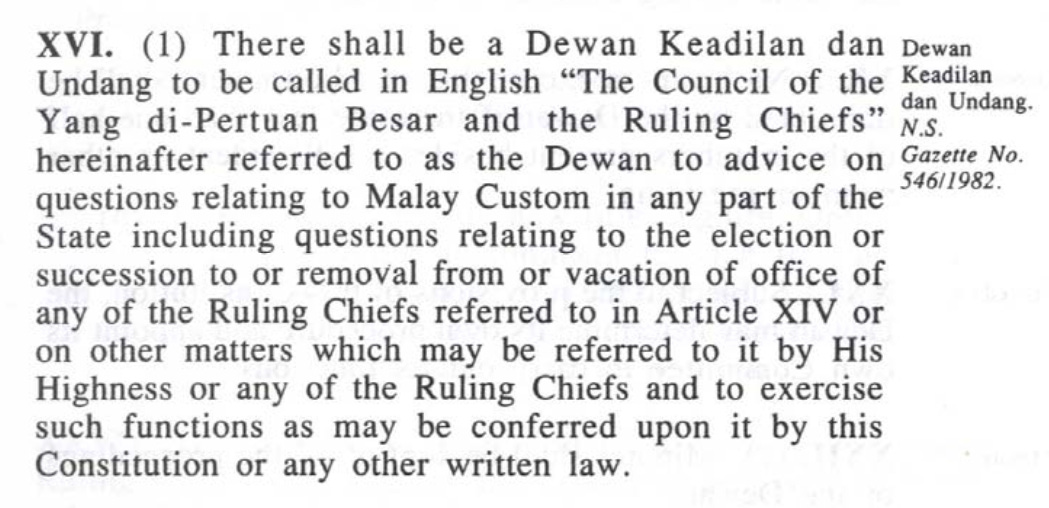
The most a Ruling Chief may do under Article 16(1) is refer a matter to the Dewan for its advice. Article 16(1) carries no power to fix a date or summon the sitting at which the question would be heard.
Was an alternate presiding officer lawfully appointed for the 5 June sitting?
No presiding officer was named. The election of a substitute under Article 19 is an act performed by the members at a convened DKU sitting; it cannot be settled beforehand by circular. The 29 May statement fixed a venue and focused on the Secretary, but left the chair unnamed.
Can a majority of the Ruling Chiefs exercise the DKU’s powers by signing a joint statement?
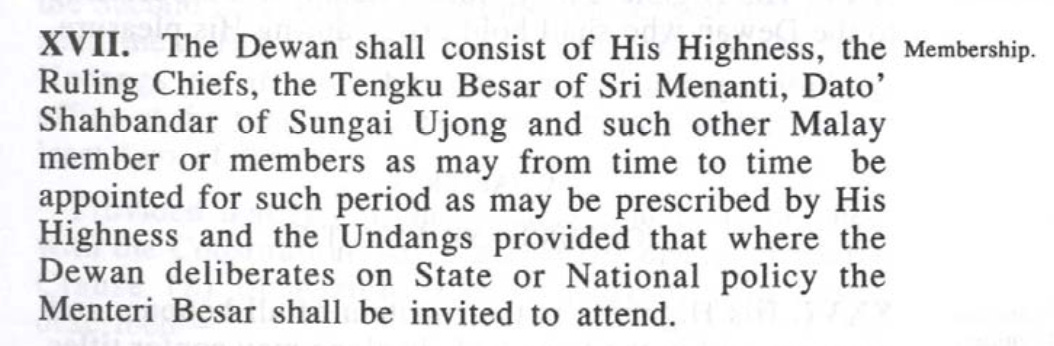
No. A majority of members has no capacity to exercise the Dewan’s powers by instrument, because those powers vest in the Dewan as a constituted body rather than in its members acting on their own. Article 17 is a composition provision: it enumerates who the members are and confers no executive faculty on members acting outside a sitting. The deliberative and advisory functions of the DKU are exercisable only once it is lawfully convened under Article 19 and quorate under Article 20. The statement conflates composition with authority. Membership of the Dewan does not, by itself, confer authority to exercise the Dewan's powers outside a lawfully constituted sitting.
Can the sitting be quorate without the Yang di-Pertuan Besar or a lawfully elected presiding member?
No. Article 20 assumes the existence of His Highness or substitute presiding officer. If no person is lawfully in the chair, the quorum provision cannot operate as intended.

Can the Ruling Chiefs invite non-members to DKU meetings?
Article 24 permits the Dewan to invite non-members to its meetings where their presence is considered desirable. That power belongs to the Dewan itself and is exercisable only when it is lawfully in session. The signatories to the 29 May declaration cannot exercise the Article 24 power of invitation, because the Dewan was not in session when the invitations were issued.

What this means
On this publication’s reading, the 29 May announcement is inconsistent with multiple provisions of the Constitution.
The DKU possesses authority only when it sits as a constituted body, convened in accordance with constitutional procedure, presided over by the Yang di-Pertuan Besar and quorate. Its powers belong to the Dewan acting in session, not to its members acting by declaration.
Measured against that standard, the statement purports to meet without His Highness contrary to Article 19; to proceed without a quorum that Article 20 cannot supply absent a lawful presiding figure; to suspend a Secretary whom Article 25 places in His Highness’ hands alone; to vest his powers in a committee that Article 21 cannot create for that purpose; to convene a sitting that no provision empowers the members to summon; and to invite observers under a power that Article 24 confers upon the Dewan rather than upon its members.
Mubarak and five adat office-holders set out to suspend a Secretary, install a committee and summon a sitting with a statement issued on 29 May. On this reading of the Constitution, none of those acts fall within their powers.
Read Next: Tuanku Muhriz is still the Yang di-Pertuan Besar of Negeri Sembilan
Footnote:
1 “Ruling Chiefs” is the term the Constitution uses for the Undangs of the four Luaks, Sungei Ujong, Jelebu, Johol, and Rembau together with the Tunku Besar of Tampin. The heading uses it for convenience to describe the signatories, yet one of them signs as Undang of Sungei Ujong while no longer holding that office. Mubarak ceased to hold the Sungei Ujong chieftainship on 17 April 2026, his removal having occurred under the custom of the Luak and acknowledged by the Dewan Keadilan dan Undang (DKU) under Article 16.
If you are new to this Substack, and are not sure where to begin, visit our Start Here page, where we list all our articles organised by theme.
Related Posts:


Sources:
The Laws of the Constitution of Negeri Sembilan 1959 (Negeri Sembilan State Government), 1959
Undangs take Negeri Sembilan crisis to court (Free Malaysia Today), 5 May 2026
Enam pembesar adat NS arah DKU buat sidang khas bincang kemelut (Malaysiakini), 23 May 2026
‘Kami amat murka’ - Undang Luak berempat gantung tugas setiausaha DKU (Malaysiakini), 29 May 2026
Anak Nogori is independent commentary on the unfolding constitutional crisis in Negeri Sembilan, where centuries-old Adat Perpatih, royal succession law, and modern political manoeuvring are colliding in ways Malaysia has never seen before. If you find this useful, share it with someone who should be following this, or subscribe to receive the latest articles in your inbox.
