

What is Article 15 of the Negeri Sembilan Constitution 1959?
Article 15 creates the office of Dato’ Shahbandar of Sungei Ujong, fills it by Luak custom, and requires the Dato’ Klana to consult him on affairs of the Luak.

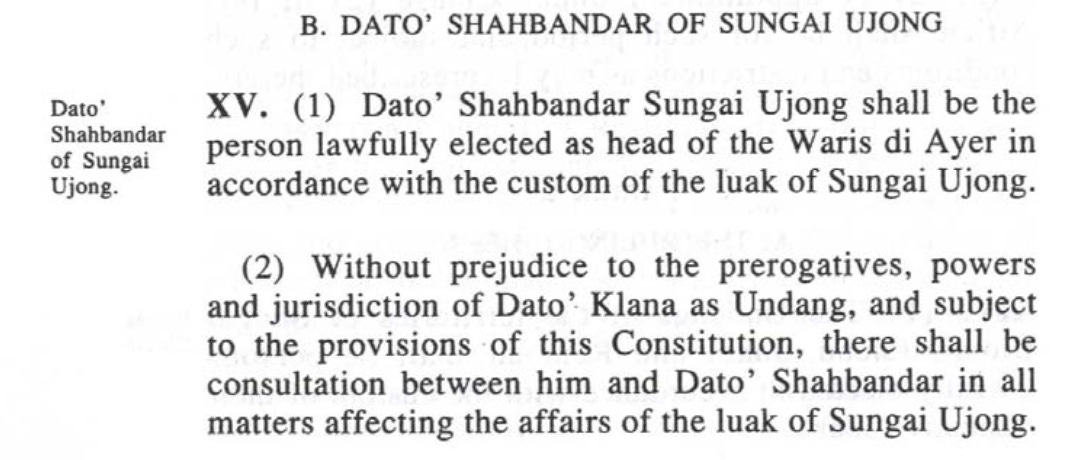
Chapter 5 of the Negeri Sembilan Constitution 1959 deals with the Ruling Chiefs. It comes in two parts. Part A, Article 14, covers the four Undangs and the Tengku Besar of Tampin.
Part B, Article 15, contains a single Article devoted to one office in one Luak, the Dato’ Shahbandar of Sungei Ujong.
What each clause means
Article 15(1): Who is Dato’ Shahbandar Sungai Ujong and how he is elected
(1) Dato’ Shahbandar Sungai Ujong shall be the person lawfully elected as head of the Waris di Ayer in accordance with the custom of the luak of Sungai Ujong.
The drafting mirrors Article 14(1), which describes the four Undangs in the same terms. The Constitution names the office and then sends the reader to customary law for how the office is elected. Luak custom determines who holds the office, and the Constitution recognises whoever has been lawfully elected under Luak custom.
The Waris di Ayer (literally, "the heirs of the water") is one of the principal hereditary lineage groupings (waris) within the Luak, alongside the Waris di Darat and the Klana Perut Hulu and Perut Hilir.
Article 15(2): The duty of consultation between the Dato' Shahbandar and the Undang on matters affecting the affairs of the Luak
(2) Without prejudice to the prerogatives, powers and jurisdiction of Dato’ Klana as Undang, and subject to the provisions of this Constitution, there shall be consultation between him and Dato’ Shahbandar in all matters affecting the affairs of the luak of Sungai Ujong.
The clause opens with two qualifiers before it reaches its operative words. The first preserves the prerogatives, powers and jurisdiction of the Dato’ Klana as Undang of Sungei Ujong. The second makes the whole clause subject to the rest of the Constitution.
Only then does the duty appear: there shall be consultation between the Dato’ Klana and the Dato’ Shahbandar in all matters affecting the affairs of the Luak. The obligation is mandatory in form, since the Constitution uses “shall”. Its subject matter is expressed in broad terms, extending to "all matters affecting the affairs of the Luak. Its effect stops at consultation, and the clause is silent on agreement, concurrence, veto or joint decision.
The separate treatment of the Dato’ Shahbandar reflects the distinctive constitutional position of Sungei Ujong. Although he is not a Ruling Chief, the Constitution singles the office out for express recognition, requires consultation between him and the Undang on Luak affairs, and separately makes him a member of the Dewan Keadilan dan Undang under Article 17. No equivalent constitutional provision exists for any other subordinate customary office.
What Article 15 does not say
The Dato’ Shahbandar is not a Ruling Chief. Article 34 defines “Ruling Chiefs” as the four Undangs together with the Tengku Besar of Tampin, and defines “the Undangs” as the Ruling Chiefs excluding the Tengku Besar of Tampin. The Dato’ Shahbandar falls outside both terms, so the functions the Constitution reserves to the Undangs, including the election of a Yang di-Pertuan Besar under Article 7 and Article 11 and the appointment of a Regent under Article 12, lie beyond his office.
However, he is a member of the DKU. Article 17 names the Dato’ Shahbandar of Sungei Ujong separately as a member of the Dewan Keadilan dan Undang (DKU), alongside the Ruling Chiefs and the Tunku Besar of Seri Menanti. That seat, and its effect on the quorum under Article 20, comes from Article 17 rather than from Article 15.
It says nothing about vacation of office or allowances. Article 14(3) provides a post-office allowance for an Undang or the Tengku Besar of Tampin, and sets out when the Legislative Assembly may withhold it. Article 15 carries no equivalent and describes no route out of the office.
It gives no role in proclaiming the Undang of Sungei Ujong. The Undang holds the title Dato’ Klana Petra, the office Article 15(2) refers to as Dato’ Klana. Any role for the Dato' Shahbandar in proclaiming a new holder rests on the customary law of the Luak rather than on the Constitution.
Article 15 brings the Dato’ Shahbandar into the Constitution but leaves the substance of the office to Adat, while requiring consultation with the Undang on all matters affecting the affairs of the Luak.
Footnote:
1 The Constitution numbers its Articles in Roman numerals. This publication uses Arabic numerals for readability.
2 The Constitution spells the Luak "Sungai Ujong" and the title "Tengku Besar of Sri Menanti". This publication uses "Sungei Ujong" and "Tunku Besar of Seri Menanti" throughout.
Our posts referencing Article 15 or Dato’ Shahbandar
Can Negeri Sembilan’s Ruling Chiefs Suspend the DKU Secretary and Convene Their Own Sitting?
Joint Media Statement: 29 May 2026 of removal of DKU Secretary\
Sources:
Anak Nogori is independent commentary on the unfolding constitutional crisis in Negeri Sembilan, where centuries-old Adat Perpatih, royal succession law, and modern political manoeuvring are colliding in ways Malaysia has never seen before. If you find this useful, share it with someone who should be following this, or subscribe to receive the latest articles in your inbox.
