


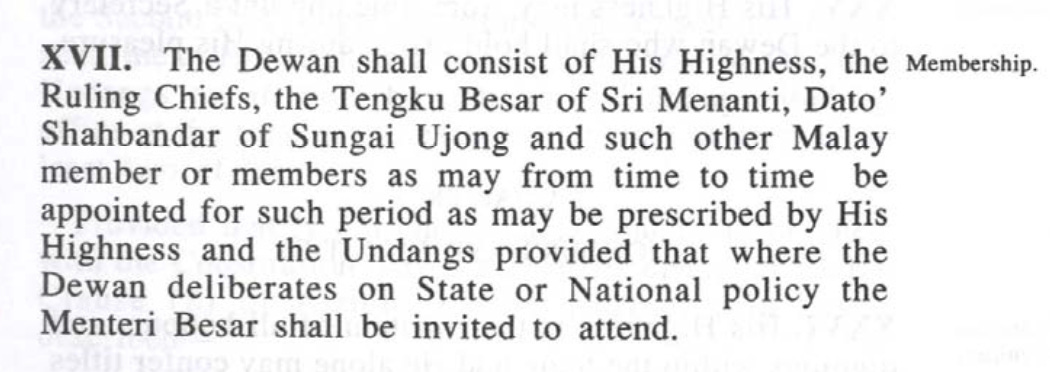
Article 17 defines the offices that carry the membership of the Dewan Keadilan dan Undang (DKU).
It covers three distinct matters:
It names eight offices whose holders sit as members by virtue of that office.
It creates a power to appoint further members, and says who may exercise it.
It then attaches a proviso about the Menteri Besar.
Because Article 17 defines the membership, it also supplies the denominator for Article 20, which sets the quorum, and for Article 19, which makes the Yang di-Pertuan Besar the presiding member. Anything the DKU does depends on the list in Article 17 being settled.
The eight core DKU members
“The Dewan shall consist of His Highness, the Ruling Chiefs, the Tengku Besar of Sri Menanti, Dato’ Shahbandar of Sungai Ujong…”
The eight members include:
“His Highness”, defined in Article 34 (an interpretation clause) as the person elected as the Yang di-Pertuan Besar by the Undangs under Article 7 to exercise the functions of Ruler under the Constitution or any law, or as a member of the Conference of Rulers. Article 19, which makes His Highness the presiding member, reads with that definition.
“Ruling Chief” as the Undang of the Luak of Sungei Ujong.
“Ruling Chief” as the Undang of the Luak of Jelebu.
“Ruling Chief” as the Undang of the Luak of Johol.
“Ruling Chief” as the Undang of the Luak of Rembau.
“Ruling Chief” as the Tengku Besar of Tampin.
Tunku Besar Seri Menanti, the most senior of the Putera Yang Empat (the four princes), conferred by the Yang di-Pertuan Besar in customary ceremony. The office has been held by Tunku Ali Redhauddin ibni Tuanku Muhriz since 22 February 2009, when the conferral was reported as only the third in 120 years (The Star, 23 February 2009). Tuanku Muhriz himself held the same seat before his own accession.
Dato’ Shahbandar of Sungei Ujong, established by Article 15(1), which states that he shall be the person lawfully elected as head of the Waris di Ayer in accordance with the custom of the Luak of Sungei Ujong.
The Constitution defines His Highness, the Ruling Chiefs, the Tunku Besar of Seri Menanti and the Dato' Shahbandar each as separate constitutional offices, and the order in which they appear reflects descending constitutional rank.
It is also worth noting that Luak Sungei Ujong supplies two of the eight named seats, while each of the other three Luak supplies one.
And any other appointed Malay members, and who prescribes their term
“…and such other Malay member or members as may from time to time be appointed for such period as may be prescribed by His Highness and the Undangs…”
Three things are established by that phrase.
Appointed membership carries a racial qualification, consistent with the qualifying conditions the Constitution applies to the throne under Article 7(3) and to the office of Menteri Besar under Article 36(2).
The appointment runs for a period rather than for life, and that period is fixed at the time of appointment.
And the power is joint, resting with the Yang di-Pertuan Besar together with the Undangs, so it takes both sides acting together.
The Menteri Besar’s attendance on State or National policy
“…provided that where the Dewan deliberates on State or National policy the Menteri Besar shall be invited to attend.”
The sentence closes with a proviso. Where the Dewan deliberates on State or National policy, the Menteri Besar shall be invited to attend.
The obligation falls on the invitation rather than on the attendance, and what it confers is presence rather than membership.
The Menteri Besar also appears in Article 16(2), which allows him to refer to it for advice any question relating to Malay custom, including questions of election, succession, removal or vacation of office of a Ruling Chief. Article 24 sits alongside both, permitting the Dewan to invite any person whose presence it considers desirable.
What Article 17 does not say
Article 17 lists the offices that comprise the members of the DKU. The questions it leaves open are the ones that arise when an office is in dispute.
Vacancy and contested title. Article 17 assumes each named office has one holder. Where a seat stands empty, or where two people claim it, the answer comes from elsewhere. Such questions are dealt with by Article 16, under which the DKU advises on the election, succession, removal or vacation of office of a Ruling Chief, with that advice made final and unchallengeable in any court by Article 16(3).
Removal of a member. Article 17 provides for the appointment for a prescribed period, and it stops there. Ex officio members leave the Dewan when they leave the office, by whatever route the office itself provides. In constitutional terms, an ex officio member is someone who holds a seat by virtue of holding another office, rather than by personal appointment or election to the body itself.
A ceiling on appointed members. The words “member or members” carry no upper figure. In principle the Yang di-Pertuan Besar and three Undangs acting together could appoint any number.
A definition of “State or National policy”. The Constitution does not define the expression "State or National policy". Whether advice on questions of Malay custom under Article 16 falls within that expression is therefore a matter of interpretation.
The membership question became the subject of court proceedings in May 2026. Six plaintiffs filed an originating summons at the Seremban High Court seeking the minutes of the DKU special sitting of 17 April 2026, claiming the entitlement as members of the DKU (The Star, 6 May 2026). That claim depends on Article 17: whether any individual is a member therefore depends on whether he lawfully holds one of those offices.
Article 17 names eight offices as members. The four Undangs hold office by Luak custom, the Tengku Besar of Tampin by descent, the Tunku Besar Seri Menanti by royal conferral, the Dato' Shahbandar by the custom of the Waris di Ayer (water lineage), and the Yang di-Pertuan Besar by the Undangs' election under Article 7.
Anyone who wants to change who sits in the DKU has to go somewhere else and change who holds an office, which describes a good deal of what has happened since April 2026.
Footnotes:
1 The Constitution numbers its Articles in Roman numerals. This publication uses Arabic numerals for readability.
2 The Constitution spells the Luak "Sungai Ujong" and the title "Tengku Besar of Sri Menanti". This publication uses "Sungei Ujong" and "Tunku Besar of Seri Menanti" throughout.
Our posts referencing Article 17:
An Anonymous Law Review’s Case Against Tuanku Muhriz Examined
Can Negeri Sembilan’s Ruling Chiefs Suspend the DKU Secretary and Convene Their Own Sitting?
Joint Media Statement 29 May 2029: the removal of the DKU Secretary
Tuanku Muhriz is still the Yang di-Pertuan Besar of Negeri Sembilan
What Is Article 15 of the Negeri Sembilan Constitution 1959?
What is Article 10 of the Negeri Sembilan Constitution 1959?
Sources:
Anak Nogori is independent commentary on the unfolding constitutional crisis in Negeri Sembilan, where centuries-old Adat Perpatih, royal succession law, and modern political manoeuvring are colliding in ways Malaysia has never seen before. If you find this useful, share it with someone who should be following this, or subscribe to receive the latest articles in your inbox.
