


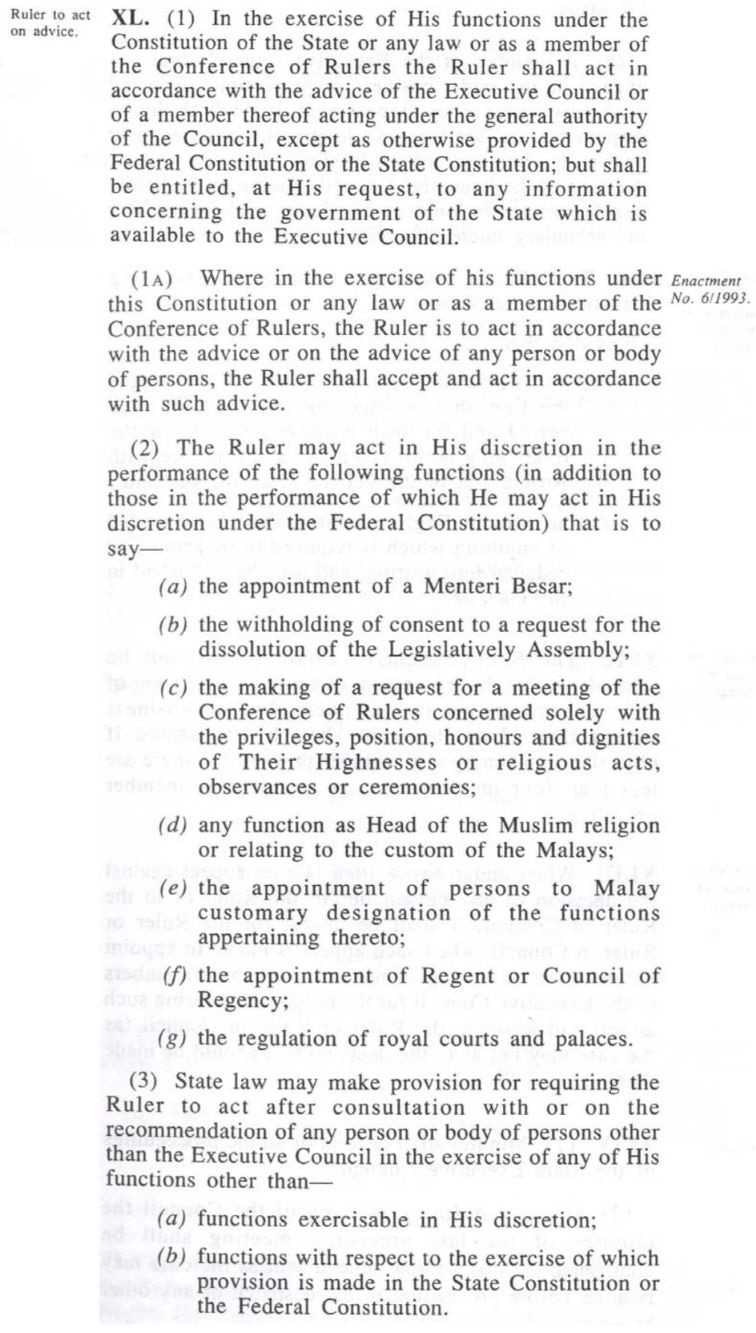
Article 40 sits in Chapter 2 of the Second Part of the Constitution, which deals with the Executive.
Article 35 establishes the basic structure: executive authority is vested in the “Ruler”, but may be exercised by His Highness or by the State Executive Council.
Article 40 then supplies the next part of the machinery by determining when the Ruler must act on advice and identifying seven State constitutional functions in which the Ruler may act in discretion.
For the Second Part generally, Article 28(1) defines the Ruler as His Highness together with the Ruling Chiefs who are available and holding office at the material time. Under Article 34, “His Highness” means the Yang di-Pertuan Besar elected by the Undangs in accordance with Article 7. Ruling Chiefs are defined as the four Undangs of Sungai Ujong, Jelebu, Johol and Rembau together with the Tunku Besar Tampin.
However, for the seven discretionary functions in Article 40(2), Article 28(2) substitutes a more specific composition consisting of His Highness together with at least three of the four Undangs. If only three Undangs are in office at the time, the threshold drops to at least two of them.
What each clause means
Article 40(1): the general rule of Executive Council advice
(1) In the exercise of His functions under the Constitution of the State or any law or as a member of the Conference of Rulers the Ruler shall act in accordance with the advice of the Executive Council or of a member thereof acting under the general authority of the Council, except as otherwise provided by the Federal Constitution or the State Constitution; but shall be entitled, at His request, to any information concerning the government of the State which is available to the Executive Council.
Where the Ruler exercises a function, they shall act under the advice of the State Executive Council (Exco or the state cabinet). Under Article 38, it consists of the Menteri Besar and up to ten other members appointed from the elected Legislative Assembly.
The rule gives way where the Federal Constitution or the Negeri Sembilan Constitution provides a different arrangement.
The second half of Article 40(1) gives the Ruler a corresponding right to information. On request, the Ruler is entitled to information concerning the government of the State that is available to the Executive Council.
Article 40(1A): when advice is binding
(1A) Where in the exercise of his functions under this Constitution or any law or as a member of the Conference of Rulers, the Ruler is to act in accordance with the advice or on the advice of any person or body of persons, the Ruler shall accept and act in accordance with such advice.
Where the Constitution or another law requires the Ruler to act on the advice of a person or body, that advice is binding.
For example, Article 38(2)(b) requires the Ruler to appoint the other members of the State Executive Council on the advice of the Menteri Besar. Once that advice is given, Article 40(1A) requires the Ruler to accept and act in accordance with it.
Article 40(2): the seven discretionary functions
(2) The Ruler may act in His discretion in the performance of the following functions (in addition to those in the performance of which He may act in His discretion under the Federal Constitution) that is to say:
(a) the appointment of a Menteri Besar;
(b) the withholding of consent to a request for the dissolution of the Legislatively (sic) Assembly;
(c) the making of a request for a meeting of the Conference of Rulers concerned solely with the privileges, position, honours and dignities of Their Highnesses or religious acts, observances or ceremonies;
(d) any function as Head of the Muslim religion or relating to the custom of the Malays;
(e) the appointment of persons to Malay customary designation of the functions appertaining thereto;
(f) the appointment of Regent or Council of Regency;
(g) the regulation of royal courts and palaces.
This clause identifies the seven specific functions where the Ruler may act in discretion. These seven functions are additional to any functions in which the Ruler may act in discretion under the Federal Constitution.
For Article 40(2), Article 28(2) provides a special definition of the “Ruler”: His Highness together with at least three of the four Undangs. Where only three Undangs hold office, His Highness must act with at least two of them.
This is narrower than the “Ruler” definition in Article 28(1) and excludes the Tunku Besar Tampin from the composition of the Ruler.
Article 28(2) contains two exceptions. His Highness may act alone under Article 40(2)(f) when appointing a Regent or Council of Regency where the appointment does not affect the prerogatives, powers and jurisdiction of the Ruling Chiefs in their respective territories. His Highness may also act alone under Article 40(2)(g) in regulating the royal courts and palaces.
And yes, there is a typo in the Constitution, “Legislatively Assembly”!
Article 40(3): State law may require additional consultation
(3) State law may make provision for requiring the Ruler to act after consultation with or on the recommendation of any person or body of persons other than the Executive Council in the exercise of any of His functions other than:
(a) functions exercisable in His discretion;
(b) functions with respect to the exercise of which provision is made in the State Constitution or the Federal Constitution.
Article 40(3) allows State law to add a further requirement for consultation or recommendation before certain functions are exercised. That power does not extend to functions exercisable in the Ruler’s discretion, or to functions for which the State Constitution or Federal Constitution already provides a procedure.
What Article 40 does not say
Article 40(2) does not make the Undangs co-rulers of Negeri Sembilan. Their discretionary powers as part of the constitutional definition of “Ruler” are confined to the seven functions listed in Article 40(2). For every other function, Article 40(1) binds the “Ruler” to the advice of the Executive Council.
Article 40 does not give the Ruling Chiefs a general power to administer the State government. Article 35 provides the mechanism through which executive authority is exercised, while Article 40(1) places ordinary constitutional executive action within the system of Executive Council advice.
Article 40(2)(d) gives the Ruler discretion over functions relating to Malay custom, subject to the specific rules in Articles 14 and 16 where Ruling Chiefs are concerned.
Article 14 provides that an Undang is elected, and may be removed, in accordance with the custom of his Luak,
Article 16 gives the Dewan Keadilan dan Undang (DKU) an advisory role in questions concerning the election, succession, removal or vacation of office of a Ruling Chief. Under Article 16(3), the DKU’s advice on such questions is final and cannot be challenged or called in question in any court.
Why this matters in 2026
Article 40(2), along with Article 28, have become two of the more contested provisions in 2026 crisis. See Article 28 for a full explainer of the co-ruler controversy.
Read also Undangs Are Not Co-Rulers With Equal Status and Power, which sets out why Article 40(2), read with Article 28(2), does not equate to equal rank or power.
Summary
Article 40 separates functions governed by advice from functions placed within discretion.
For the ordinary exercise of functions, Article 40(1) requires the Ruler to act in accordance with the advice of the State Executive Council, subject to contrary provisions in the Federal or State Constitution. Article 40(1A) makes required advice binding. Article 40(3) allows State law, within defined limits, to create further requirements for consultation or recommendation.
For seven specific constitutional functions, the “Ruler” as defined Article 28(2), may act in discretion, consiting of His Highness together with the required number of Undangs. Article 28(2) also allows His Highness to act alone in the specified circumstances under Article 40(2)(f) and (g).
Footnote: The Constitution numbers its Articles in Roman numerals. This publication uses Arabic numerals for readability.
Our posts referencing Article 40
What Is the Negeri Sembilan Royal Crisis and Why Does It Matter?
Who Appoints the Menteri Besar After the Negeri Sembilan Election?
Does Article 79 Let the Ruling Chiefs Convene a DKU Sitting on 5 June?
What is Article 28 of the Negeri Sembilan Constitution 1959?
Sources:
Anak Nogori is independent commentary on the unfolding constitutional crisis in Negeri Sembilan, where centuries-old Adat Perpatih, royal succession law, and modern political manoeuvring are colliding in ways Malaysia has never seen before. If you find this useful, share it with someone who should be following this, or subscribe to receive the latest articles in your inbox.
